What If There Is Nothing Worth Writing About?
Posted by Keith Spillett in Articles I Probably Shouldn't Have Bothered Writing, Existential Rambings on February 13, 2011

“The dreamcrossed twilight between birth and dying.”
–TS Eliot from Ash Wednesday
Recently, a terrible feeling has been crawling up the base of my spine. It awakens me in the middle of the night, it hounds me when I am driving home from work, it swims in and out of my mind every time I consider this cursed blog. I think I had this thought in my mind even before I started blogging, but over the last month its light buzz has grown to a deafening roar. This feeling is in the pit of my stomach and the recesses of my mind all at once. It is a voice that talks to me while I write and a spirit that haunts me when I do not. Nothing makes it grow quiet. It is omnipresent. It is a simple idea, but if you follow it to its logical extreme it is as dangerous as a nuclear bomb. The question is this…Is there that is really worth writing?
It seems a rather harmless line of questioning. That is how it starts. The point of writing is to create something. I hope to create something new. Have all the worthwhile thoughts already been had? Has someone else already put down all the truths and mysteries of life on paper? With the Internet, you can find access to nearly every idea that has been conceived of. Most of us concern ourselves with whether LeBron is better than Kobe or who is married to who and who is getting a divorce or who wore what on the red carpet or who embarrassed themselves in front of the world. If you want to dig deeper you can find recipes for how to prepare ox tail, the history of Buddhism, better and more in depth formulas to calculate the value of third basemen or the performance of treasury bonds, or the lost works of some 19th century poet you came across at three in the morning on some insomnia driven information binge. But to what end? Is it just more and more stuff to fill our minds with?
Maybe I shouldn’t concern myself with creating something original. After all, what is the point of originality? Am I simply trying to justify my existence by conning myself into the belief that I am so special and unique that I can think a thought that the rest of the 6 billion of us could not come up with? Am I so narcissistic that I think I am capable of an idea that has never been here before?
Maybe the point is to appreciate the experience of writing. Maybe the whole thing is about letting my synapses fire and my fingers pound away at some keyboard. To what end? I do it again and again. Words appear. More words appear. Then more. More. They mean something, but who really knows what? They dance in patterns. I already have forgotten most of what I’ve written. I could look back. To what end?
Why bother sending this nonsense out to the world? Looking for fellow travelers on the good ship Earth as we spiral towards our own personal oblivion. To what end? Am I simply standing in front of the Grand Canyon shouting at the top of my own lungs in the hopes of hearing an echo? And then what?
Maybe my words will help ease the pain of human suffering. A noble goal but when you look at what we are up against, it hardly seems possible. A dying heap of flesh and consciousness trapped in a fading world that is saturated with mountains of disconnected ideas adding up to nothing in particular is going to be helped by some random guy typing random words on a computer screen? Really? I haven’t watched enough Frank Capra to buy it. It is a pleasant delusion, but a delusion nonetheless. Maybe the goal is to delude others into forgetting their troubles. They will remember them soon enough or, worse, they will enjoy the delusion so much they will forget what is happening to them and the ones around them. Apathy or sadness. Ignorance or constant horror. To what end?
If I could write something that could teach people how to live forever or convincingly show them that their actions are connected to something greater then maybe I would be writing something worth reading. But I am not that good of a writer and I doubt I will ever be. I wonder if anyone is. Existential dread is what it is and I can’t write it away for myself or anyone else. Can writing change the truth of what we are? I simply don’t believe that. And even if it could…to what end?
Maybe all of the thoughts have been thunk and all of the dreams have been dreamt and we are simply recycling the same old nonsense in slightly different packages again and again and again. Over and over. The paint job changes but it’s still the same old world. Meet the new boss same as the old boss.
This isn’t my MacArthur speech to the troops blog. I plan to keep doing this again and again for no apparent reason. It is a complete waste of time. It has no value and is utterly and completely useless. I enjoy writing more times than I don’t. I like hearing how my words hit people. I am deeply curious as to how my innermost thoughts are perceived by strangers. I guess that is something, but it will fade after a while. These are simply words on a page and they don’t mean anything. Nothing lasting or real or forever or genuine will ever come out of my mind or my hands. They are shapes, they are colors contrasted with the background, they are a speck in the eye of history. They are words. Their lifespan is about as long as it takes to get to the next sentence.
George Washington Plunkitt and the Value of Honest Graft
Posted by Keith Spillett in Pointyheaded Highbrow Stuff on February 9, 2011

Thomas Nast Cartoon Depicting the "Thought Process" Behind Tammany Hall
It is a rare person who can make being a scoundrel seem like a completely respectable way to make a living. Occasionally, this sort of scoundrel works his way into politics. Most corrupt politicians today bathe themselves in the murky oil of self-righteousness. It is quite unique to find a man completely devoid of principals and willing to make that a matter of public record. George Washington Plunkitt was such a man.
Plunkitt was a State Senator in New York during the heyday of Tammany Hall. The Tammany political machine ran New York City for over a century by offering jobs and protection for new immigrants in exchange for votes and political influence. Tammany produced some of New York’s most influential politicians (William Mallory “Boss” Tweed being the best known) and even counted a Vice President (Aaron Burr) and a Presidential candidate Al Smith among its ranks.
The organization had many outspoken, charasmatic politicians, but Plunkitt was probably the best at explaining “The Tammany Way”. Plunkitt’s book “Plunkitt of Tammany Hall: A Series of Very Plain Talks on Very Practical Politics, Delivered by Ex-Senator George Washington Plunkitt, the Tammany Philosopher, from his Rostrum—the New York County Courthouse Bootblack Stand” contains some of the most intriguing justifications for corruption that have ever been written. His distinction between honest and dishonest graft is deeply flawed but amazingly compelling.
Here is an excerpt that captures Plunkitt’s belief about how the system works…
Everybody is talkin‘ these days about Tammany men growin’ rich on graft, but nobody thinks of drawin‘ the distinction between honest graft and dishonest graft. There’s all the difference in the world between the two. Yes, many of our men have grown rich in politics. I have myself. I’ve made a big fortune out of the game, and I’m gettin’ richer every day, but I’ve not gone in for dishonest graft—blackmailin’ gamblers, saloonkeepers, disorderly people, etc.—and neither has any of the men who have made big fortunes in politics.
There’s an honest graft, and I’m an example of how it works. I might sum up the whole thing by sayin‘: “I seen my opportunities and I took ’em.”
Just let me explain by examples. My party’s in power in the city, and it’s goin’ to undertake a lot of public improvements. Well, I’m tipped off, say, that they’re going to lay out a new park at a certain place.
I see my opportunity and I take it. I go to that place and I buy up all the land I can in the neighborhood. Then the board of this or that makes its plan public, and there is a rush to get my land, which nobody cared particular for before.
Ain’t it perfectly honest to charge a good price and make a profit on my investment and foresight? Of course, it is. Well, that’s honest graft. Or supposin‘ it’s a new bridge they’re goin’ to build. I get tipped off and I buy as much property as I can that has to be taken for approaches. I sell at my own price later on and drop some more money in the bank.
Wouldn’t you? It’s just like lookin‘ ahead in Wall Street or in the coffee or cotton market. It’s honest graft, and I’m lookin’ for it every day in the year. I will tell you frankly that I’ve got a good lot of it, too.
I’ll tell you of one case. They were goin‘ to fix up a big park, no matter where. I got on to it, and went lookin’ about for land in that neighborhood.
I could get nothin’ at a bargain but a big piece of swamp, but I took it fast enough and held on to it. What turned out was just what I counted on. They couldn’t make the park complete without Plunkitt’s swamp, and they had to pay a good price for it. Anything dishonest in that?
Up in the watershed I made some money, too. I bought up several bits of land there some years ago and made a pretty good guess that they would be bought up for water purposes later by the city.
Somehow, I always guessed about right, and shouldn’t I enjoy the profit of my foresight? It was rather amusin’ when the condemnation commissioners came along and found piece after piece of the land in the name of George Plunkitt of the Fifteenth Assembly District, New York City. They wondered how I knew just what to buy. The answer is—I seen my opportunity and I took it. I haven’t confined myself to land; anything that pays is in my line.
For instance, the city is repavin’ a street and has several hundred thousand old granite blocks to sell. I am on hand to buy, and I know just what they are worth.
How? Never mind that. I had a sort of monopoly of this business for a while, but once a newspaper tried to do me. It got some outside men to come over from Brooklyn and New Jersey to bid against me.
Was I done? Not much. I went to each of the men and said: “How many of these 250,000 stones do you want?” One said 20,000, and another wanted 15,000, and other wanted 10,000. I said: “All right, let me bid for the lot, and I’ll give each of you all you want for nothin’.”
They agreed, of course. Then the auctioneer yelled: “How much am I bid for these 250,000 fine pavin’ stones?”
“Two dollars and fifty cents,” says I.
“Two dollars and fifty cents” screamed the auctioneer. “Oh, that’s a joke Give me a real bid.”
He found the bid was real enough. My rivals stood silent. I got the lot for $2.50 and gave them their share. That’s how the attempt to do Plunkitt ended, and that’s how all such attempts end.
I’ve told you how I got rich by honest graft. Now, let me tell you that most politicians who are accused of robbin’ the city get rich the same way.
They didn’t steal a dollar from the city treasury. They just seen their opportunities and took them. That is why, when a reform administration comes in and spends a half million dollars in tryin’ to find the public robberies they talked about in the campaign, they don’t find them.
The books are always all right. The money in the city treasury is all right. Everything is all right. All they can show is that the Tammany heads of departments looked after their friends, within the law, and gave them what opportunities they could to make honest graft. Now, let me tell you that’s never goin’ to hurt Tammany with the people. Every good man looks after his friends, and any man who doesn’t isn’t likely to be popular. If I have a good thing to hand out in private life, I give it to a friend. Why shouldn’t I do the same in public life?
Another kind of honest graft. Tammany has raised a good many salaries. There was an awful howl by the reformers, but don’t you know that Tammany gains ten votes for every one it lost by salary raisin’?
The Wall Street banker thinks it shameful to raise a department clerk’s salary from $1500 to $1800 a year, but every man who draws a salary himself says: “That’s all right. I wish it was me.” And he feels very much like votin’ the Tammany ticket on election day, just out of sympathy.
Tammany was beat in 1901 because the people were deceived into believin‘ that it worked dishonest graft. They didn’t draw a distinction between dishonest and honest graft, but they saw that some Tammany men grew rich, and supposed they had been robbin’ the city treasury or levyin‘ blackmail on disorderly houses, or workin’ in with the gamblers and lawbreakers.
As a matter of policy, if nothing else, why should the Tammany leaders go into such dirty business, when there is so much honest graft lyin’ around when they are in power? Did you ever consider that?
Now, in conclusion, I want to say that I don’t own a dishonest dollar. If my worst enemy was given the job of writin’ my epitaph when I’m gone, he couldn’t do more than write:
“George W. Plunkitt. He Seen His Opportunities, and He Took ‘Em.”
Theme From An Imaginary Grindcore Album: The Birth of UnMusic
Posted by Keith Spillett in Articles I Probably Shouldn't Have Bothered Writing, UnMusic on February 5, 2011
Today is a landmark day in the history of music. On Saturday February 5th at 10:37 AM a new genre of music has been born. Welcome to the world of UnMusic. Many times I have read the song titles on albums and thought to myself “This album has great song titles, it’s too bad the songs are horrendous.”
If you have had that thought from time to time, then UnMusic is for you. UnMusic removes the irritating and grating music that is on albums and merely gives you song titles. I give you the song title, what your imagination does with them is up to you. Think of the possibilities? Music without the limitations of actually having a song! I’m not even going to give the album a cover with artwork. I feel like that would be selling out. You, the listener, have complete artistic freedom to imagine what we would have sounded like had we actually recorded the songs.
For the purposes of marketability, the music will (not) be recorded by my band E.T.A.F. (Eats Things that Aren’t Food), who are known for their top 40 single “Jodie Meeks”. This genre is deeply influenced by grindcore (particularly by the band A.C.). Grindcore is a style of metal that often features hysterical song titles and horrifically unlistenable songs. Why bother with the songs?!?!?!
I was thinking about grindcore when these songs were (not) written, and actually believe this album better fits into a subgenre known as UnCore. That being said, I don’t want to limit your imagination, so if the songs sound in your mind like Michael Bolton or Earth Wind and Fire when you think of them, go with it.

Band: E.T.A.F.
Album Name: Unfriended By Life
Songs:
1. Obligatory 2 Minute Acoustic Guitar Instrumental Intro
2. Tipper Gore Told You To Throw Out All of Your Judas Priest Albums…But You Didn’t Listen
3. I Got Scolded Because I Made Fun of the Drummer From Winger
4. You Hung Out With The Band Skindred in A Parking Lot
5. If Lincoln Were Alive Today, He’d Be Angry They Buried Him
6. Stop Staring At Me…I’m Not Going to Talk to You
7. You Have Children
8. Mubarak Has the Best Interests of His People In Mind
9. “So…Wait….Now You Are Saying That You Are Not A Doctor?!?!”
10. I Follow People Around Malls
11. You Like Tomatoes, But You Don’t Like Ketchup
12. You Met Your Wife At A Viking Metal Concert
14. Ketchup Is A Vegetable
15. You Lost Your Children’s College Fund Because Jerome Bettis Fumbled
16. You Missed a Meeting With Your Parole Officer To Go To An ICP Concert
17. You Sent Your Son To School With Head Lice
18. Choose Life…The Lesser of Two Evils
19. You Learned to Speak Latin In Order To Sound Arrogant
19. You Gave Blood
19. There Are 3 Track 19s on This Album
20. You Were Unfriended By Soccer
21. You Voted In Florida And It Didn’t Count
22. Two Tens For a Five (A Tribute To Goldman Sachs)
23. You Have Restless Leg Syndrome
24. No One Follows You On Twitter
25. You Are Allergic To Dog Dander and Milk
26. You Live In Buffalo
27. You Were Unfriended By Bacon
28. My 98 Year Old Grandmother Just Compared Municipal Waste to D.R.I.
29. You Live In Buffalo
30. “No Officer, A Sound Did Not Come From My Trunk”
31. You Gave Your Son Cortisone Shot So He Could Play In A Little League Game
32. You Have A Bank Account
33. People Don’t Take You Seriously Because You Have A Mustache
34. You Pay Taxes Because You Think Its Patriotic
35. If It Wasn’t For All The Crime, Miserable People and Decaying Buildings, Gary, Indiana Would Be a Great City
36. Sucks to Be You…You Play Soccer
37. Soccer is The World’s Most Popular Sport
38. You Own A Copy of The Movie “Space Jam” and You Don’t Have Any Kids
38. HA! HA! HA!!! You Voted For Obama…and He Lost!!!
39. You Went On Strike Until Your Company Agreed To Show Jerry Springer In The Break Room
40. You Live In Buffalo
41. You Are An Organ Donor
42. You Know How To Properly Use A Semi-Colon
43. You Quote Ayn Rand
44. You Hope That Iron Maiden Plays All The Songs From The X Factor At Their Next Concert
45. Your Kids Don’t Talk To You Because You Have A Mohawk
46. You Think That People Are Smiling In Commercials Because They Are Happy
47. Nobody Goes To Your MySpace Page Because Your Band Does Lionel Richie Covers
48. Spellcheck is Wrong…Grindcore is One Word
49. No One Knows What Barney Greenway is Talking About
50. I Listened To The First Carcass Album and Became a Vegetarian
51. You Are So Metal That You Were Into Ozzy Before He Joined Black Sabbath
52. Raggacore Is The Next Big Thing
Hidden Tracks:
52. You Think It’s Ironic To Have Song Titles Without Actual Songs
53. It’s Funny Until You Start Talking
54. Some Random Cover of A Band I’ve Never Heard Of Like Budgie
55. A.C. Can’t Sue Me For Stealing Their Idea Because They Can’t Afford A Lawyer
56. Even Spammers Ignore You
Paul Pierce’s Rasputin-like Performance Leads the Celtics Past the Heat 121-119
Posted by Keith Spillett in Articles I Probably Shouldn't Have Bothered Writing, Basketball Coaching Nonsense, Blithering Sports Fan Prattle on February 1, 2011
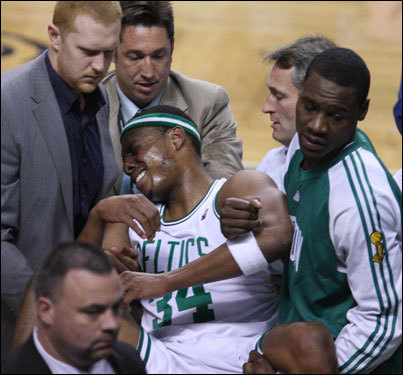
Paul Pierce Being Carried Off The Floor After His 9th First Quarter Injury
Last night, Paul Pierce put together a game that will certainly go down in the annals of the Boston Celtics as one of the most warrior-esque performances in that franchise’s history. After receiving numerous injuries, Pierce returned to the game against the Miami Heat and scored 37 points and grabbed 14 rebounds to lead the Celtics to a 121-119 overtime victory. What made the game special was not just Pierce’s fabulous numbers, but the amazing series of setbacks that Pierce overcame to lead his team to victory. In the postgame press conference Ray Allen called Pierce’s performance “amazing” and said that he was “a true warrior”
About 3 minutes into the game, Ray Allen stole the ball from LeBron James and threw the ball the length of the court to Pierce. Pierce went up for a layup and was hammered to the floor by Udonis Haslem. The team doctor brought Pierce back to the dressing room and after a series of x-rays determined that he had a fractured orbital bone in his face. Grasping the importance of the game, Pierce put on a plastic, Rip Hamilton mask and returned to action with 3 minutes left to go in the quarter.
Upon his return to the floor, Pierce scored 6 quick points. He threw in a great slashing layup to tie the game up at 27. Unfortunately for Pierce, he landed off balance on his right ankle causing a severe sprain. Pierce was carried off the floor to the locker room by several teammates and it looked like he would be lost for the game. Three minutes after Pierce went to the locker room he miraculously ran out of the tunnel and on to the court just in time for the beginning of the second quarter.
Pierce faced more suffering in the second quarter. While taking a jump shot, Pierce was shot in the back by a deranged Heat fan in the 8th row. The shooter, Karl Lee Wiley, was arrested immediately by security. Pierce, who was lying on the court in a pool of blood, was carried on a stretcher to an ambulance. As the ambulance was driving away, Pierce burst out of the back and ran towards the court. With 2 minutes left in the second quarter, Pierce checked back into the game. Coach Doc Rivers was truly impressed. “I’ve had players play through injuries before, but I’ve never seen a player overcome a gunshot wound and go back in the game. Paul is a true warrior.”
The second half was also quite difficult for Pierce. While drinking contaminated Gatorade before the half begun he contracted a severe case of dysentery. Pierce spent much of the next 10 minutes shaking and running to the bathroom. He became delirious when he was in the locker room and claimed that he saw Larry Bird, Robert Parrish and Kevin McHale walking through the door. Yet somehow, Pierce was able to get his symptoms under control and return with 6 minutes left in the third quarter.
Pierce continued to play an inspired game. He went up for a monstrous dunk to cut the Heat’s lead to 9 with 7:22 left in the fourth quarter. Unfortunately, his fingers got hooked on the webbing of the net and he was stuck, hanging by one arm in the air. Doctors, worried that Pierce could die from being suspended in mid-air for too long, immediately amputated the arm allowing Pierce to be freed. Pierce was again rushed to the locker room by the medical staff. But, it a moment reminiscent of Willis Reed’s injured return to the court during the Knicks championship game in the 70s, Pierce came out of the tunnel with only one arm and checked back into the game with 2 minutes remaining. Showing no effects from the terrible, arm amputation surgery he had only moments earlier, Pierce quickly fired in two three pointers to tie the game at 107 and send it to overtime. “He’s simply a warrior,” said Celtics Forward Kevin Garnett, “and this was the most warrior-like performance I’ve ever seen.”
During overtime, Pierce suffered a severe concussion, a brain aneurysm, a broken leg, was diagnosed with Type 2 Diabetes and a contracted a severe staph infection. With 3 minutes remaining, Pierce’s heart stopped and he collapsed on the court. Medics pronounced him dead on the scene and began to cart him off the floor, but somehow his heart began beating again and he returned to action. On a night where nothing could stop him, Pierce threw in a jumper from the corner with 2 seconds remaining giving the Celtics the victory. Shaquille O’Neal added 19 points and 12 rebounds as the Celtics pulled ahead of the Heat for the best record in the NBA’s Eastern Division. Pierce expects to play tomorrow night when the Celtics travel to Sacramento to face the Kings.
I Lost 30 Pounds in 30 Days…Without Amputation!!!
Posted by Keith Spillett in Health Tips for An Early Death on January 30, 2011

Picture of a James Sullivan BEFORE he started the Nine and FINE Diet
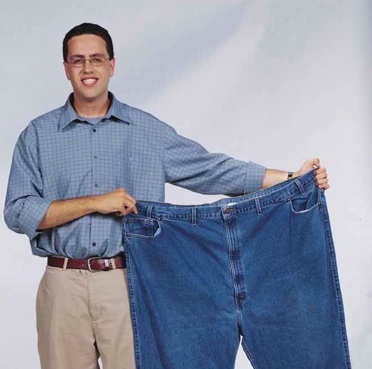
Picture of James Sullivan JUST 30 DAYS AFTER starting the Nine and FINE Diet!!!!!!!!
Hello!!!!!!! Today, I am here to talk to you about a diet that changed my life. For years, I have struggled with my weight. I have tried every diet on the market, but after a few days I am unable to keep to the diet because I am hungry all the time. The most recent studies have said that eating 5 small meals a day will result in significant loss of pounds. I heard this and thought it was impossible but it seems to be very effective. Unfortunately, I have been unable to make this system work quickly enough and I still find myself hungry at night. It seemed like there was no hope for me, and then I found out about the Nine and FINE Diet. Are you sitting down? I am about to tell you something that may sound too good to be true, but rest assured, this diet is one hundred and twelve percent effective for everyone. According to scientists*, eating NINE large meals a day will help you lose significant amounts of weight overnight.
What?!?! Eat nine large meals and lose weight! How could it be true? Well, according to scientists, the human body has some pretty amazing properties. There is a certain point that the body hits where it is so overwhelmed by fat, carbohydrates and proteins that it begins to secrete a substance recently discovered by scientists called Jimbobwe. Jimbobwe is a substance that eats fat. If you have ever had a night where you ate to the point of near sickness and woke up a pound or two lighter it is because you tripped your Jimbobwe receptors. If you think about it, the human body is kind of like the card game hearts. In hearts, if you have the best cards you get a lot of points. But, if you have the worst possible hand, you get even more points. The body works in the same way. Impossible, you say!?!?! Scientists have proven it!!! Ever see a 98 year old who ate badly all of her life and is still in great health? How, you ask?!?! Jimbobwe!!!!
Let me give you a personal example. I started the Nine and FINE Diet on a Monday morning. For breakfast, I had a full plate of eggs, bacon, pancakes, French toast and grits. At about 9 o’clock, I ate a large ham sandwich, two plates full of mashed potatoes, and macaroni and cheese. At 10:30, I ate three large hamburger patties wedged between two grilled cheese sandwiches, fries and 6 cokes. At noon, I ate a rack of ribs, twelve dinner roles covered in butter, a side of lobster bisque soup and a plate of fried plantains. At 1:30, I ate half of a medium cooked turkey, a large vanilla milkshake, two plates of collard greens, a hot fudge sundae and 4 peanut butter sandwiches. At 4, I ate a large porterhouse steak, a baked potato covered in sour cream, a plate of braised pig’s knuckles, 4 slices of pizza dipped in bleu cheese and 4 cans of A and W root beer. At 6, I ate another steak, fried onions, a Cinnabon, an entire bag of cool ranch Doritos, a Meximelt from Taco Bell, and a large vat of cookie dough ice cream. At 6:45, I ate six fried Snicker Bars, a Whopper from Burger King and fries from Checkers. Then, as I was getting ready for bed at 8 o’clock, I ate a bag of caramel corn, 4 turkey legs, cotton candy, a dish of funnel cake covered in ice cream, 7 pieces of chicken fried in Crisco, another Cinnabon, nine bagels covered in cream cheese, a Big Mac and 3 more milkshakes. In total, I consumed close to 40,000 calories that day. I also lost 5 pounds. After 30 days of the diet, I had lost 56 pounds**.
Maybe I’m just lucky, you say. Well, then how do you explain Marvin Altcheck? Marvin followed the Nine and FINE for thirty days and lost 37 pounds***. Or Jane Smith? Jane lost 67 pounds in 30 days on the Nine and FINE Diet****. What about Julia Marshall? Julia began the diet at 883 pounds. After thirty days on the diet, she was 938 pounds. Now that’s progress!!!

Picture of Kate Johnson BEFORE the Nine and FINE Diet

Here's Kate Johnson AFTER JUST 2 MONTHS of the Nine and FINE Diet
I often hear people say things about Americans eating too much. Maybe, these so-called “doctors” and “dieticians” are wrong. Maybe the problem is we don’t eat enough!!!!!!!
Let’s say you have the problem that many overweight, patriotic Americans have. You simply don’t like to eat. Well, for just 19.99 I can offer you a thirty-day supply of Jimbobwe supplements. Or, eat nine large meals a day AND take the supplements. Hey…every little bit helps…Right?!?!?!? Simply send your credit card/bank account information the address given below in the Cayman Islands and expect your supplements in the mail any day. If you send your information in the next 12 hours, I will include a book called “The Mysteries of Jimbobwe”, a 98-page book with pictures of some of our success stories along with 47 brand new Crisco based recipes for weight loss.
So, if anyone asks you what you weigh…go ahead and finish that ice cream sundae, that box of Oreos and that stick of butter, look them in the eyes and tell them “I’m Nine and FINE” and let the results speak for themselves.
* When using the term scientists, I am referring to several friends of mine who have taken at least 3 college level science classes.
** Results of the diet are not typical. Many people lose only thirty pounds in a month while other gain large amounts of weight.
***Marvin credits the Nine and FINE Diet (coupled with liposuction surgery) with his dramatic weight loss
****Jane died from congestive heart failure on the seventh day of the diet, but for the sake of the study, scientists continued to track her progress after her death
Herded Through The Grapevine
Posted by Keith Spillett in Blithering Sports Fan Prattle on January 26, 2011

Colin Cowherd
There is an oft-quoted line popularized by Mark Twain that says, “There are lies, damned lies and then there are statistics.” Twain clearly hadn’t listened to much sports talk radio. If he had, he would have said, “there are lies, damned lies, statistics and then there are sports talk show hosts with statistics.” The truth of this quote became apparent to me, as it often does, while listening to the Colin Cowherd radio show the other day.
In fairness to Cowherd (which could only be his real name in a truly cruel universe), he does a very entertaining show. He is engaging and often makes me want to argue with him, which seems to be the point of most sports talk radio shows. Louisville Coach Rick Pitino once referred to sports talk radio as “the fellowship of the miserable”, which would apply to much of what I’ve heard, but not to Cowherd’s show which is quite upbeat and enjoyable if you can ignore the nearly endless stream of commercials for hair growth products and lite beer. That being said, Cowherd is the best I’ve heard at taking a statistic and making it mean a whole bunch of things that it doesn’t. If it weren’t for sports radio I am convinced he would be making millions of dollars a year convincing people that 9 out of 10 dentists prefer Aquafresh. The ability to take numeric information and blow its significance way out of proportion to the point of near absurdity is a skill that those who are successful in the business have mastered.
Cowherd can make a number dance like few I’ve ever heard. In support of some ludicrous theory that a recently lobotomized six year old couldn’t have been conned into, I once heard the man say “if you believe that I’m right 98 percent of the time, which I am, I must be right about this as well.” Basically, what he’s saying is that if you have been duped into believing the rest of the nonsense that comes out of my mouth, don’t you think you should believe this too? What strikes me about this quote is how the number really makes the argument seem plausible. Last time I checked, there was no agency that gives scores to sports talk radio hosts based on the veracity of their ravings. He clearly was making a hyperbolic point about his acumen as an “understander of all things sports related.” I caught myself thinking, after the sixth or seventh time I heard him say this, “well…he is right 98 percent of the time. Maybe this isn’t so far-fetched.” Take a fake number, repeat it over and over to justify an absurd claim and watch the magic happen.
Where Cowherd is really at his best is when he has a real number to mess around with. The other day I listened to him take one statistic and turn it into an hour of wild speculation, conjecture and rage. Sports radio at it’s finest. He started the madness by giving a statistic that was tangentially related to Ben Roethlisberger, the quarterback for the Pittsburgh Steelers who seems destined to one-day share a prison cell with Art Schlichter. The stat showed that the Steelers record gradually improved during each month of the season when Roethlisberger was playing and not on suspension, awaiting arraignment or injured. During the first month of the season, the Steelers won half of their games and lost half, by December the Steelers significantly better than average (or .500 as is the accepted term among sports junkies). Cowherd had the audience call in and guess what this meant. By the second caller, Cowherd had found the answer he was looking for. It was obvious that this stat proved, beyond all doubt, that Roethlisberger did not prepare enough in the off-season. He went on to back his point up by referring to the fact that he had gotten into several scrapes with the law while he was away from his team. I marveled at the simple beauty of this argument. Point A: The Steelers have gotten better in terms of wins and losses as the season has gone on over the last few years Point B: Roethlisberger has gotten in trouble with the law during the off-season. Therefore, Roethlisberger is unprepared when the season begins.
There are an almost limitless supply of problems with this argument. Quarterback production is only one in a series of thousands of things that affect a football game. Maybe they had other significant injuries. Maybe they played a more challenging schedule in September. Maybe they are better in cold weather. Using one of the more ridiculous clichés in sports, maybe they are more of a “clutch” team. Maybe they are affected adversely by the position of the moon as it relates to Saturn during a certain period of the season. Maybe they are lucky. Who knows? If anyone believes quarterback play always correlates with victory or defeat I could point you to any number of examples, including Roethlisberger’s nightmarish Super Bowl XL victory performance to prove the opposite.
Another problem with the argument is that he doesn’t bother to explain what being “prepared” means. Is he implying that he doesn’t work out enough in the off-season? If so, I would argue that he would be more adversely affected at the end of a rigorous, punishing football season than at the beginning. As a basketball coach, I don’t do conditioning work with my players so they will be fast in the first two minutes of our opener, I do it so that they will be physically able to handle the long, tiring effects of a season. I’m quite sure a good number of coaches and players think this way as well. Maybe he meant Roethlisberger is not mentally prepared. Does that mean he doesn’t watch enough game film? Does it mean he doesn’t meet with his receivers after practice? Does it mean he doesn’t spend extra time in meetings with coaches? Or is Cowherd, as I suspect, simply throwing out a buzzword at an easy target to try to work his audience into a lather? He never defines it or uses anything beyond this one, lonely stat to prove his point so how can I assume anything but the final option.
The worst criticism I could ever throw at sports radio is that it should be immune to this sort of critique because it’s just a mindless time waster meant to get people riled up for no purpose other than selling people things they don’t need. That might in fact be true, but many people who enjoy sports spend a lot of time with it. There should be some expectation of something beyond “getting the audience worked up” even in the things that we accept as entertainment. As an audience member, I appreciate being treated as a thinking human being who is interested in seeing how statistics relate to reality and not as a rage-filled 35-51 year old male who will consume more products if made angry.
If You Don’t Believe There is a Meaning to Life, Why Don’t You Just Go Around Killing Other People?
Posted by Keith Spillett in Existential Rambings on January 23, 2011
I was asked this question recently during a discussion about morality with a friend of mine. I do not believe that there is an objective meaning to life and this was his way of countering my argument. At first, I didn’t really take the question seriously and I laughed it off as a weird reductio ad absurdum argument meant to link my lack of belief to the worst possible outcomes. It is not the first time I have been asked this question in this context and I began to wonder why I felt the question was ridiculous. For the purposes of this article, I really don’t want to debate my feelings on objective meaning. It is a much larger topic that I feel deserves considerably more explanation than I am ready to give. However, I feel there is a basic misunderstanding in this question that is worth addressing on it’s own.
The questions strikes me as a silly one because I don’t see what one thing has to do with the other. I am not clear about how Proposition A (There is no meaning in life) leads one to Proposition B (I should go around killing people). The argument makes about as much sense as saying “If you don’t believe there is any ice cream, why don’t you just go around killing people?” Why does the lack of basic meaning imply that people would commit violent acts towards one another? Where is the causal link between violence and the lack of meaning? Proposition A is a stand alone idea. It doesn’t lead to anything. It simply is.
The implication at the center of this idea is that the only thing that keeps human beings from running around causing severe harm to one another is the belief that there is some reason for everything. The deeper idea in the point my friend made was that without meaning, humans are nothing more than bloodthirsty animals that will do whatever they want, whenever they want. This is an extremely Hobbsean conception of what people are. I have a hard time believing that humans without meaning would find nothing better to do with their time then kill other humans. This view of humans, when held up to the light, seems quite vacant of truth. There are many secular humanists, atheists and nihilists who live their lives not believing in objective meaning without causing significant harm to others around them. Violence is something used by people of many different belief systems. There have been Christian murderers, Muslim murderers, Atheist murderers and so on.
I think part of the problem with the question is the assumption of direct correlation between belief and action. A person’s beliefs may help to define their actions, but we are never sure how. A person may believe strongly in a universe with objective meaning and choose to manifest that belief in the form of violence against people who think differently (The Spanish Inquisition is a good example of this) or they may choose to take that belief and manifest it in the form of non-violent protest (Martin Luther King would be a good representative of this). I don’t think we know what drove these people to act as they did. There is often an assumption that humans are basically machines. If you input this belief into the machine a specific set of actions will be waiting on the other end of the conveyor belt. The truth is that we have no idea what believing in certain things leads to. We know that we believe them, that’s all.
A good lens to see this question through is David Hume’s Problem of Induction argument. Hume argued that we can never convincingly prove that A will lead to B. We may assume that every time we flip the light switch on the room will light up, but on some occasions (power outages, blown fuses, unexplained failure) the room will not become illuminated. We may think that if a person has a certain set of values and beliefs they will turn out a certain way, but there are nearly limitless examples throughout history of times when that hasn’t happened. There is no such thing as a sure thing. We never know in advance how a set of beliefs is going to effect a person’s actions. We cannot accurately predict the future thus we never know what believing in certain things is going to lead to.
There is a troubling dynamic in this answer for those who are raising children. If we can’t convincingly know what the beliefs we are teaching our children are going to lead to, how are we supposed to raise them? My wife and I are currently raising two young children, so this question is a very serious one for me. As a parent, one of the most difficult realities that you are faced with is the understanding that you may do a great job teaching your children to love and respect the people around them and they still may turn out to be humans who take actions that appear angry, violent and anti-social. Humans are filled with complexities are impossible to completely understand. We can read the all of the “right” books, make the “correct” sacrifices and do what we think are the right things and we are still given no assurances. All we as parents can do is love our children no matter who they become. I don’t want my children to learn right and wrong, I want them to learn that we live in a world that has extreme shades of grey. I want them to learn to cause as little harm to others as possible (be it real harm or perceived harm). We do what we can and we hope for the best whatever that may be.
Original Sinners: The Immorality of Babies
Posted by Keith Spillett in Totally Useless Information on January 20, 2011

They Crawl Among Us
A new class of criminal is lurking in the shadows of organized society looking to take advantage of those who have been lulled into a false sense of complacency. The most effective criminals are often ones who can appear innocent. Their innocence gives an unsuspecting victim a feeling of security, and then, when their guard is down and they are at their most vulnerable, these criminals will strike. Babies are often thought to be the most innocent among us, but upon closer consideration, this façade of innocence quickly fades.
The other day I was walking around the local Target and a family shopping with an adorable little child who had to have been about a year and a half old sitting in a shopping cart. I immediately became fascinated with this family and began following them around the store. While they were in the toy aisle and the parents were distracted, I watching this “harmless” child reach out of the cart and grab a small toy car. He played with the toy car for the rest of his time in the store continuing to play with it as the parents moved through the checkout aisle and out of the store. This baby had just committed the crime of shoplifting. What disturbed me about this was the joyful, guilt free expression on the child’s face and the ease with which he pulled off this little heist. Many of you are apathetic to this sort of crime. You may wonder why it even matters. You may think that this sort of theft is a victimless crime. According to research done by the Thurston County Sheriff’s Office in Olympia Washington, shoplifting costs American businesses 16 billion dollars per year. Yet babies, who commit this type of felony with impunity, are rarely held accountable for their crimes.
Recently, I watched two babies fight over who was going to get to play with a Fisher Price Little People Happy Sounds Home. One of the babies pushed the other baby to the floor and snatched it up into its sinister little hands. If this had taken place on a street corner and it had been a mugger throwing an older woman to the ground and taking her bag, people would have been horrified and the mugger would have been jailed for several years. This baby, however, was merely put in timeout for 2 minutes. After this so-called punishment, the baby returned to the toy room to no doubt continue its violent, plundering ways.
By the standards of any civilized society, babies are immoral little creatures. Let’s measure the actions of most babies against the golden rule: do unto others as they would do to you. This is a maxim that has showed up in different forms in many major world religions. Babies are often willfully negligent of this idea. If you were to rip a toy out of a baby’s hand, it would scream and cry for mommy or daddy to make things right. Clearly, babies value possessions and feel as if their rights to property should be protected. But babies will clumsily grab an item that belongs to another child without a moment’s thought. When the size two Hello Kitty slipper is on the other foot, they feel no remorse or empathy.
If this argument sounds absurd to you, it shows how deeply you have been conned. They look back at us with those darling little eyes and make those cute little sounds and we are ready to forgive almost anything. But we must not be fooled. The impact of baby kleptomania is a massive drain on our economy. Baby on baby crime has reached near epidemic levels. The sociopathic, inconsiderate nature of babies is an issue that has strained our great nation to its breaking point. As a society, we must band together and take a stand against them…before it’s too late.
Ester of Wood Rosin: The Miracle Preservative that Works Miracles
Posted by Keith Spillett in Health Tips for An Early Death on January 18, 2011

An Oasis of Hope???
Today I’d like to talk to you about a preservative that has been given a bad reputation over the years. Many people believe that because ester of wood rosin is made from wood or that its chemical cousin ester gum is used in paints, lacquers and varnishes, that it is something that they should avoid drinking. People who think this couldn’t be further from the truth. I have found, through days and days of careful research, that it is, in fact, a wonderous creation that has transformative, healing powers.
I came to this discovery by accident. I was in my home working on my model airplane collection and I cut my finger. I did not have a band aid, gauze or any soy sauce handy to stop the bleeding. Not wanting to ruin my scale model reconstruction of Delta’s first DC-10 airplane, I took the can of Fresca I was drinking and poured it directly on the wound. I wasn’t sure what might happen but you can imagine my surprise when the bleeding stopped and the wound closed within about 10 seconds. This was a rather large cut that should have required stiches, but the Fresca seemed to heal it right away.
I started to wonder why this happened so I looked at the can of Fresca. The ingredients seemed rather normal (EDTA, acesulfame potassium, brominated vegetable oil, carob bean gum). I looked each of the ingredients up and found nothing that piqued my interest until I got to ester of wood rosin. With one search of the internet, my entire life changed forever. Apparently, a scientist named Dr. Arnold Kreifeld conducted a study near Harvard University back in 2003 where he tested the effects of ester of wood rosin on injuries. Kreifeld’s assistants cut the arms of 100 study participants with razor blades. They then poured water on the wounds of half the participants and Fresca or Tahitian Treat (both drinks with large amounts of ester of wood rosin) on the other half. The half that were treated with ester of wood rosin showed significant improvement compared to the other group. Kreifeld, who is currently in Leavenworth Federal Prison for sending “suspicious” packages to news broadcasters, had stumbled on to the medical discovery of the decade, perhaps the century. Kreifeld first gained a great deal of recognition as a researcher for the tobacco industry back in the late 1980s. During his time there he co-authored a monumental study that showed that long term cigarette use leads to increased IQ scores. As important as his earlier work was, it is clear that his work in the field of ester of wood rosin research could have changed much of how we view medicine today. Had he not been imprisoned on trumped up charges, he’d be viewed with the same reverence as great medical minds like Jonas Salk, Hippocrates and Dr. Oz.
Deeply impressed with Dr. Kreifeld’s work, I decided to do a few experiments of my own. For one month, I bathed my two young children exclusively in Fresca. This was quite an expensive proposition (it takes nearly 17 cans of Fresca to fill a bath tub), but it was a sacrifice I needed to make for the good of mankind. My son, who we will refer to as Mortimer for the purposes of this post, has grown 29 inches since the experiment began. Mortimer, who at 3 years old stands nearly 6 feet tall, has already gotten recruiting phone calls from The University of Kentucky, The New Jersey Nets and The Ringling Brothers Circus. Thanks to ester of wood rosin, his future is bright.
I began pouring two cans of Fresca over my head per day, one first thing in the morning, one during afternoon visitation, and I have watched my head go from looking like bowling ball to having long, flowing Fabio-esque hair. My wife, who recently suffered a broken leg in a waterskiing accident, was injected with Fresca once a night during her sleep for two weeks. The doctors said it would take 3 months for her leg to heal; it took 9 days. I took a syringe to a local senior center down the street and randomly injected an 82 year old woman. With one surprise injection of ester of wood rosin, she went from barely able to walk to turning double back flips while singing the opening song from Guys and Dolls.
Fresca is not the only soft drink with ester of wood rosin, but I prefer it because of it’s tangy flavor. There are many drinks that contain this miracle of modern science. Several government military contractors and food conglomerates are considering creating ester of wood rosin supplements which may be on the shelf at your local supermarket within the next few years. Until then, you’ll have to stick to drinking soft drinks to get the health benefits of this little wonder. When you are staring at your birthday cake and looking at 146 candles, you’ll thank me for this great bit of advice.
Op-Ed Response to the Sarah Palin Oystergate Scandal
Posted by Keith Spillett in The Sarah Palin Fiasco on January 15, 2011
If you want to find out what started this whole mess, here’s a link to the original article.
Get more coverage of Sarah Palin and Oystergate on Facebook or Twitter

There have been many scathing editorials written throughout America on the Sarah Palin Oystergate Scandal. This recent item was a column that appeared in this morning’s Fort Worth Examiner. Jonathan Winthrop, who is referred to in his bio as a “true, red blooded patriot”, writes a weekly column for the paper called “America: Love It or Leave It or Don’t”.
Even Bloodier Libel
By Jonathan Winthrop
If there’s one thing Americans have had enough of its Sarah Palin bashing. First, the liberal media machine said she was not “intellectual” enough to join their little club. Next, they said her words were causing deranged loners to turn violent. Now, they are saying that she hates Swedes. By the end of the year, they’ll be accusing her of the Kennedy assassination, breaking into the Watergate Hotel and turning Jeffery Dahmer into a cannibal. It is interesting that every time that Kenyan in the White House has his poll numbers drop or has to go to the sentencing of one of his former Chicago cronies, Sarah Palin says something that gets herself in trouble. If one looks closely, it starts to become obvious that the Obama administration, along with the wealthy Hungarian-American George Soros, are behind this latest round of Sarah bashing. Sound crazy? Let’s look at the facts.
First of all, lets clear up the comments made by Palin. We need to face the uncomfortable fact that much of what Palin said is true. Unless they started having elections recently without me noticing, Sweden is a socialist country. Tax rates for the average Swede are right around 99.3 percent. According to several studies, the average Swede works two and a half hours a week. Yet, for less than 12 hours of work a month, Swedes have full health care, a chauffeured limousine ride once a week to the local “free store” and are given up to four massages a month. And who pays for all these perks? Why the taxpayer, of course!
From a young age, Swedes are taught not to work. The most commonly used Civics Textbook in Swedish classrooms is a malignant piece of socialist propaganda called “Why Work…The Government Will Pay You Anyway”. The crime rate among Swedish teens is appalling. By the age of 15, 1 in 2 Swedes has committed a violent crime, stolen a car or missed more than 10 days of school in a year. Most young Swedes wile away their time hanging out with friends or listening to violent so-called “heavy metal music” or surfing on the Internet in these things they like to call “chat rooms”. Their government sponsored schools and socialist parents are getting them ready for a life of reading Lenin, taking government handouts and mugging senior citizens all while the US tax payer foots the bill. In this context, Palin’s point makes a good deal of sense. Do we want our young men and women forsaking their commitment to truth, justice and the American way and becoming like young Swedes? I, for one, do not.
Much of the rest of the story includes your usual cast of characters. Wildly inaccurate MSNBC stories, articles written by deranged (George Soros sponsored) bloggers and money hungry former employees and their fictitious accounts of anti-Swedish tirades by the Palin family. All the while, the Obama administration skillfully manipulates the media into anti-Sarah commentary and Swede-baiting. It is not a coincidence that several of the states with large Swedish-American populations were toss-up states during the 2008 election. Minnesota, Wisconsin and Indiana could all sway the 2012 election in favor of Obama. The Obama administration, a ruthless organization of Chicago pols bent on forcing all working people to their knees at the altar of Godless Islamic Communism, is again playing puppet master, pulling the strings of the media in order to force good people to believe bad things.
Before we join in with the legions of torch carrying former 60’s love children eager to step on the throats of hard working Americans with their collective Birkenstocks, let’s remember the lessons of 9/11. The price of freedom is eternal vigilance. The price of eternal vigilance is abiding loyalty. The price of abiding loyalty is everlasting devotion. Let us never forget the dream our forefathers struggled and died for. Let us never forget the price some have paid and others may pay and still others haven’t paid. We must defend freedom! We must defend liberty! We must defend Sarah!
 The Tyranny of Tradition
