Archive for category Pointyheaded Highbrow Stuff
New Book Claims Nixon Considered Assassinating Black Sabbath Members
Posted by Keith Spillett in General Weirdness, Pointyheaded Highbrow Stuff on March 16, 2012
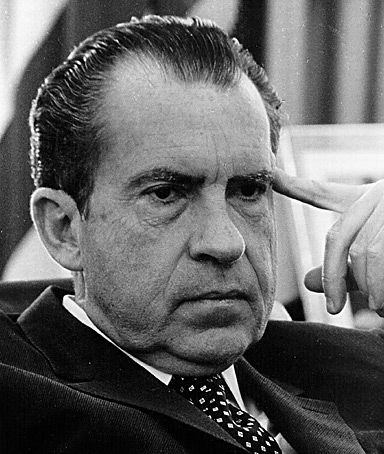
For years one of the great mysteries in American political history was what President Nixon said in the missing 18-½ minutes of tape that was “accidentally” erased before it was given to investigators. A new book may just answer that question.
According to Nixon’s story, his personal secretary Rosemary Woods erased the missing section of tape when she was trying to transcribe the details of the conversation for the Watergate Hearings. In a new book, “Knowing Dick: My Mother’s Time Under President Nixon”, Petey Woods, Rosemary’s eldest son, claims that she revealed to him that Nixon had detailed discussions about assassinating members of the metal band Black Sabbath on the deleted section of the tape. He also claimed that his mother was asked by the President to destroy the section because he worried about “a wave of heavy metal coming over to the U.S. from England and spreading lawless, godless communism.”
The book claims, Nixon, who has also been rumored to have encouraged the assassination and overthrow of Salvador Allende in Chile, wanted to see a similar fate for Bill Ward, Tony Iommi and Geezer Butler. Nixon was much less concerned about Ozzy, who he felt was a drag on the talents of the rest of the band. However, Nixon was concerned that “Sabbath might go ahead and get someone like that fellow Dio from the band Elf. Then, they’d all have to go or they’d be unstoppable.”
Nixon believed the CIA could be enlisted in plans to get rid of Sabbath. “After all, we used them to overthrow Mossadegh in Iran and Arbenz in Guatemala. They helped get rid of Trujillo in the Dominican Republic, Diem in Vietnam and Patrice Lumumba in the Congo. They even tried to kill Castro 8 times for god sakes. Getting rid of a bunch of angry, power-chord obsessed Brits should be no trouble whatsoever for the boys over at Langley.”

“The President was deeply concerned about the potential dangers of a style of music that loud and that intense,” says Woods in his book. Apparently, most of the 18-½ minutes is an anti-metal rant that featured the President raving about the future of metal. “Eventually they’ll be bands that play a style called speed or thrash metal. They’ll have names like Slayer and Demolition Hammer and they will corrupt the young. I can envision a world where kids run into each other in a dance they like to call “moshing”. They’ll be encouraged to kick their friend in the head and have a ball. Is this the type of America you want, Haldeman?”
One of the most shocking revelations about the tapes is Nixon’s Nostradamus-like ability to accurately predict the path of heavy metal. At one point, he allegedly referred to a style of metal from Scandinavia that he believed would be called “bleak metal” and would feature band members wearing corpse paint and playing fast, angry metal filled with high pitched screams. He then allegedly went into graphic detail about his concern that there might be a so-called “death metal” scene in Florida in the early 1990s where bands like Death and Morbid Angel “could completely warp the minds of an entire generation with satanic imagery and blast-beat drumming.”
Nixon even went as far as saying that if Black Sabbath isn’t killed, we’d see a future with bands like “Suffocation, Pig Destroyer, and Goatwhore telling our kids god knows what”. By “taking out Sabbath”, Nixon believed he could strike a final and decisive blow against the forces of heavy metal. “All we need are a few bullets, a little arsenic in their beer and a car bomb or two. Then the kids will start listening to positive stuff like Anita Bryant and Bing Crosby again. And just what the hell is a Goatwhore anyway?”
However, if Sabbath was successful in their metal mission young people would “fall like dominos” and eventually America would be filled with a majority of “black tee-shirt clad, long-haired maniacs who live to thrash all night and sleep all day.”
Later in Nixon’s life, he slowly began to accept heavy metal and even was rumored to have listened to Pantera’s “Cemetery Gates” on his deathbed. However, his willingness to use the power of the Presidency to kill members of a heavy metal band is deeply troubling for the remaining twenty or so Americans who believe that America doesn’t have the right to go around the world murdering people who are a perceived threat.
The Future Ain’t What It Used To Be: Reflections on The Significance of Teaching and Learning History
Posted by Keith Spillett in Pointyheaded Highbrow Stuff on November 17, 2011

I believe strongly that one of the most significant things that can be gained through the study of history is a more profound understanding of the experiences of another human being. We can never completely understand what a person has felt or known, but it is possible to see a vague reflection of their condition. The full scope of human understanding is probably far beyond what a single person can ever completely grasp, but in the search for the meaning of individual moments in time, it is possible to see deeper into what it means to be that particular human in that particular moment. That understanding can grant us the grace that comes with feeling a genuine connection to those who we may not physically ever meet. This connection allows us to know more of what it means to be human. For me, this is the most important reason to teach and learn history.
Often, the study of history is presented as a magical panacea for all that ails the human race. I don’t believe history can “fix” anything. The most well-worn and wildly inaccurate cliché about history is that “those who fail to learn from history are doomed to repeat it.” Students are often programed like robots to repeat that as a way of explaining why it is worth spending hour upon hour of their time on earth pondering the actions of William the Conqueror or Marie Antoinette. Granted, explaining the deeper meaning of history is a labyrinthine task, but simply leaving students with the veiled threat about how not paying attention to a lesson may leave them to the brink of extinction is hardly an effective means of fostering a long-term commitment to learning. Nobody knows what patterns will unfold as time passes. Studying what has happened is not a recipe for understanding what will happen.
One of the few recognizable truths that the subject seems to offer is that it is impossible for history to ever repeat itself. Sets of circumstances are always unique. Sure, there are similarities between the French and Russian Revolutions, but to argue that history was merely re-running an episode of “The Revolution Hour Hosted by Vladimir Lenin” is a grotesque oversimplification. My experience has been that historical themes that “repeat” themselves only look that way if one is paying little attention to the actual circumstances of the event. There are nearly infinite numbers of minor unrecorded actions and forgotten decisions that made the event what it was. We know so little and presume so much.
By understanding the past, we gain little insight into our future. Even if I magically found a way to absorb every moment of the past, I strongly doubt that I could even know what the weather was going to be like a week from Sunday. The future is created by the sum total of the actions of human beings in each particular moment. I have not been given the machinery to synthesize a trillionth of the events of a given millisecond. If they all count for varying degrees of something, then how on earth could I possibly expect to understand the moment I’m in, let alone the ones that will come next?
The problem with a historical outlook that is built on gaining future “results” is that it obscures a much more powerful purpose for historical study, which is to genuinely understand something that goes beyond ones own wishes, desires and beliefs. Historians often try to bend events into coherent themes in the hopes of explaining large blocks of time. This form of historical shorthand is necessary on many levels, but when it comes to supersede the experiences and events that have taken place, then it becomes a major barrier to the path of empathy that true engagement with the subject can create.
If the goal of learning history is trying to predict the outcomes of a series of events, then it is certainly not an effective tool. However, history may well be one of the greatest engines ever created to teach empathy and compassion. The problem with teaching students to believe that history follows certain patterns is it robs them of the understanding of what a remarkable role uncertainty plays in history. Students often ask why a certain historical actor was so dumb as not to see how obvious their fate was to anyone who paid attention. After all, we know how all the stories end. The problem is, historical actors do not know how their lives will end up. They are making decisions in the moment without the benefit of hindsight. No historical pattern can guarantee a person’s well-being. They were fishing around in the dark just like we are. They didn’t know how they would die, they didn’t know what their actions would mean and they certainly didn’t have the benefit being able to walk away from their stories when events became too challenging. We don’t either. This basic human truth should be the bedrock of any exploration of history.
To attempt to fully comprehend meaning of even one moment of a human life is an awe-inspiring goal. Even with the comparatively small amount of information we have about the lives of our fellow travelers, when we can see a flicker of their humanity we have granted ourselves the wonderful kinship that comes with knowing that we are not making our journey alone. Humans can survive perfectly well without studying history. The past, however, can teach us so much more than simply how to survive. It offers us an amazing window of insight into the miraculous complexities of what it means to be alive. This understanding is history’s truest gift to us. This is why it is worthwhile to learn about the past.
A Confessional Review of David Mamet’s Homicide
Posted by Keith Spillett in Pointyheaded Highbrow Stuff on October 19, 2011

“A Grandma is at the shore in Florida with her little Grandson. The grandson is playing on the beach when a big wave comes and washes the kid out to sea. The lifeguards swim out, bring him back to the shore, the paramedics work on him for a long time, pumping the water out, reviving him. They turn to the Grandma and say, “We saved your grandson!” The Grandma says, “He had a hat!””
-Henny Youngman
Bobby Gold was born to die a thousand slow deaths. His is the pain of a man without a country. Homicide is his confession. The confession of the man that can never be whole. He is the first through the door, the last to leave the gym. His mistakes must be rationalized or his coat of armor will become tin foil. He has an answer to every question even before you ask it, because he cannot afford to show an ounce of skin. He must convince them of his worth. He must be more than human or else they will see him. Then, they will know.
Bobby Gold, set to wander the desert into eternity. He must be exceptional or he is lost. He is the map of human misery. Bobby the Nomad. Every time he finds a river he drinks a mouthful of sand. He knows that you see him and he thinks you won’t let him forget it.
His is the story of the self-made man. What becomes of the self-made man when he stops creating? What if he gets tired? What if hasn’t the strength to work at the rate to which he has become accustomed? No one will catch him if his arms and legs cramp up. He knows this as surely as he knows how much time it will take him to get there 15 minutes early.
He looks around at people and instead sees the ocean. The ocean is still and never needs anything more than what is given. The ocean is a mystery to him. Who built it? How does it hide its shame? In his hands are a set of tools from which he must construct himself. From nothing. From the ground up. He must explain himself over and over. He recoils, overwhelmed by the fear that they’ll recognize the sadness in him. He explains and explains and explains never making the point that is so obvious to anyone who takes a moment to look. And he hopes his explanations will blind them to the truth. And he hopes they’ll see him and forgive his existence.
He looks enviously at those who have never had to work a day in their life to exist. Some people just wake up and “are”. He must invent. He must create. All of his actions reek of existential survival. Bobby is a reminder of how fast a man must run to not fall down. The faster he runs, the closer the oblivion he gets. It is gaining on him, always.
Bobby Gold, never to know the stillness and quiet of a dreamless sleep. Haunted by his visions of wholeness. Mocked by his own creations and talents. Bobby hears with a third ear. He is haunted by the stumbling footsteps of those who do not belong. The flesh on his neck stands at attention when he is near them. He doesn’t need files and he doesn’t need a map. He knows the look. He is blessed with the curse of understanding. As like is drawn to like, as “a dog goes back to its own vomit”, as pain seeks out pain. He is them and they are he. Outcasts. Alone in a crowded universe.
Bobby Gold, born to see what people pray to have the strength to ignore. Bobby the Outcast. Bobby the Obscure. Bobby the Stranger Among Strangers. Bobby the Donkey. Capable of so much, but unable to hide the absurdity of his being. Imploring the world to see him for what he does and not what he is. Doomed by the pain of the man who can never be more than he can build.
Gods and Ends
Posted by Keith Spillett in General Weirdness, Pointyheaded Highbrow Stuff on September 4, 2011

Greek Mythology has always been a source of great fascination to me. The Ancient Greeks had an uncanny way of explaining the random, capricious nature of life through their deities. The gods were wild and erratic. They could hand you a check for a million dollars one minute and throw you in a pit with a thousand rattlesnakes the next. Imagine the entire Old Testament was The Book of Job and you have a decent sense of how things worked for The Greeks.
The gods seemed to be a great way to explain anything and everything. At times, it can seem as if there were more gods then Greeks. Often, scholars spend their time focusing on the better-known gods like Zeus, Poseidon or Athena. However, there are many fascinating stories of gods that were widely worshiped in their day, but have disappeared into the great dustbin of history. Here are some great examples:
Arteriosclorities-The God of Deep Fried Foods
Beyond contributing democracy and many other key philosophical insights to our world, The Greeks are also the first society to deep-fry their foods. From yak to Snickers bars (a delicacy first created by Aristotle), the Greeks would throw nearly anything into a bubbling cauldron of oil. It is no wonder that the Greeks are believed to be the progenitors of Western medicine. Most Greeks weighed upwards of 300 pounds and were barely able to run. This fact tends to throw their achievements during the Olympic games into a whole different light.
Supposedly, Arteriosclorities was one of Zeus’ many sons from an affair with Eris, the goddess of strife and discord. In order to hide this affair from his wife Hera after the child was born, Zeus placed Arteriosclorities into the stomach of Dionysus while he was sleeping off a wild night of overeating and general debauchery. Dionysus awoke with a terrible feeling of discomfort and collapsed. Zeus, not meaning to have harmed Dionysus, sent Indigestius, the Greek god of stomach acid and ulcers, into his stomach to destroy Arteriosclorities. The two had a great battle, which was won by Indigestius. Dionysus finally awoke with terrible stomach pains that could only be allayed by eating massive amounts of antacids.
McKuenius-The God of Bad Poetry and Greeting Cards
The Greeks are known for creating some of the most poignant and moving poetry in human history. But, for every Homer, there were 1,000 less talented hacks trying to write their own Iliad. Many of these no talent writers ended up working for the Hallmark Corporation, which was founded in 654 B.C., with the mission of sending sappy, dull poetry to people on important days of their lives. Their patron saint is the god McKuenius.
McKuenius was known for writing terribly boring, pointless poetry and asking Hermes to deliver it. Hermes, the busy messenger god, was forced to deliver idiotic compositions like “Roses are Red, Violets are Blue, You are a Goddess and Athena is too” to Aphrodite or “Poseidon likes water, Demeter is his sister, She gave birth to his daughter,” to the god of the sea. After growing tired of having to read this drivel, Hermes begged Zeus to punish McKuenius in order to make him stop writing. First, Zeus sentenced him to one hundred years of writing dirty limericks on bathroom stalls. However, Zeus quickly discovered that he was enjoying his job. Zeus realized he was a lost cause and sent him to pits of Tartarus and made him write a detailed description of Sisyphus rolling a rock up the hill for eternity. He is still there today, happily describing suffering and misery in a pithy, gleeful, and highly moronic way.
Aggasius-The God Of Male Pattern Baldness
The gods seemed to all have some sort of fatal flaw. Be it rage, greed, avarice or just plain old insanity, they all seemed to have something locked into their character that made them both all-powerful and amazingly vulnerable. One of the earliest examples of this is Aggasius, the god of male pattern baldness. Aggusius was one of the original Titan gods who were overthrown by Zeus and The Olympian gods at 4:22 PM on February 12th 3212 B.C. Aggasius was capable of creating tornadoes, causing earthquakes and smiting entire nations with a wave of his staff. However, he was unable to grow hair on the top of his head. The tragic irony of Agassius was that he could grow massive amounts on his back, his ears and even on his shoulders like Sonny Corleone in the first Godfather film. He tried several potions created by Greek pharmaceutical manufacturers, a terribly made hairpiece created from the beard of Hyperion, and even tried to rubbing pomegranate seeds on his head three times a day, nothing seemed to work. In spite of his great power, the other gods laughed at “The Bald One” whenever his back was turned. Eventually, he grew tired of the mockery, quit being a god and moved to a suburb of Stillwater, Oklahoma, where he still lives today working as a successful middle manager at a meat packing company.
Watching The Defective
Posted by Keith Spillett in Existential Rambings, Pointyheaded Highbrow Stuff, The Politics Of Catastrophe on August 1, 2011

The following conversation took place recently in a mental hospital on the planet Klorg located in the Rumach Galaxy 20,000,000 west of Arcturus. The patient, Wsghk Z Weryhi, was locked in a padded cell and sedated for his own safety approximately one week ago. His family brought him in claiming that he disappeared for a day and reemerged exhibiting signs of severe dementia. We now join an interview between himself and the esteemed Doctor zZefgh W KorgabS already in progress.
(Editors note: The conversation was conducted in KlorgeanRW, a dialect common in the Southern Provinces of Klorg. The language and concepts have been adapted so that it can be understood by the primarily English speaking audience of The Tyranny of Tradition)
Dr. KorgabS: So, I want to go back to what you were saying earlier, about this America you claimed to have visited…
Weryhi: Doctor, I am sure that I was there. I snuck into the interstellar dock at the community center and set it for random coordinates. It took me to America.
Dr. KorgabS: Okay, so, let’s talk about this America. I want to make sure I understand what you are telling me. Please describe this whole, what did they call it, (consulting his notes)…ah yes, this “free market” idea that many of these Americans believe.
Weryhi: Sure….some of them believe that this system of economics that they have, they call it capitalism, is essentially perfect. They think that if they all do as they wish and accumulate as many resources as they can, everything will work out for the best for those that make what they like to call “good decisions”. Basically, some of them actually believe that selfishness is a good quality that is the best thing for the community.
Dr. KorgabS: (with a perplexed look on his face) Okay….now Wsghk, you can understand why I’d think this sounds a bit odd, right?
Weryhi: Believe me, I had the same response. One of them told me about this fellow named Adam Smith who said an “invisible hand” runs things and allows people acting only in their best interest to be protected. The invisible hand makes everything work out. Or, that’s what the fellow in the bowtie told me.
Dr. KorgabS: An…invisible hand???
Weryhi: Yes.
Dr. KorgabS looks down at his information tablets trying not to look concerned and moves on to the next subject
Dr. KorgabS: And….this democracy idea that most of them talk about.
Weryhi: Yes! It was a fascinating thing. From time to time they actually pick the people who make the most important decisions. It sounds like a great idea, but what they do with it is bizarre. Once they’ve picked these “politicians”, many of these people turn around and blame them for everything that goes wrong in their lives. Even though they were the ones who picked them in the first place! Then, if the politicians do what they want them to, they pick them again and start blaming them the minute these folks are elected. It’s amazing! They seem to take no responsibility for the choices they make!
Dr. KorgabS: Yes, you seem to talk a lot about how they blame each other.
Weryhi: One of the most amazing things I’ve ever seen. One very small section of the population controls most of the resources. Most of them struggle while a few of them have more than they need. Yet, many of the Americans blame those who have very little of the resources for making “bad decisions” and ruining things for the group. Every once in a while, a few of the people with a lot of resources blame other people with a lot of resources, but they don’t really try to change anything.
Dr. KorgabS: Do these Americans blame any one else?
Weryhi: They blame EVERYONE! That’s all they do. They blame people who don’t live in America. They blame people who come to America. They blame people who have new ideas. They blame people who don’t do what they want them to. They have entire television channels dedicated to blame.
Dr. KorgabS: Fascinating. Is anyone ever above blame?
Weryhi: Well, they like to make up stories about these people they call The Founding Fathers. Apparently, they understood everything and rarely had bad ideas. The funny part is they use these made up stories to justify all sorts of bizarre actions. These people seem to have almost limitless imaginations!
Dr. KorgabS: This is truly amazing.
Weryhi: Isn’t it. Some of them believe that this invisible all powerful being, that they have a bunch of different names for, controls everything and tells them what to do.
Dr. KorgabS: (incredulous) An invisible, all-powerful being that…tells them what to do? Sounds like that invisible hand thing.
Weryhi: Yes!!!! This invisible being idea is so strange. If things go well for them, they say he did it. When things are going badly, many of them don’t change anything about their lives, they just close their eyes and pretend to talk to this being. Apparently, they think this invisible being has some great plan that they are all a part of. If they disobey the voice in their head, they fear that after they die they will be set on fire for the rest of time.
Dr. KorgabS: Simply amazing. And many of them believe all of this?
Weryhi: Here’s the weirdest part….not only do they believe it, they are proud of it. Incredibly proud of all of these strange ideas. They wave flags and have parades to celebrate them. Without a trace of irony, these people act as if they have found the greatest set of ideas ever created. They are so impressed with these ideas they are willing to go to war and commit querby so that people will act more like them. (editors note: there is no English equivalent to the word querby. It means something like killing or harming based entirely on a delusion. It is the worst possible act in Klorgian society. No one there has committed querby in the past 20 years)
Dr. KorgabS: They commit QUERBY and are proud of it!!!! I simply cannot believe that.
Weryhi: If I hadn’t been there, I wouldn’t either.
Dr. KorgabS: (standing up and leaving the room) You understand that this sounds pretty far fetched?
Weryhi: I know, I know. But I saw it with my own three eyes.
Dr. KorgabS: We will be in to check on you and talk more later. Until then, try not to think about that place.
Weryhi: I’ll try, Doctor. Thanks for listening.
20 minutes later in Doctor KorgabS office. KorgabS sits at a desk discussing the interview with his colleague and friend Doctor QwB
Dr. KorgabS: He seemed so convinced. The details are incredible. I have never worked with a patient with such detailed delusions.
Dr. QwB: It all sounds so crazy. I mean, the part about the interstellar space travel is quite possible, but this America he described sounds ridiculous. Does he know it can’t possibly be real?
Dr. KorgabS: No, I don’t think he does. It’s so sad. I’ve never met a sicker being in my entire life.
Souls in The Heads of Corpses: A Psychological Review of Allegaeon’s “Fragments of Form and Function”
Posted by Keith Spillett in Existential Rambings, Pointless Music Reviews, Pointyheaded Highbrow Stuff on July 9, 2011
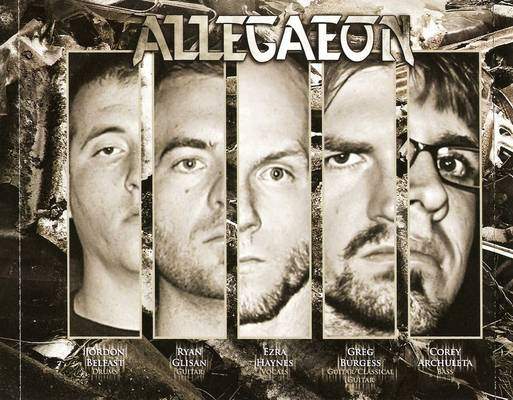
Few people realize that the recent Allegaeon album “Fragments of Form and Function” is a doorway to a separate dimension. Even if it hadn’t turned my body into a giant alpha wave and projected me into the substratum of the upper atmosphere, I’d have thought it was an entirely captivating record. At first, my ears began to shoot orange beams from them. My children noticed this and were immediately frightened. Eventually, they got used to it and my daughter continued talking to my toes and trying to feed them milk. As the solo from the song The God Particle came through my cheap 9-dollar Sony headphones, I became a bundle of pure light energy and bounced from wall to wall. I had the right headphone in my left ear and vice versa, which caused my body to carom with on a strange, knuckleball like trajectory. And then…..a universe without dimension……
Freud once posited that original sin was actually a strange response to witnessing a patricide. After all, the divine sacrifice wouldn’t be called for unless it was in response to a murder. A universe that avenges theft with murder or lust with murder or greed with murder would be the most unjust possible universe. But why would this idea bother us so much? Maybe it is the idea that what creates life also “owes its death to the universe” that fills us with such dread and wills us to punish ourselves over and over. When you are hurdling through the universe at light speed, it all seems irrelevant. The human conception of justice cannot be understood at this speed. All actions happen simultaneously. From above, it’s all the same.
As the stirring stillness of the post-script guitar solo in “Biomech –Vals No. 666” began to well up in my consciousness I became vaguely aware of the illuminated bits of human spiritual form in these bodies of light that surrounded me. Then, the whole ride came to a screeching halt. I realized that I was, in fact, deliriously spinning into some weird new age fantasy that had no baring on anything and would be useless to anyone unfortunate enough to read it. People don’t devolve into sweetness and light, they lumber along in these fleshy tombs for what qualifies as eternity (or about 76.8 years, depending on where you live). We are not spiritual beings on some wondrous journey. We are getting deader by the hour. There is nothing poetic about a corpse that isn’t aware enough of itself to begin rotting. Trapped in this dying form and making up stories about interconnection and light and love and beauty and meaning. Charming.
“WHO ARE YOU TO DESIGN THE LIFE WE LIVE?!?!?!?!!?!!”
A Cosmic Question. Don’t bother. Don’t bother with any of it. “What defines reality? What defines a soul?” That’s your problem, pal. I’m just decay with a bit of personality. Apatheism is the only answer that allows my monstrous form any solace. Yet…I want to know as well. Do I suffer because I want to know or do I suffer because I cannot dream? Descartes went around trying to find souls in the heads of dissected corpses. (Come out with your hands in the air!!!!!!! Put the soul on the ground next to you and don’t make any quick moves!!!!! Up against the wall, Descartes!!!!!) I’d take it over pretending knowledge I do not have or seeking knowledge I cannot gain. I prefer the ever-quickening pace of the double bass in “From Seed To Throne” to any rational explanation of what I am or to anything else this moment can offer. There is that much for now.
Solutions Are Not The Answer: Political Communication For Toddlers
Posted by Keith Spillett in General Weirdness, Pointyheaded Highbrow Stuff, The Politics Of Catastrophe on July 8, 2011

Photo By Angie Hill (picture is of her son Braxton)
It has often been said that you can learn a lot from listening to a child talk. People tend to mean that you can learn a great deal about the beautiful simplicity of life and the importance of innocence. These are valuable lessons, but certainly not the only things children can teach you. What I have found from listening to my children is that they have an amazing understanding of how political communication works. It’s not that I am one of those parents who think their children are so smart they can handle molecular biology in the first grade, but my two year old and four year old have given me remarkable examples of arguments that are popular in the realm of American political discourse. Carter could have gotten a third term with some of the things my kids say in passing.
Fallacy of Extension or The Strawman Argument
My 2-year-old daughter looked at me yesterday and announced, “It’s not night daddy, it’s the morning.” She was certainly correct, it was 10 o’clock in the AM and the sun was shining brightly. The intriguing part about her statement was that I had never said anything about it being nighttime. She had ascribed to me a position that was both irrational and, more importantly, not mine. She had used this to make her own case for the fact it was daytime. Somewhere, Roger Ailes was smiling. This argument is the backbone of much of the political debate that goes on today.
In the “non-toddler world” it works like this. I accuse you of saying something you have never said and do not believe and then make my case in opposition to the illogical premise that now belongs to you. You look like a lunatic and I look like my argument is not only correct, but a common sense response to the weird stuff that you have said at another time (even though you never said it!) Richard Nixon’s Checkers speech is the most famous example. The man was accused of misusing 18 thousand dollars and ended up making an argument over how his political enemies were asking him to give a dog back that his children really loved. No one had said anything about the dog except him. Even my two-year-old couldn’t pull that off with a straight face.
Misdirection or The Old Red Herring
This one is common among children when the subject of bedtime comes up. My four-year-old son has this down to a science. He is a naturally curious boy, but this curiosity comes in spades right around the time he’s looking to stall the natural forces of parenthood.
Me: “It’s bedtime.”
Son: “Why do the leaves fall off of trees?”
Me: “Let’s talk about it tomorrow, it’s bedtime.”
Son: “Where do the stars come from?”
Me: “We can talk about that first thing tomorrow, it’s time to go to sleep.”
Son: “Why do people sleep?”
Politicians often use this one when they get in trouble. The same sort of change the subject magic can be seen at many a press conference. Here’s a made up example that should look familiar to anyone who spends more than a half hour a month watching the news.
Reporter #1: “Is it true that you took illegal contributions from the law firm of Screwed, Over and Often?”
Politician: “The question of what makes a contribution illegal is an important one. Political contributions have been the bedrock of our great political system. Without them, many great Americans wouldn’t have had the chance to become President. Lincoln took contributions from great Americans like Cornelius Vanderbilt. Lincoln was one of our greatest Presidents. He took a stand against the evils of slavery.”
My son hit me with this one yesterday and nearly ruined what was left of my barely usable brain.
Me: We’ll be here for 18 more days.
Son: 1, 2, 3, 4, 5, 6, 7, 8, 9, 10, 11…uhm. Daddy, it can’t be 18, 18 isn’t a number.
Basically, he was saying that if he doesn’t know what it is then it simply can’t be true. In politics, there are many bizarre variations on this hustle. The most surreal is the use of the absence of something to prove its existence. Future Supreme Court Justice Earl Warren ran this one out back in the early 1940s to justify some of the post-Pearl Harbor, anti-Japanese sentiment in California “I take the view that this lack (of enemy subversive activity in the west coast) is the most ominous sign in our whole situation. It convinces me more than perhaps any other factor that the sabotage we are to get, the Fifth Column activities are to get, are timed just like Pearl Harbor… I believe we are just being lulled into a false sense of security.”
If you observe children enough, you’ll see all sorts of interesting political communication going on. The argument from personal charm is another standard. “I’m cute and harmless, therefore, even though I have a chunk of my brothers hair in my hands, I couldn’t possibly have done that bad thing you are thinking I did.” This explains much of the political career of Ronald Reagan. The argument ad infinitum is a common tool used when politicians repeat the same expressions thousands of times to try to cement them in the minds of voters. When your 4-year-old asks you for the six thousandth time for the Thomas the Train Misty Island Rescue Set, understand that they are exhibiting traits that may one day allow them to lead this great nation.
If you are interested in more of the great strategies used to obfuscate truth and contribute to the further cheapening of language, check out this link…http://www.don-lindsay-archive.org/skeptic/arguments.html
Review As Revelation: A Call To Arms
Posted by Keith Spillett in Pointless Music Reviews, Pointyheaded Highbrow Stuff, The Poetry of Death on June 27, 2011

“children guessed (but only a few and down they forgot as up they grew)”
-ee cummings
The music review has been pronounced dead in many quarters. Some say it has lost its relevance, some argue it no longer has a story worth telling. I think there is some truth to this idea. There is a formula for a standard review and it is tried and true. A few strong metaphors, a band comparison or two, a reference to earlier work and the albums place within its genre and you’ve got a review. This is not to demean much of the writing that is out there. There are some truly exceptional writers who can take the standard form and make it deeply engaging, but there are a lot of reviews out there that simply don’t make an impact on me. I don’t believe that this is the fault of the writers but rather the fact that the medium they are using has confined its creator to the narrow world of observing and reporting. I think it is fair to say the music review as pure informational medium is probably on its last legs. While I believe that its role as informer of music fans is ending, I believe that it is in the process of going in a bold, exciting new direction that can make it relevant again and even an art form of its own.
Audiences no longer want to be informed, they want to be involved. They are not just looking for information about a band; they are looking for a deeper understanding of what it is like to experience the music. Audiences want to connect to the music, not just read about it. The dramatic shift that I believe is taking place is moving the review away from being about the artist and towards about the experience the artist has created.
The star of the review is no longer the band, but the audience as voiced by the writer. The goal of the writer used to be to melt into the background and let the band be heard. Objectivity was a characteristic to be aspired towards. The idea of the writer as passive communicator no longer has a major place in the all-at-once culture of engagement that we live in. More and more, the writing I see is coming to reflect this truth. The writer, no matter how much he or she tries, is a subjective creature. This is not a liability. The experience had by the audience is, in my opinion, the single most interesting thing about music today.
Director Jean Luc-Goddard supposedly once said the only way to review a movie is to make a movie. To me, this is a near perfect description of that the type of writing that will move the review to its next level. The review itself is an act of creation. A review can exist nearly independent of the original material. It can be a story unto itself that uses its source material as a beginning step into a labyrinth of unbridled creativity. A review can mark a unique moment in time, the moment when the artist meets the audience. Inspiration transfers from musician to writer and a new world is created. This world would not exist without the musician but it has transcended the original idea and morphed into something beyond its original intent. When the writer simply describes, it short-changes the audience of the revelatory power of the music. What has the music awakened within you? What did you see? What did you find? What did it genuinely make you feel? Instead of a medium that narrows the experience, a review can be something that becomes more than what was originally intended expanding exponentially through each person it comes into contact with.
In order to achieve this the writer must shun the formula and go beyond. The review need not be constricted by anything, even words. It can be photography, painting, sculpture, and maybe even more music. It must be an original statement of experience. A confession. That is its only qualification. It may present itself in a form that may be at times incoherent, but sometimes visions are not easily explained or understood.
The label often placed upon this type of creation is self-indulgent. There is an unwritten rule that good writing must purge the self as much as possible and fit neatly the pantheon of writing that came before it. What that really means is that in order to truly create we must forget who we are. This is insane. The unedited self, allowed breaking free of the artificial covenants that chain it to the floor, is capable of bringing a new vitality to a stilted form of expression. Imagine six billion selves illuminated, simultaneously witnessed and witnessing, all expressing unique shades of humanity and learning in fullness what it is like to human from every possible angle. This is what music reviewing can be.
When Is A War Not A War?
Posted by Keith Spillett in Pointyheaded Highbrow Stuff, The Politics Of Catastrophe on June 18, 2011

This Drone Is Providing Support But Is Not Actually Involved In War. See The difference?
A helpful guidepost in understanding the recent debate over President Obama’s use of the military in Libya and the War Powers Act is Garry Wills seminal work “Bomb Power: The Modern Presidency and The National Security State”. In it, Wills makes a strong case against the misuse of Presidential power that has come from the creation and control of America’s nuclear arsenal. Wills case is a deeply convincing one that should be read in full by any one who wants to properly understand the major structural changes that have taken place in the United States government since the end of World War II. A short but powerful section of the book to explaining issues related to Congress’ 1973 passing of The War Powers Act. He makes argument that The War Powers Act itself is unconstitutional.
The Constitution seems to bear out Wills point when it clearly states in Article 1 Section 8 that “Congress shall have the Power…to declare war.” The War Powers Act implies that the President must ask for a Congressional Declaration of War within 60 days of using the military in a conflict. This appears to be illogical. If Congress has the sole power to declare war why would the President be allowed to send the military into conflict for 60 days before these powers kick in? How can Congress cede it’s right to declare war for any period of time? There is no clear provision in the Constitution that allows such a use of military power and there is certainly no provision that allows a Congressional abdication of this power.
The President does have some power over the military as outlined in Article 2 Section 2. He or she has the role of Commander-in-Chief over the military “when called into the actual service of the United States.” Clearly, the President can control the armed forces when they are at war, but nowhere does the President have the right to actually call the armed forces into service. Wills deals with this idea at length and debunks the myth that the term Commander-in-Chief means that the President has the right to use the military whenever they feel it is correct to do so.
President Obama has argued that in the case of Libya, the Executive Branch does not have to gain the approval of Congress because it is a limited military action and the United States is merely playing a supporting role. Indeed, this logic has been used to justify many incursions into foreign countries without the approval of Congress. The fact that it has been deemed acceptable in the past to skirt the separation of powers that have been outlined in the Constitution is certainly not an argument to continue doing so. Further, what properly defines a supporting role in conflict? If we commit the military to a conflict that is under NATO supervision the armed forces have still been called into service. Even if we are using them in a limited fashion, it still constitutes calling them into service. It is not hard to see how the “limited scope” of a conflict could be used repeatedly to justify the Presidents usurption of the Constitutional mandate of Congress for any reason whatsoever. It is a legal fiction that continues an alarming trend of consolidating the power of the military in the hands of the Executive Branch.
The attempt here is not to make an Originalist argument for the interpretation of the Constitution. Occasionally, there are moments where the necessity of the moment is more significant then the Constitution itself. If the United States came under attack and Congress was unable to convene, their would be a rationale for the President calling up the military. A once-in-a-lifetime national emergency could force the President to ignore the Constitution and take action to keep the American people safe. This is clearly not the situation in Libya, nor has it been the case in just about every use of the military over the nation’s history.
The problem with the War Powers Act is that it legitimizes the belief that the military is the dominion of the Commander-In-Chief. When a piece of legislation is passed to restrain someone’s power, it is an admission that they have that power in the first place. In the case of Libya, President Obama is using a power he doesn’t have and actually arguing that it cannot even be limited Congress.
Support of the Libyan rebels might well be a worthwhile cause. It is easy to understand the motivation to help support their struggle against Gaddafi’s tyrannical state. If the rationale is so righteous and the need so great, why not make the case to Congress and ask it to take seriously the plight of the Libyan people by supporting their revolution? It is true that Congress has been infested with obstructionist tactics and absurd partisan bickering, but are they so far gone that they are incapable of being trusted with any sort of worthwhile cause?
The task of using the military is a solemn one. Its improper use has led to significant suffering and a slew of seemingly never-ending problems around the world. The power was put into the hands of Congress because its use should be stridently argued and debated, not simply decided unilaterally. By legitimizing a process that shifts this power to one person instead of a legislative body drawn from the people we are continuing to feed a monster that grows ever more frightening by the day.
Let Them Eat Schools: An Entirely Hostile Review Of Charlie Wilson’s War
Posted by Keith Spillett in Mr. Spillett's Academy Of Film Study For The Mentally Tormented, Pointyheaded Highbrow Stuff on May 30, 2011
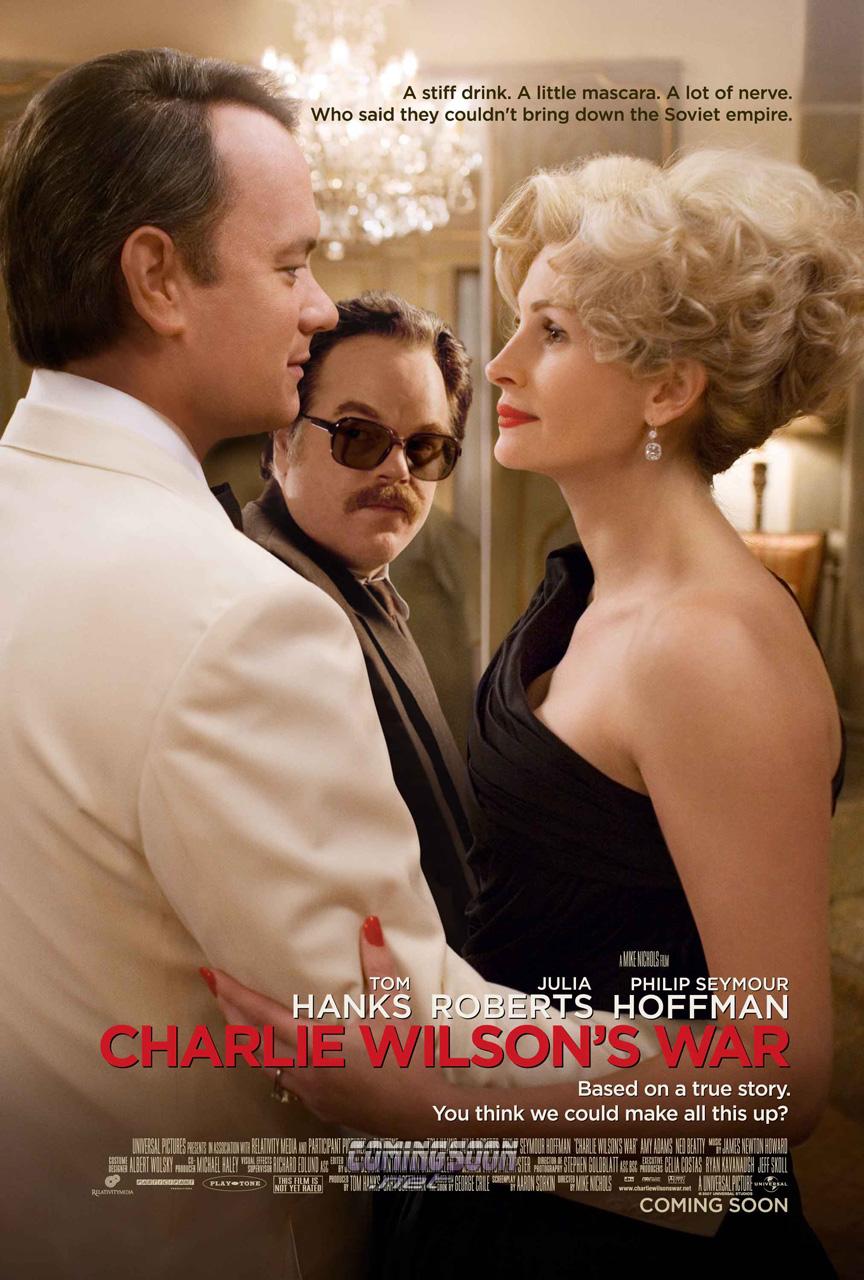
Charlie Wilson’s War is a highly entertaining film. It is funny, fast-paced and extremely well acted. Phillip Seymour Hoffman is captivating as Gust Avrakoto, the cynical, highly skilled CIA agent who helps Congressman Charlie Wilson (Tom Hanks) and Joanne Herring (Julia Roberts) finance a covert war against the Soviets in Afghanistan in the 1980s. Apparently, you can make a good-natured, romantic comedy out of nearly anything nowadays.
The film sets out to make “Good Time” Charlie Wilson, the hard drinking, womanizing Democratic politician from Texas, out to be the greatest American hero since Abe Lincoln. Sure, he’s got some character flaws, but when it comes down to it he worked hard for the cause of freedom and democracy. Blah, blah, blah. I personally could care less about his love for whiskey, his multiple girlfriends, his cocaine use or whether he was a good juggler or not. His decisions as a Congressman are what disturb me. The halo simply does not fit.
Afghanistan was not Wilson’s first crusade. He spent much of the late 1970s championing the cause of Anastasio “Tachito” Somoza Debayle, Nicaraguan dictator and serial human rights abuser. Somoza’s reign of corruption was legendary. He was best known for stealing millions of dollars that were supposed to go the victims of the devastating 1972 Managua Earthquake. To Wilson, Somoza was not the evil bucket of slime that tortured and murdered just about anyone who disagreed with him publicly while robbing his country blind. Somoza was a great representative of America in the fight against communism. The dictators big mistake was to get drunk and attempt to make a move on Wilson’s girlfriend, Tina Simons. It was only at that point that Wilson decided that Somoza was, in fact, not a great representative of truth, justice and the American Way. This is not to say that Wilson was entirely awful. He was a very complex man who made some important contributions while in office. He also gave aid and comfort to a monster. The second part was apparently not significant enough to make the final cut of the movie (the book by George Crile does cover this in detail).
The movie focuses on Wilson’s role in arming the Afghan rebels against the Soviet Union. The film uses the familiar Russians=Evil theme that was quite popular in Cold War propaganda movies. At least in Red Dawn we saw the Russians doing something beyond killing innocent people for a few frames. The only Russians in this film are the ones shooting unarmed peasants from the sky or getting shot down by American supplied Stinger missiles.
It’s easy to find fault with what the hideous actions taken by the Russians in Afghanistan. The problem with how the Russians are portrayed in this film is two-fold. First of all, it is mindlessly simplistic and creates the idea that the war was an easily understood battle between good and evil. It was not. The second problem is that it supports the widely accepted narrative that the Russians were solely at fault for the war. In fact, evidence exists to the contrary. Zbigniew Brzezinski, National Security Advisor under Jimmy Carter, has stated that the United States began arming the mujahedeen fighters, who were trying to overthrow the Soviet backed government, months before the Russian invasion. The goal, according to Brzezinski, was to “knowingly increase the probability” that the Soviets would invade. Can you imagine what the reaction of the United States would have been if the Russians were caught doing the same thing in Mexico? This is extremely significant because it clashes with the official story of how the war began. Through the lens of Brzezinski’s comments, Charlie Wilson was not simply helping out a group of people fighting to free themselves from the Soviets, but rather was continuing a pattern of expensive and wrongheaded U.S. intervention into sovereign nations that wreaked havoc across the world.
The film ends with a strange postscript. Wilson is recognized as a hero for getting weapons into the hands of the mujahedeen and helping to end Soviet dominance in the region. However, when he tries to get a million dollars in aid to the Afghans after the war he is rebuffed. A Wilson quote about us winning the war but messing up the endgame runs across the screen right before the credits. The message seems to be that it was totally justified to give over a billion of dollars to arm a group of Islamic radicals, but we should have built some schools. Are you kidding me? The largest covert war in American history is fine as long as we build a few schools at the end? As if throwing a few bucks into rebuilding the infrastructure of the country can somehow compensate for the untold damage that arming and training many future Taliban members caused.
The idea is reminiscent of some of the crackpot schemes hatched by Kennedy/Johnson advisor Walt Whitman Rostow. He was the guy who decided we could win the hearts and minds of the Vietnamese by taking them off of their land and moving them to fancy, new, isolated towns called Strategic Hamlets. The Vietnamese didn’t want our makeshift Levittowns, they just wanted us to leave. The common thread in this logic is that United States intervention is justified as long as the people get something that we deem valuable out of it. Sometimes the greatest gift we can give a country is to leave them alone. Unfortunately, this message is entirely absent from Charlie Wilson’s War. It is replaced with the twisted idea that the U.S. can plant its flag anywhere it wants as long it brings “civilization” and modernity with it.
 The Tyranny of Tradition