Keith Spillett

I have a lot of strange debris rattling around my mind that I need to work out in a useful way.
Homepage: https://tyrannyoftradition.wordpress.com
Reflections of a Wayward Blogger
Posted in Articles I Probably Shouldn't Have Bothered Writing on January 10, 2011

Get to know the man behind the mask!
I’ve been doing this for three months and I decided, since the point of this blog for me is to better understand the mess in between my ears, to do a quick inventory of what I have learned in doing this. Personally, I’m not a big fan of this sort of exercise, but I figure I can indulge my narcissistic tendencies for a few lines. If you are not one for eavesdropping on the self-reflections of a stranger, this is probably the column to skip. In fact, this column is probably of no practical purpose to anyone except me. I’m sure I could think of something to say where it could make it seem like I’m trying to present something of value to the human race and how we’re all the same in some ways and all of that, but it would be highly disingenuous and I haven’t the time or interest to bother. If you can find something worthwhile in the next 900 or so words, more power to you. Away we go:
1. I really enjoy talking to strangers. I get a genuine buzz out of the reply part of the column. I am really excited to see what people think of what I wrote and I like trying to synthesize their ideas with mine. I’m like a 17 year old waiting for the limo to show up on prom night every time I see one of those “Please Moderate Comment” messages in my email inbox. Getting a reply never fails to make my day.
2. I’m a heck of a lot meaner than I thought. For a good number of years, I have functioned under the assumption that I was over the whole “being evil to people” thing. I spent a good portion of my teen years and some of my twenties being downright cruel to others because I liked how the words I was saying sounded. I had a notion that this was gone, but I have had a few moments where I felt bad blood boiling up to the surface again. Sometimes, I get hooked into the rhythm of how things sound and forget that I am talking about another human being. There are moments where I think I would probably throw my grandmother off a speeding train just to see if she’d bounce. I’m not particularly proud of this aspect of my character, but it’s real.
3. Sarcasm reads different than it sounds. I check in with a few of my friends who know me off of here to get a sense of how things came across on the page. What is astonishing is that points I make that I think are obviously sarcastic do not always translate how I think they do. How it sounds in my head is not always how it sounds in other people’s minds.
4. I have no idea what the reader is thinking. This could really be 3B, but I felt like it deserved its own number. There is a weird calculus that must be considered when writing to an audience. You aren’t just thinking of the idea, but also what people will think when they read the idea. Throw in the fact that I don’t really know a lot of the people who are reading my stuff and I get a sense that I am never really going to understand how things are going to be perceived, but I can’t help but to try to figure out what the reader is going to see in my words. The stuff I’ve written that I liked the best is usually way different than the stuff other people have said they liked. It’s a heck of a mystery. What makes it somewhat frustrating for me is that in person, I’m halfway decent at reading a persons response and flowing off of that. In writing, I really am not sure how to do that yet and I’m not sure I’ll ever know or if it is even possible.
5. I am terrified of repeating myself or writing a boring column. There are several things of written that I read and thought, “Wow! This is horrendously bad.” Mercifully, I have not included most of them on the blog (but there have been a few that made it). The worst thing I feel like I could ever do to a reader is bore them. I also worry that I am going forget that I used a line and repeat it in another column. The second one is an odd thing to be worried about, but it wakes me up sometimes in a sweat.
6. Speaking of blinding fear and panic…I am frightened I will run out of ideas. I don’t even want to write about this one because I’m afraid that the god of ideas will decide that to punish me for some earlier, unnamed transgression and the part of my brain that produces creative ideas will seize up like the engine in most any Ford that gets over 125,000 miles. I now have even more respect for people who do this for a living on deadline. I try to imagine doing this and attempting to be interesting for 300 or so days during the year. The thought terrifies me. I think I would sleep about 20 minutes a night and would probably end up in a padded cell scrawling the lyrics from some Beach Boys song in mustard on the wall. Grantland Rice wrote constantly for over 50 years and barely ever wasted anyone’s time. Isaac Asimov managed to knock out over 400 books. I’m only three months in and I’m already doing the hackneyed “talk about myself and what I’ve learned” column.
7. Commas are infuriating. I never know when to use them and they always seem like they are in the wrong place.
8. Spell check will not catch sentences that are just plain awful. It only manages to catch spelling and grammar mistakes. I have snuck some genuine garbage past its watchful eye without a hint of a squiggly green line.
9. I am even more obsessive about this than I thought I’d be. I stayed away from doing this for a while because I have the type of personality where I get very, very into things. I knew this would be an issue going in, but wow. If my wife has to endure another dinner table discussion about potential blog ideas, I’ll shoot me for her.
Enough of this already. I’ll try to get back to something interesting next time. Maybe I can write about what I did on my summer vacation or an exciting tell-all piece about my favorite flavor of ice cream.
How Could Hell Be Any Worse?
Posted in Existential Rambings on January 7, 2011

From a distance, it really looks like Cleveland
Lately, I have found myself more and more interested in the Christian idea of hell. Maybe it’s the awful chill of winter. Maybe I’ve been listening to a bit too much black metal. I’m not quite clear what has put me on this mental course, but I have spent a good amount of time thinking about what it would actually be like to be in hell. I don’t even really believe that hell exists. I am not completely against the idea, but I accept that I have no way of possibly proving its existence or non-existence to myself, so I just figure I’ll find out after I die. That is not the part that really interests me. What I want to know is what, assuming that hell is real, would torment a human for eternity.
In the Book of Matthew, we are warned to “be afraid of the one who can destroy both soul and body in hell.” To be honest, I find this quote a bit odd. This implies that we take our body with us to hell. If this is true, one must wonder what that thing in the casket back there on earth is. Is that a wax replica of us at the funeral while the real body goes to hell? Is your body snatched out of the coffin and sent to hell the minute you enter the ground? (But then, what happens if they dig you up?) Does God duplicate our body and send that one to hell while the real one is on earth? Is the body I am currently in an illusion and my real body somewhere in the ethers waiting for judgment? In that case, can I blame the illusion body for the sins committed on earth? After all, the earth body did the things I am getting sent to hell for. As the eloquent, renowned philosopher Silkk The Shocker once said, “It ain’t my fault!!!”
If it is just your soul in hell, that opens up another can of worms. I can specifically tell you that the conditions of hell would be awful on my body, but I can’t predict what extreme heat would do to my soul. No part of the Bible mentions the soul having nerves, so why should we expect that it would feel pain in the way the body does? If it is physical, it is capable of feeling physical pain, but I have not often heard the soul described as a physical thing. It is usually thought to be a spiritual entity independent of the flesh. Most descriptions of the soul are of the ghost in the machine variety, where the soul is a non-physical being that steers our body around then hops out when the body is no longer sentient.
In order to move forward with this line of questioning, I’ll pick the most likely scenario, which is that the soul just recreates your body once you get to hell. There is no reference to this happening in the Bible, but this explanation gets my body in hell, which for the purposes of this argument, is where I want it. Then, we run into another problem. Revelation says that you shall be tormented “forever and ever”. If hell is supposed to be eternal, how can the body and soul be destroyed? I mean, once you are destroyed isn’t that it for you? If the torment of hell is supposed to be eternal, how can it be that you are destroyed? Revelation refers to hell as “a second death”, but what happens after the second time you die. Do you continue to go to new hell after new hell? Do you die and wake up again?
Let’s assume that my body and soul are now in hell which is described in the book of Revelation as being “the lake of fire and brimstone”. I think that would be really terrible…for a while. The thought of an extended amount of time in extreme heat is an awful thought. 20, 30 years would be gruesomely terrible. 100, 200 years would be worse. But, after some point, wouldn’t I just get used to it? I mean, the thought of eternal fire is terrible, but eternity is a long time. My immediate reaction would be a period of unbridled misery. But, after a while, wouldn’t I forget what normal earth temperature felt like and become hardened to the torrid warmth? After a period of time, wouldn’t I get used to the pain? I don’t think this would happen right away, but we are talking about eternity here! Even if time is different between hell and earth, there has to be some point where a person accepts their surroundings, no matter how miserable.
To understand this phenomenon, imagine a thought experiment where from the age of 15 to the age of 100 a person named Bob was awakened by a right hook to the face thrown by Mike Tyson. Day after day, Bob is waylaid by a vicious shot the skull from the former champ. The first 10 or 20 years of this would be awful, but after some period of time wouldn’t Bob simply adjust and accept the beating as the way things are supposed to be. Bob would be able to brace himself and would build up a tolerance to this sort of abuse. Any brief survey of history would lead one to believe that humans have the miraculous ability to adjust to nearly any set of awful circumstances.
Another problem with hell as it’s currently constituted is that going to hell actually removes one of the most dreadful aspects of being alive…. death. In hell, one doesn’t really seem to have a rational reason to fear death. The terror that humans feel from never knowing for certain what the afterlife is has been removed. Dying in hell would be a relief to many who are stuck there. Endless, painless silence would seem to be a good deal better than eternal torture.
There are some basic structural problems with the idea of hell that I cannot quite reconcile. I’d like to believe that whole thing is just an idea created by humans to scare people into doing good, but maybe that is not true. However, if it is real, you have to question its effectiveness. I really have to wonder if it is the most efficient possible use of a sinner’s afterlife.
H.L. Is Not Other People
Posted in Existential Rambings, The Politics Of Catastrophe on January 3, 2011
Mencken's Favorite Target At Work
If H.L. Mencken is not the greatest American writer, he is certainly its most cruel. With a few strokes of the pen, this one-man wrecking crew was able to annihilate ideas, beliefs and people. He had little love for misconceptions that paraded as truth. He was at his best when he was demolishing strongly held beliefs that wilt under the light of reason.
Mencken had a special place in his dark heart for mauling politicians who he believed to be demagogues. He seemed to particularly enjoy berating William Jennings Bryan. Bryan, the renowned Congressman, three time Presidential candidate and Secretary of State under Woodrow Wilson, was best known for his vehement attack on the teaching of evolution in public schools during the Scopes Monkey Trial. The trial was an embarrassing end to Bryan’s career and he died soon after.
Upon Bryan’s death, Mencken wrote a truly intriguing column. It was one of the most vicious, malevolent pieces of writing ever published and it was an OBITUARY. Usually, death is something that would make even the most cynical of writers call off the dogs, but not Mencken. He proceeded to desecrate the corpse of Bryan with a stream of invective that is legendary for it’s sheer mercilessness.
Upon reading the piece, many readers are left with two feelings. The first is that Mencken’s writing is incredible. His epic prose shows the pure buffoonery exhibited by Bryan in a way that is both frightening and hysterical. The second is a feeling of disgust. Should Mencken really have been attacking a dead man in this way? Obituaries are often read by friends and family who are mourning the passing of someone dear to them. A reader could easily walk away with the feeling that the world is better without Bryan and that his passing is something to be reveled in. Mencken was stating what he believed to be true. He was being honest in a way that is almost brave. He is not only attacking Bryan, but also the social custom of allowing the recently dead to be exonerated for the way they lived their lives. However, his words could easily have led to untold suffering and misery.
The question of what sort of limit should be set on the amount of pernicious rage that a writer should exhibit is not an easy one to answer. Sometimes it feels like saying the worst possible thing is the correct action. Language can be a weapon that teaches ignorant people to keep their mouths shut. There is a certain beauty in that. There is also a liberating feeling in calling the thing what it is with no restraint. This sort of rage can also be a weapon that causes irreparable harm. We are all humans who, at times, can say and do highly unenlightened things. Should we be ruthlessly punished for each mistake we make? Should we be tormented for living ridiculous lives based on senseless beliefs? Will this sort of brutality teach us to be better people? I’m not sure, but I think the Mencken piece allows us to ask this question and for that reason it is a highly valuable thing. Plus, it’s really, really funny.
Originally published in The Baltimore Evening Sun July 25, 1925
William Jennings Bryan
It was plain to everyone, when Bryan came to Dayton, that his great days were behind him — that he was now definitely an old man, and headed at last for silence. There was a vague, unpleasant manginess about his appearance; he somehow seemed dirty, though a close glance showed him carefully shaved, and clad in immaculate linen. All the hair was gone from the dome of his head, and it had begun to fall out, too, behind his ears, like that of the late Samuel Gompers. The old resonance had departed from his voice: what was once a bugle blast had become reedy and quavering. Who knows that, like Demosthenes, he had a lisp? In his prime, under the magic of his eloquence, no one noticed it. But when he spoke at Dayton it was always audible.

When I first encountered him, on the sidewalk in front of the Hicks brothers law office, the trial was yet to begin, and so he was still expansive and amiable. I had printed in the Nation, a week or so before, an article arguing that the anti-evolution law, whatever its unwisdom, was at least constitutional — that policing school teachers was certainly not putting down free speech. The old boy professed to be delighted with the argument, and gave the gaping bystanders to understand that I was a talented publicist. In turn I admired the curious shirt he wore — sleeveless and with the neck cut very low. We parted in the manner of two Spanish ambassadors.
But that was the last touch of affability that I was destined to see in Bryan. The next day the battle joined and his face became hard. By the end of the first week he was simply a walking malignancy. Hour by hour he grew more bitter. What the Christian Scientists call malicious animal magnetism seemed to radiate from him like heat from a stove. From my place in the court-room, standing upon a table, I looked directly down upon him, sweating horribly and pumping his palm-leaf fan. His eyes fascinated me: I watched them all day long. They were blazing points of hatred. They glittered like occult and sinister gems. Now and then they wandered to me, and I got my share. It was like coming under fire.
II What was behind that consuming hatred? At first I thought that it was mere evangelical passion. Evangelical Christianity, as everyone knows, is founded upon hate, as the Christianity of Christ was founded upon love. But even evangelical Christians occasionally loose their belts and belch amicably; I have known some who, off duty, were very benignant. In that very courtroom, indeed, were some of them — for example, old Ben McKenzie, Nestor of the Dayton bar, who sat beside Bryan. Ben was full of good humor. He made jokes with Darrow. But Bryan only glared.
One day it dawned on me that Bryan, after all, was an evangelical Christian only by sort of afterthought — that his career in this world, and the glories thereof, had actually come to an end before he ever began whooping for Genesis. So I came to this conclusion: that what really moved him was a lust for revenge. The men of the cities had destroyed him and made a mock of him; now he would lead the yokels against them. Various facts clicked into the theory, and I hold it still. The hatred in the old man’s burning eyes was not for the enemies of God; it was for the enemies of Bryan.
Thus he fought his last fight, eager only for blood. It quickly became frenzied and preposterous, and after that pathetic. All sense departed from him. He bit right and left, like a dog with rabies. He descended to demagogy so dreadful that his very associates blushed. His one yearning was to keep his yokels heated up — to lead his forlorn mob against the foe. That foe, alas, refused to be alarmed. It insisted upon seeing the battle as a comedy. Even Darrow, who knew better, occasionally yielded to the prevailing spirit. Finally, he lured poor Bryan into a folly almost incredible.
I allude to his astounding argument against the notion that man is a mammal. I am glad I heard it, for otherwise I’d never believe it. There stood the man who had been thrice a candidate for the Presidency of the Republic — and once, I believe, elected — there he stood in the glare of the world, uttering stuff that a boy of eight would laugh at! The artful Darrow led him on: he repeated it, ranted for it, bellowed it in his cracked voice. A tragedy, indeed! He came into life a hero, a Galahad, in bright and shining armor. Now he was passing out a pathetic fool.
III Worse, I believe that he somehow sensed the fact — that he realized his personal failure, whatever the success of the grotesque cause he spoke for. I had left Dayton before Darrow’s cross-examination brought him to his final absurdity, but I heard his long speech against the admission of expert testimony, and I saw how it fell flat and how Bryan himself was conscious of the fact. When he sat down he was done for, and he knew it. The old magic had failed to work; there was applause but there was no exultant shouts. When, half an hour later, Dudley Field Malone delivered his terrific philippic, the very yokels gave him five times the clapper-clawing that they had given to Bryan.
This combat was the old leader’s last, and it symbolized in more than one way his passing. Two women sat through it, the one old and crippled, the other young and in the full flush of beauty. The first was Mrs. Bryan; the second was Mrs. Malone. When Malone finished his speech the crowd stormed his wife with felicitations, and she glowed as only a woman can who has seen her man fight a hard fight and win gloriously. But no one congratulated Mrs. Bryan. She sat hunched in her chair near the judge, apparently very uneasy. I thought then that she was ill — she has been making the round of sanitariums for years, and was lately in the hands of a faith-healer — but now I think that some appalling prescience was upon her, and that she saw in Bryan’s eyes a hint of the collapse that was so near.
He sank into his seat a wreck, and was presently forgotten in the blast of Malone’s titanic rhetoric. His speech had been maundering feeble and often downright idiotic. Presumably, he was speaking to a point of law, but it was quickly apparent that he knew no more law than the bailiff at the door. So he launched into mere violet garrulity. He dragged in snatches of ancient chautauqua addresses; he wandered up hill and down dale. Finally, Darrow lured him into that fabulous imbecility about man as a mammal. He sat down one of the most tragic asses in American history.
IV It is the national custom to sentimentalize the dead, as it is to sentimentalize men about to be hanged. Perhaps I fall into that weakness here. The Bryan I shall remember is the Bryan of his last weeks on earth — broken, furious, and infinitely pathetic. It was impossible to meet his hatred with hatred to match it. He was winning a battle that would make him forever infamous wherever enlightened men remembered it and him. Even his old enemy, Darrow, was gentle with him at the end. That cross-examination might have been ten times as devastating. It was plain to everyone that the old Berseker Bryan was gone — that all that remained of him was a pair of glaring and horrible eyes.
But what of his life? Did he accomplish any useful thing? Was he, in his day, of any dignity as a man, and of any value to his fellow-men? I doubt it. Bryan, at his best, was simply a magnificent job-seeker. The issues that he bawled about usually meant nothing to him. He was ready to abandon them whenever he could make votes by doing so, and to take up new ones at a moment’s notice. For years he evaded Prohibition as dangerous; then he embraced it as profitable. At the Democratic National Convention last year he was on both sides, and distrusted by both. In his last great battle there was only a baleful and ridiculous malignancy. If he was pathetic, he was also disgusting.
Bryan was a vulgar and common man, a cad undiluted. He was ignorant, bigoted, self-seeking, blatant and dishonest. His career brought him into contact with the first men of his time; he preferred the company of rustic ignoramuses. It was hard to believe, watching him at Dayton, that he had traveled, that he had been received in civilized societies, that he had been a high officer of state. He seemed only a poor clod like those around him, deluded by a childish theology, full of an almost pathological hatred of all learning, all human dignity, all beauty, all fine and noble things. He was a peasant come home to the dung-pile. Imagine a gentleman, and you have imagined everything that he was not.
The job before democracy is to get rid of such canaille. If it fails, they will devour it.
Down With CMOBD: A Survivor’s Story
Posted in Totally Useless Information on December 30, 2010

Digging my way out from mega despair
“You can watch them all day and never know why…”
-The Mighty Machines Theme Song
I’ve spent the last 43 hours and 12 minutes with a song from my son’s Thomas the Tank Engine video in my head. The song is called “Accidents Can Happen” and, needless to say, it’s not very good. They tell you about a lot of things before you have a child, but they never seem to mention the debilitating effects of children’s music on the functioning of your mind. There was a point in my life where I was able to have a normal flow of thought. That time is over. In less than four years, my mind has turned into a Ringling Brothers sideshow act.
There was a song on a Blues Clues DVD called “Bebop A”. My 2 year old daughter spent the entire car trip from New Jersey to Atlanta screaming “BEBOP A…HEY, HEY…BEBOP A…HEY HEY!!!” Once or twice is very cute. Heck, 50 or 60 times isn’t bad. But after a while, the stuff gets into your blood. You can’t go anywhere or do anything without thinking of it. It’s like graffiti on your cerebral cortex. You zone out for a minute and there it is. Over and over. When you lay down and close your eyes in a 30 dollar a night Motel 6 somewhere in Southern Virginia and you see Steve from Blues Clues staring at you with that smug, goofy look shouting “BEBOP A!!!!” you really get how far gone you are.
There are three stages of CMOBD (Children’s Music on the Brain Disorder). The first is a general acceptance of the song. You hear the Clifford the Big Red Dog theme and you don’t think much about it. You go about your life pretty much unhindered. Occasionally, you notice that you are humming it, but you are nothing more than slightly amused that you remember it. This is the denial stage. Maybe you’ve been hooked before, but you think…not this time.
The second stage is where you start to lose control. It’s when the song starts to consume you. It runs through your mind constantly. Sometimes it’s just the chorus, sometimes it’s a just a phrase, but it starts to take over your life. You are driving a car. Suddenly, you realize you are headed in the wrong direction on a highway. You realize you were singing the awful Aaron Neville theme to The Little People. Something about how Aaron says “little people and we’ll always be friends”. Perfect. You are lost in it.
You are an air traffic controller and someone asks you “What runway should we land that DC-10 on?” You reply with a blank stare. You were thinking about the music at the beginning of Dinosaur Train. Hundreds of lives hang in the balance and you are thinking about dear old Mrs. Pteranodon. You have lost all orientation. You are a CMOBD zombie headed with a one-way ticket to destruction.
Then, there is the third stage. Complete withdrawal. Blinding rage. Utter confusion. You are angry at the world because they can’t hear what you hear. You don’t care whether they understand you or not. You know that there is no thought that is more important than the Teletubbies theme. You close your eyes and you begin to understand that the smiling baby inside of the sun is looking at you and only you. You crave Tubby toast. You start to feel angry that the Tubbies have spilled things again and forced the Noo-Noo into more backbreaking labor. You can no longer distinguish the world from your own personal CMOBD purgatory.
Many recover, but a relapse is never far away. A CMOBD sufferer need only here a few notes and the whole vicious cycle starts again. The confusion. The hysteria. The shame. There is no known cure for CMOBD but we as parents must be vigilant. I have spent three and a half long years suffering from repeated bouts of CMOBD, but I have not lost hope. I know that a brighter tomorrow is just around the corner. Won’t you be, won’t you be, won’t you be…my neighbor.
An Open Letter to the Beatles
Posted in Totally Useless Information on December 28, 2010
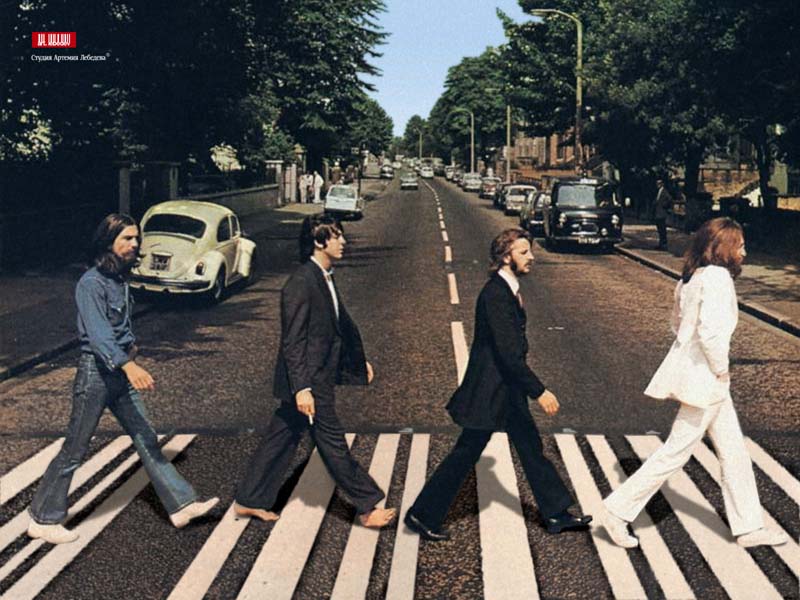
Crossing the street…or CROSSING THE LINE?!?!
Dear Paul, Ringo, John and The Other Guy,
I was driving my children to swimming lessons yesterday and your song “All You Need Is Love” came on the radio. I had never really listened to the words in this song, but as a concerned parent, I decided to try to listen to the words that my children were hearing. What I heard was truly shocking! I find the message in this song to be deeply troubling and, as a concerned parent, I beg you to do what you can to stop radio stations from playing this song.
I’m sure that you thought that you were just writing another silly love song and, I mean, what’s wrong with that? But, if you really think about the message in the song, I think you’ll come to understand why it disturbed me so much. Imagine for a second, that an impressionable child heard this song and took it seriously. Clearly, human beings need a good deal more than love to survive. They need food, shelter, clothes (preferably from a decent designer), and air. What if an impressionable child heard this song and decided to stop eating completely? His concerned parents would beg him to eat but he would not. What if, as he widdled away to the size of a twig, slowly starving to death and his concerned parents, now grief-stricken, asked him why he was doing this and he replied “Because the Beatles told me all I need is love”? Could you live with your selves?
What if, even worse, he just decided to stop breathing? He could die within a moment or two giving the concerned parents only a few seconds to react. What if his friends saw him stop breathing and thought that it was the “cool” thing to do? What if hundreds, thousands of children stopped breathing just to not be “square”? It could be an epidemic of epidemic proportions! Children, falling over dead in classrooms across America, with the words “All You Need Is Love” passing though their blue lips as they meet their maker. Is that what you want?
Music has a major effect on the ideas of young people. Do you know what Jeffrey Dahmer, Adolf Hitler, and Ted Bundy have in common? As young men, they all listened to music. And look what suffering they caused!
I demand that you stop allowing this song to be played on radio stations everywhere. I also ask that you never fill our children’s souls with such blasphemous, anti-social ideas by playing this live. Until you agree to stop this madness, I and a group of like-minded concerned parents, plan to boycott love. We will not express love in words or actions. We even plan on starting all tennis games at 15 so that no person ever has love.
Yours truly,
A Concerned Parent
The New, New Thing
Posted in Uncategorized on December 26, 2010
 Call it too much time on my hands. Call it a blogging addiction. Whatever. I have come to realize that there are some pretty amazing blogs out there. Within about a three-month period I have managed to subscribe to 2/3s of the blogs in the known universe. What I am quickly learning is that there are a great number of amazing, unique, powerful voices on the net. Great writers who have wit and wisdom and commit regularly to sharing that with the world. I’ve got a lot of respect and reverence for that. I’ve decided a way I can contribute to making the world a more interesting place is to do my part to help get these great blogs into more people’s hands. So, I have developed a second blog that will be known as “Spanning the Whirled”. I will try to update this site regularly with cool blogs I have run into along with a brief description of what I find intriguing about them. . I will still be doing my thing over here at “Tyranny”, but I will be posting up there a lot as well. Check it out if you are looking for some new voices or ideas or if you just have a half an hour to kill or if you accidently get stuck in your Y2K shelter with Internet access and 5 days worth of canned food.
Here’s the link…http://spanningthewhirled.wordpress.com/
Theoidiocity
Posted in Existential Rambings on December 25, 2010

Can you really trust a guy with hair like this?
Gottfried Wilhelm Leibniz is a fool. That’s the only explanation for theodicy, the inane, laughable idea that he came up with to rationally prove that his version of God was real and all-powerful. Leibniz, for those of you who have lives and don’t spend your afternoons reading philosophical nonsense, came up with the idea that our world must be “the best of all possible worlds”. I believe that his “best of all possible worlds” hypothesis is in a category by itself in the pantheon of truly moronic thoughts.
If I had to argue what the dumbest idea in history is, this is my vote. Now, I’m sure some of you have an crazy uncles who have theories that link vampires and global warming or think that the phone company had John F Kennedy killed, but I am speaking of ideas that have been taken seriously by a good number of people. Leibniz was and is a highly respected thinker. As a matter of fact, he is one of the most significant and respected minds of his era. They named a cookie after him in Germany for God sakes.
Granted, many great philosophers have had dumb ideas. Descartes had some pretty blockheaded ones and he was certainly no slouch. The guy ran around dissecting corpses because he believed that the soul was physically located somewhere inside of their skulls. God’s very own set of rabbit ears, I guess.
Leibniz, however, took intellectual goofiness to new heights. Voltaire used the better part of his book Candide ridiculing Leibniz by portraying him as the doltish Dr. Pangloss. No matter what horrible bit of suffering affected his view that “all is for the best in this best of all worlds”. Voltaire clearly and succinctly put this idea out of its misery, but for an idea this horrendous, there are simply not enough nails for the coffin.
Leibniz begins this monstrous theory with the idea that God is perfect. This is a completely unprovable assumption. How would Leibniz know if God is perfect? Has he seen another world that God has created and compared the two? Has he evaluated each an every atom in the universe and found no mistakes? Who is he to even think he can judge the work of the creator of the universe? How does he even know for certain if there is a God?
If Leibniz wants to say that he has faith that this is true, that’s fine with me. He can have any spiritual belief he wants. But that is not what he’s saying. He’s trying to make the assertion that his belief can be rationally proven. He gets no leeway here because he’s trying to smuggle his spiritual beliefs into the world of rationality.
Just so we can get to the silliness that comes next, let’s take him at his word about the God being perfect thing. This perfect God had a choice of every possible universe. He looked at each, evaluated it and came up with the perfect one. Why you ask? Because he’s perfect and is incapable of choosing a less than perfect world. If he’s perfect and has the choice of any possible universe, what makes Leibniz so certain he would choose the perfect one? Leibniz is making the mistake of trying to assume what the thinking of a perfect being would be. Again, how would Leibniz know what God would choose? Maybe God wanted to experiment to see what an imperfect world would look like if it played out for a few hundred thousand years. Maybe God just picked at random. I don’t know what happened and neither does Leibniz.
So, he’s 0 for 2 so far with two strikeouts, but he isn’t going to stop there. Now, he’s going to take his perfectly unprovable God who picked this unproveably perfect universe and pull the proverbial rug out from under him. See…cuz…this perfect being, right, he only had a choice of lots of imperfect worlds and he chose the best one he could find.
So basically, God, the perfect being, is unable to go shopping at say, Macy’s, and instead has to pick potential universes out of the 9-dollar pile at TJ Maxx. He couldn’t pick a universe where people lived forever and there was no suffering, no perception of suffering, no cancer, no starvation, no bubonic plague, an infinite amount of space, resources and joy. All of those were out of stock or on back order. He had a choice between lots of different universes that happened to have all sorts of design flaws. No new Mercedes for you, God! Its either the 1998 used Saturn with no working radio or heat or the 1975 light blue Pinto with the flaming engine.
Leibniz rests a highly questionable conclusion on top of a mountain of conjecture. Does Leibniz mean to say that God should get credit for the good things in the universe but bare no responsibility for the bad? If you only have control of some facets of the universe, then how can you be called omnipotent? You could drive an 18-wheel cement truck through the holes in this argument and still have room for the University of Michigan football team and the cast of a Robert Altman film.
The only thing that Leibniz’ argument actually proves is that Leibniz believes in God. I have no call to hassle the man if he simply wants to make the point that he doesn’t know why, he just believes in God. I have a good deal of respect for people of faith, because they are able to believe in something they can’t exactly explain but feel deeply. An argument for the existence of God based on belief or faith can be a powerful and beautiful thing. Arguing for God based on quasi-rational statements that are filled with highly speculative “proof” is at best slightly insane and at worst highly disingenuous.
Sympathy for Il Divo
Posted in Mr. Spillett's Academy Of Film Study For The Mentally Tormented on December 20, 2010
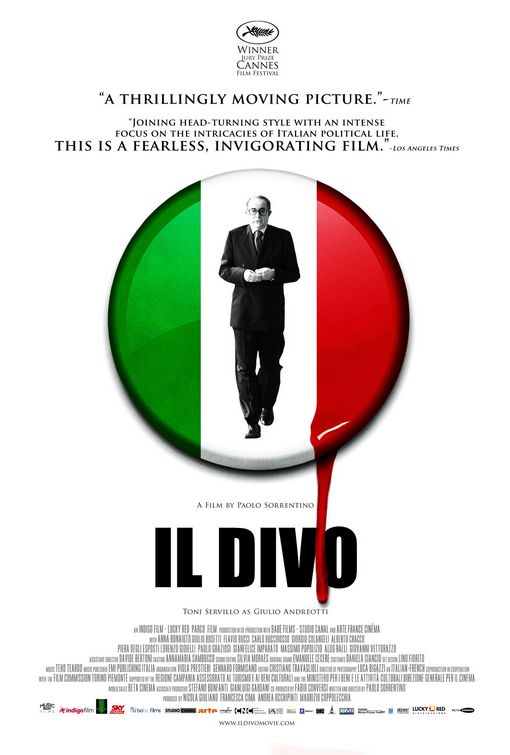
Official Movie Poster
Paolo Sorrentino‘s 2008 film Il Divo might well be the best movie about politics I have ever seen. After reading a great write-up of the film in Dr. Matthew Ashton’s Political Blog and seeing the Roger Ebert‘s it’s “Nixon meets the Godfather” blurb I knew this was one I had to get my hands on. The minute the opening credits flashed on my computer screen I was hooked. The film, quite literally, takes you by the throat and never lets go. It is the story of Guilio Andreotti, Italy’s seven-time Prime Minister, might be the most polarizing Italian politician since Benito Mussolini. Andreotti has earned more nicknames than Apollo Creed and is known as everything from “The Hunchback”, to “Beelzebub”, to “The Divine Julius”, to “The Black Pope”. Andreotti, who once said, “aside from the Punic Wars, which I was too young for, I have been blamed for everything,” has long been alleged to have significant Mafia ties and has been linked to all forms of malfeasance up to and including assassinations. He has the Clintonian ability to survive every political disaster and emerge with his fingernails firmly lodged in the cliff of political power. Andreotti is a walking advertisement for the ability of an intelligent but thoroughly unprincipled politician to overcome all obstacles in his quest for continued political power.
Il Divo is two hours of mind-blowing scene after mind-blowing scene. Sorrentino has a style that borrows heavily from some of the great masters of the craft, yet he manages to take those ideas in a unique and bold new direction. The film starts with a startling opening sequence, a modern, bass-driven update of the baptism scene from The Godfather. It is followed soon after by a slow motion introduction to Andreotti’s gang that feels like something out of a Leone Western. Then, there is the drum laden post victory celebration dance number featuring one of the most awe-inspiring tracking shots since Kalatazov’s pool scene in “I Am Cuba“. And all that is just in the first twenty minutes. Watching this film is like wandering through the Louvre; everywhere you look there is another classic moment of artistic expression.
About two-thirds of the way through the film, there is an absolutely jaw-dropping soliloquy where Andreotti (played to perfection by Toni Servillo) explains his internal contradictions and motivations. This two-minute section is the film’s crowning achievement. The short speech is an appalling vision of what it means to wield power. It is a statement of pure, unbridled cynicism. In it, Andreotti seems to justify every possible act of iniquity that he has committed as being in the public interest. What is really horrifying about this scene is how convincing his words are. Is the price of power the complete betrayal of all human values? Is this what a person must do to rule? Andreotti’s charisma almost makes you believe that anything is justified in the name of power.
Another element that contributes to the majestic feel of this film is the pulsing, resounding soundtrack. The film’s composer, Teho Teardo, provides one of the most compelling scores in recent memory. He seems to have a preternatural ability to frame the tone and character of a moment with blasts of inspired auditory brilliance. If Sorrentino’s camera is the film’s heart and soul, Teardo’s music is the blood that pumps through its veins.
Il Divo succeeds both as a sprawling masterpiece of epic dimension and a simple allegory of human frailty and weakness. The film never allows you to hate Andreotti but instead presents him as an acutely flawed leader with a deteriorated moral compass that seems to always point south. Sorrentino allows the audience to see Andreotti as not only a powerful man, but also a prisoner of his own power. It is a horrible cage he lives in and we are its bars.
Buggin’ Out: The Paranoid Style in American Motel Rooms
Posted in Existential Rambings, Mr. Spillett's Academy Of Film Study For The Mentally Tormented on December 15, 2010
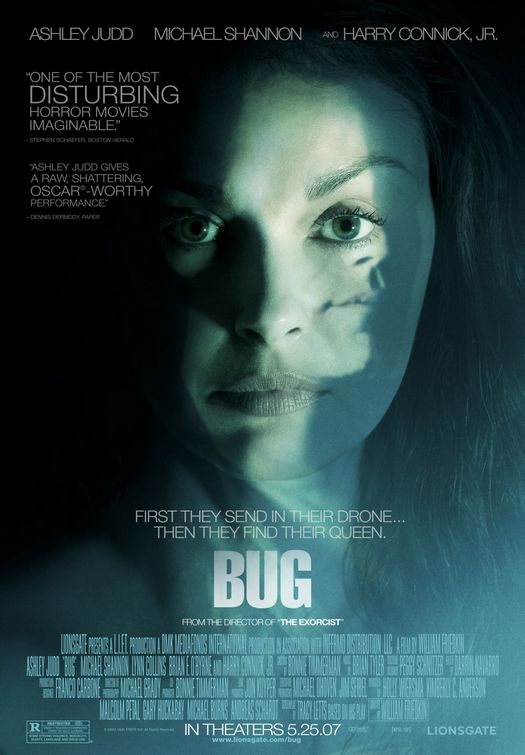
Few films capture the spirit of modern American paranoia better than William Friedkin‘s 2006 film “Bug“. It is a bleak, disturbing picture of two people consumed by sadness and connected through a shared feeling of conspiratorial persecution. Peter Evans (Michael Shannon) is a drifter who wanders into the life of Agnes White (Ashley Judd). They quickly find themselves embroiled in one of the more unhealthy relationships in recent film history. Agnes has barely survived a horrifically abusive marriage and the kidnapping of her young son. Peter has just finished a stretch some sort of shadowy psychiatric hospital where, depending on who you believe, he was either a severely disturbed escaped patient or a survivor of a series of Operation MK-Ultra meets The Manchurian Candidate type experiments. Together, they become the proverbial Bogey and Bacall of the Black Helicopter set. It would be easy to dismiss their ideas as the demented imaginings of two troubled people, but the narrative they construct about the meaning of lives and their relationship to the world is a powerful statement about modern mass hysteria.
Peter gets the paranoia party started by insisting that a mysterious THEY have put bugs in his blood. He is deeply committed to this idea, to the point of yanking some of his own teeth out in order to remove the egg sacs that are in his mouth. Quickly, things spiral out of control. They cover the walls of the room in tin foil, buy up half the bug zappers in Oklahoma and embark on a wild spree of shared psychosis and Dionysian self destruction that eventually annihilates them. The logic that gets them to this point is nothing short of amazing. They come to believe that everything that is happening to them is somehow connected to a greater plan. Peter connects his own experience to sixty years of back room schemes created by a mysterious unnamed cabal bent on completely enslaving the entire human race. In an amazing monologue, Peter manages to link the bugs he believes to be carrying to The People’s Temple in Jonestown, the Bilderberg Group and their secret meetings from 1954 until the present and even Timothy McVeigh (who was apparently the other lab rat who was given these bugs). Agnes soon links her own experiences to his and comes to realize that her abusive ex-husband and missing child are also products of the exact same treachery. It is the “everything happens for a reason” philosophy writ larger than life. All of these random, non-intersecting parts mean something. Each person’s life is a giant puzzle where all the pieces fit. It’s just a matter of collecting them all together and putting them in the correct places and then it will all make sense. This is the sort of thinking that Kurt Vonnegut lays bare in his book “The Sirens of Titan“. In that book, the entire arc of human history has been measured and calibrated in order create a replacement part for an alien space ship which will one day have the important task of placing a “greeting” message on a far away planet. We all have a purpose and that purpose happens to be completely absurd.
“Bug” takes this theme and runs wild with it. The characters have created meaning for their lives out of a mess of half-baked theories. Peter and Agnes really believe that this crazy composite of events was created for them. They see themselves as the protagonists of human history. They don’t simply pick one story as their narrative; they pick every single one that they have ever heard. The world really does revolve around them.
As I was watching this film I began to wonder if this was an accurate portrayal of the condition of the paranoia that exists in the minds of most Americans? Since I have never been in the minds of most Americans, I am not really able to say for sure. However, things are getting pretty weird out here in the real world and I have to wonder whether some of this isn’t the product of the same ideas that drove Peter and Agnes into mental oblivion. After all, there are a good number of people who will tell you that our President was born in Kenya, the National Security Council masterminded the 9/11 attacks, or the Federal Reserve killed John F. Kennedy. I’m not really interested in debating the validity of the ideas, I personally don’t believe them, but if you do that is really fine with me. I have a few pretty bizarre ideas about human history myself. What I find interesting about these theories is that how they illustrate the Woodward and Bernstein fantasy that some people are living. We are the investigators of some great cosmic puzzle whose pieces are scattered willy-nilly through a series of cultural and political markers. We are Sherlock Holmes turning our collective magnifying glass on everything. Media events are not things unto themselves; they are clues that connect us all to a larger picture.
Marshall McLuhan argued in his book “Understanding Media: The Extensions of Man” that modern technology had “extended our central nervous system itself in a global embrace”. In “Bug”, Peter and Agnes disappear as individuals and instead try to take on the narrative of the human race as their new identity. McLuhan saw this loss of identity as a dangerous thing. He ominously noted that “the loss of individual and personal meaning via the electronic media ensures a corresponding and reciprocal violence from those so deprived of their identities; for violence, whether spiritual or physical, is a quest for identity and the meaningful” (Canadian Forum, 1976) This quote is “Bug” in a nutshell. Two beings entirely destroyed (first as individuals, next as physical beings) by the electric connection to the rest of the world. If violence is a necessary and eventual component of this search for identity then maybe we do have a great deal to be paranoid of.
In Defense of Stupidity
Posted in Blithering Sports Fan Prattle, Totally Useless Information on December 11, 2010

Luke Scott Casually Discussing John Doe Number 2 and the role of the Lizardpeople in creating the Federal Reserve (borrowed from http://i393.photobucket.com/albums/pp13/cammielc)
A popular expression that tends to get used when people make asinine comments to a member of the media is “What were you thinking?” It is a common retort used to illustrate when someone has said something so utterly without merit that the reporter doesn’t feel the urge to mount a counter reply. Recently, Luke Scott, a muscle-headed, mouth-breathing Baltimore Oriole baseball player, who clearly cut many a history class in order to spend an additional hour in his school’s Chik Fil-A sponsored batting cage, made some monumentally dumb off the cuff remark about Barack Obama not being an American citizen. This sort of remark has faded a bit from its mid-2009 health care hysteria peak, but you still hear the occasional Manchurian candidate nonsense rearing its jingoistic head. I don’t expect Luke Scott to say anything worth listening to. What passes for discourse between athletes and reporters is the general ever flowing stream of “I’m going to go out there and do the best I can and, God willing, my teammates and I will get a win” type truisms that are taught to these folks in six hour cram session classes run by slime bucket agents who are looking to make their commodities more marketable to the slab of the American public that loves to hear the same thing over and over again.
I really could care less what Luke Scott has to say. What annoyed me was the glib, dismissive way that Yahoo writer Steve Henson rejected his remark in his recent free agency winners and losers column. Obviously Steve, we know what he was thinking. He was very clear about that in his statement. He was thinking that Obama was born in another country and, therefore, is an “illegitimate” President. The question seems to not be geared to mock what he was thinking, but his inability to know that when a reporter is around it is your job as an athlete to spout nothing but inoffensive, meaningless, Hallmark card style platitudes. Henson was really asking, “How could he not know that saying this would make him look ignorant? Doesn’t he know that it is his station in life to carry on this endless tradition of banal player interviews that we so love and revere? Why didn’t he just say something like “Obama will be fine if he gives this whole being born in the United States thing 110 percent”?
One of the unnamed right of passage exams that an athlete goes through on the way to householdnamedom is the “Can you say absolutely nothing of substance every time you are within 50 feet of a microphone” test. This is why listening to most athletes being interviewed is a highly painful endeavor. It’s as if the interviewer and the player a conspiring to cover up any human characteristics the athlete could possibly have. Occasionally, we are treated to colorful dimwits like Charles Barkley or Curt Schilling who say embarrassing “what the average guy is thinking” sorts of things, but mostly it’s just more of the “It was my childhood dream” sort of garbage. The Barkley/Schilling type stuff is awful for other reasons, but at least when I listen to it I know that their is a human being in there instead of a piece of equipment that runs a 4.3 40.
There is an upside to athletes feeling they have the ability to express themselves with some degree of freedom. For one, I now know that Luke Scott, once only known to me as the guy I might pick instead of Edwin Encarnacion in the 14th round of my AL keeper league draft, is a raving lunatic. Luke Scott has gone from 27 homeruns and 72 RBIs to a real human with definable features. I can like him or dislike him based on his ideas. Maybe there are a few Bill “Spaceman” Lee, Dock Ellis or Jim Bouton types who really have something unique to say. There is a real loss sports fans experience when athletes do not speak their minds. It is the loss of the chance to meet these players as human beings with real ideas and emotions. The ideas they have may be shameful, obnoxious, or ill informed but they remind us that we are living in a world of humans who feel, think and dream just like we do.

