Posts Tagged United States
Chapter One-Rebirth
Posted by Keith Spillett in The Resurrection of Michael Jackson on November 1, 2011

Photograph By Libertina Grimm
Being dead wasn’t what he expected it to be. By the end of what had become his life, he was completely overwhelmed and inundated with all of the venomous scorn that The Great American Hate Machine could produce. He had become a walking nightmare. A cautionary tale. The punch line of every inarticulate joke told by the stumbling rabble that thought that he belonged to them. Because he was wealthy, because he was famous, because he was different, they felt they had the right to turn him into something less than human. He used to pull the strings, but at some point, he lost control. He became property of those who despised him the most. He loved the fame and the attention, but he never asked for the hate. They buried him under it. So, he died.
Two and a half years after his death, he stood alone in the living room of a small bungalow on a beach somewhere in the South Pacific. He was one of the few residents of one of those rare and unique places where even the most popular celebrity in the world could be ignored. Where he was, no one cared about his identity. It helped that the massive plastic surgery he had undergone made him look remarkably like the man he was in the late 1980s.
Science was a gift to Michael. It allowed him to be whoever he wanted to be. What he had once used to remake himself into the greatest attraction on earth now made him the world’s most famous stranger. At first, he reveled in the anonymity. Conversations with people who didn’t want to ask him about his baby hanging over a balcony or Bubbles the chimp or the Elephant Man’s bones or the latest Trial of the Century. Conversations about the sunset. Conversations about the weather. What is least available to us is often what becomes what is most prized. And to him, it was normalcy.
The routines of existence were, at first, poetry to him. He awoke at 7 AM and took a walk on the beach. He got home and fed his chickens. He read extensively. He listened to the beautiful sounds of Sam Cooke and Jackie Wilson howling away on his record player. He closed his eyes and sat peacefully in the sun. He needed no sleeping pills or locked doors to create a brief and artificial quiet. Real quiet was everywhere he looked. Real harmony, at last.
For the first year, it was like heaven on earth. About halfway through Year Two of his life as a dead man, a strange feeling began to well up in him. It was a longing for something that he could not name. Something was unsettling about his life. He was far from lonely. He had made friends with a few of the locals and was able to contact the ones that were closest to him. He wasn’t exactly bored. There was much to do, even in his idleness. He missed the music.
One morning he caught himself signing along to Sam Cooke’s “A Change Is Gonna Come”. It occurred to him that he had not sung in what felt like an eternity. By the end of the song, he was so moved he felt himself begin to weep. He had forgotten what the music could make him feel when it came out of his body.
A steady need began to develop…the need to share this great gift that was given to him with others. He remembered that night on stage in Japan where he looked into that woman’s eyes and had seen the most pure love that had ever existed. To know that his voice, his music, could create that love in a person was something beyond words. He missed that feeling, that connection. When he was onstage and his voice exploded out of his slight frame and filled the theater with orgiastic light it was a feeling that transcended anything that he believed possible.
As he looked deeply into the endless horizon, he began to understand what he had to do. Sometimes, the whole of a person’s being changes in an instant and there is simply no going back. He purposefully walked to his bedroom closet. Above his clothes on a white wire shelf was an oak box. He took the box down from its perch and laid it on the nightstand.
A cold feeling gripped him. Nerves? Fear? He opened the box. There, staring back at him with quiet intent was his white glove. The white glove. The glove had come to symbolize everything he loved about his old life. It was glamor, it was beauty, it was ecstasy, it was uniqueness, it was innocence, it was joy….all together in one perfect icon.
He picked the glove up and slipped it on to his right hand. He stared silently at it for what seemed like an eternity. The sheer magnitude of the instant radiated hope and inspiration as brightly as it had ever shone for him. He had reclaimed himself. In this moment, he had been reborn.

Photograph By Libertina Grimm
Five Zombies In Search of A McRib
Posted by Keith Spillett in Existential Rambings on October 27, 2011

The Nexus of the Crisis and The Origin of Swarms
They were banging wildly at the windows. Bloody, barbeque sauce stained hands clutching at whatever they could grab. We had kept them at bay by throwing of the store’s stock of McRibs through the drive-thru window into the parking lot. The horde of undead monsters gobbled them up, consuming them in a grotesque span of seconds. In their fiendish delirium, they could no longer tell the difference between human life and a dollar ninety-nine cent sandwich (2.99 in some markets). The five of us were about to become a very unhappy meal.
There was Janet, the waitress, Addams, the cop, McBain, the lawyer with great hair, and The Doctor. They had gone through their lives secretly wondering when their hour would finally come round. They never would have believed they would perish terribly, mistaken for a limited time sandwich. I had dressed well, anticipating teaching an excellent day of thought provoking history classes. Instead, I was going to be eaten by zombies at my local neighborhood McDonald’s.
Janet: We should feed them something else.
Addams: We should not feed them, it will just encourage them.
McBain: We should reason with them.
Me: We should run.
Doctor: I’m a doctor.
Janet: We should scare them.
Addams: We should shoot them.
McBain: We should trick them.
Me: We should hide.
Doctor: I’m a doctor.
Janet: We should climb out through the air conditioning ducts.
Addams: We should set off an explosion in the parking lot.
McBain: We should wait for the army to save us.
Me: We should help them.
Doctor: I’m a doctor!
(Banging on the windows is growing louder)
Janet: We should feed them the cop.
Addams: We should feed them the lawyer.
McBain: We should feed them the poor.
Me: We should try to understand them.
Doctor: I’m a Doctor!
Janet: We should fight them with our mop handles.
Addams: We should make an example of one of them and scare the others.
McBain: We should poison the McRibs, then feed them to the zombies.
Me: We should educate them.
Doctor: I am a….Doctor!!!!!
(More zombies pounding on the windows. The zombie moaning is becoming intolerable)
Janet: We should protest their actions.
Addams: We should show no fear.
McBain: We should see if we can pay them to go away.
Me: We should build them houses.
Doctor: I……AM…..A…..DOCTOR!!!!!!
Janet: We should raise their taxes!
Addams: We should use our weapons!
McBain: We should offer them a simplified tax code that does not punish job creators!
Me: We should offer them adequate dental care!!!!
Doctor: I am a doctor…I am a doctor….I am a doctor! I’m a Doctor!!!
(The glass in the main window begins to crack. Zombies swarm towards opening with horrific glee.)
Janet: We should pray with them.
Addams: We should pray for them.
McBain: We should pray for ourselves.
Me: We should love them.
Doctor: I am a doctor????
(The window shatters and the zombies pour through)
Janet: This can’t happen; I’m too young.
Addams: This can’t happen; I have a family.
McBain: This can’t happen; this is America
Me: This can’t happen; we’ve acted honorably.
Doctor: This can’t happen; I’m a doctor.
The zombies attack and overwhelm us. Lots of gore and guts and gizzards and grossness. You’ve seen this movie before or at least one like it. Just make up your own ending. Mine is…They all die. Alone.
A Confessional Review of David Mamet’s Homicide
Posted by Keith Spillett in Pointyheaded Highbrow Stuff on October 19, 2011

“A Grandma is at the shore in Florida with her little Grandson. The grandson is playing on the beach when a big wave comes and washes the kid out to sea. The lifeguards swim out, bring him back to the shore, the paramedics work on him for a long time, pumping the water out, reviving him. They turn to the Grandma and say, “We saved your grandson!” The Grandma says, “He had a hat!””
-Henny Youngman
Bobby Gold was born to die a thousand slow deaths. His is the pain of a man without a country. Homicide is his confession. The confession of the man that can never be whole. He is the first through the door, the last to leave the gym. His mistakes must be rationalized or his coat of armor will become tin foil. He has an answer to every question even before you ask it, because he cannot afford to show an ounce of skin. He must convince them of his worth. He must be more than human or else they will see him. Then, they will know.
Bobby Gold, set to wander the desert into eternity. He must be exceptional or he is lost. He is the map of human misery. Bobby the Nomad. Every time he finds a river he drinks a mouthful of sand. He knows that you see him and he thinks you won’t let him forget it.
His is the story of the self-made man. What becomes of the self-made man when he stops creating? What if he gets tired? What if hasn’t the strength to work at the rate to which he has become accustomed? No one will catch him if his arms and legs cramp up. He knows this as surely as he knows how much time it will take him to get there 15 minutes early.
He looks around at people and instead sees the ocean. The ocean is still and never needs anything more than what is given. The ocean is a mystery to him. Who built it? How does it hide its shame? In his hands are a set of tools from which he must construct himself. From nothing. From the ground up. He must explain himself over and over. He recoils, overwhelmed by the fear that they’ll recognize the sadness in him. He explains and explains and explains never making the point that is so obvious to anyone who takes a moment to look. And he hopes his explanations will blind them to the truth. And he hopes they’ll see him and forgive his existence.
He looks enviously at those who have never had to work a day in their life to exist. Some people just wake up and “are”. He must invent. He must create. All of his actions reek of existential survival. Bobby is a reminder of how fast a man must run to not fall down. The faster he runs, the closer the oblivion he gets. It is gaining on him, always.
Bobby Gold, never to know the stillness and quiet of a dreamless sleep. Haunted by his visions of wholeness. Mocked by his own creations and talents. Bobby hears with a third ear. He is haunted by the stumbling footsteps of those who do not belong. The flesh on his neck stands at attention when he is near them. He doesn’t need files and he doesn’t need a map. He knows the look. He is blessed with the curse of understanding. As like is drawn to like, as “a dog goes back to its own vomit”, as pain seeks out pain. He is them and they are he. Outcasts. Alone in a crowded universe.
Bobby Gold, born to see what people pray to have the strength to ignore. Bobby the Outcast. Bobby the Obscure. Bobby the Stranger Among Strangers. Bobby the Donkey. Capable of so much, but unable to hide the absurdity of his being. Imploring the world to see him for what he does and not what he is. Doomed by the pain of the man who can never be more than he can build.
Califivenia Dreaming
Posted by Keith Spillett in Totally Useless Information, Uncategorized on October 16, 2011
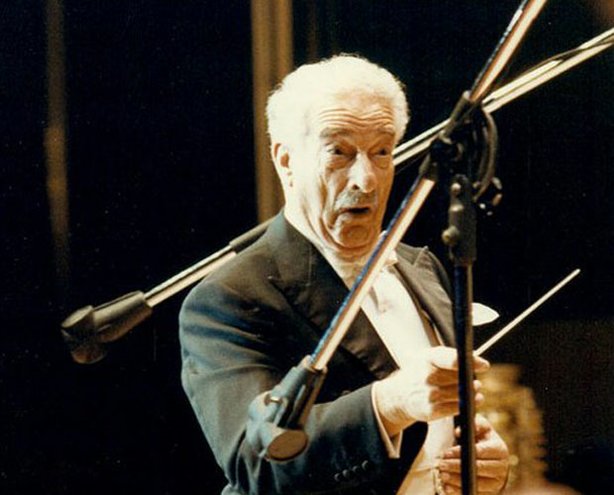
The Clown Prince of Denmark....A Grenine Dane
One of the great comedy bits ever concocted is Victor Borge’s famed “inflationary language” sketch. Borge, the brilliant Danish pianist and comedian, devised a way of inflating the value of each word that has a number in it by taking the number and adding one. Thus, the constitution becomes the constitthreesion, lieutenant becomes lieuelevenant, tulips become threelips and on and on. Utterly hysterical.
While Borge’s idea is a comedic masterpiece, I wonder if he didn’t happen to luck into a fantastic way of creating a more precise version of the English language. We live in a world where hyperbole is commonplace. Both a grilled cheese sandwich and a beautiful, once in a lifetime sunset can both be referred to as “wonderful”. The listener is left to determine from context clues and body language which wonderful is more wonderful. But, these bits of evidence can be misleading and in a text-based situation like the internet, one can easily miss the difference between the commonplace “wonderful” and the nearly spiritual “wonderful”.
Borge has unwittingly given us a solution. Numbers combined with language can help us find a more precise answer to the deeper meaning of many words. So, the excellent grilled cheese that you consumed for lunch can be “threetaful” or two points better than wonderful. The sunset which brought tears to your eyes is much more likely “tentaful”, a full nine points better than the original. In this way, once can clearly discern the differences between a great sandwich and a magnificent experience of nature’s wonder (or tender in this case).
Think of all the miscommunications this could clear up. If someone produces a really quality work of art it could be called a great “creatention”, a true masterpiece would be much more along the lines of a “creafifteention” and the best piece of art you’ve ever come across might well be a “creathirtytion” or even a “creainfinitytion”. Think of how much additional joy your neighbors will feel during the holidays when you complement them on their “sixtaful decortwelvetions”
It could work in either direction, too. Let’s say you meet someone you have a serious romantic interest in and make an offer to become better acquainted. There is no ambiguity in that person telling you, “No, I don’t want to go over your house and negativeonenicate.” In that case, it’s clear she’s not being coy and any sort of future inquiries should be made elsewhere.
In literature, there are serious possibilities as well. A writer could be given the gift of being able to explain complex circumstances in one word. A character with a ridiculously pronounced area between his eyebrows and his hairline could simply be described as a person with an “eighthead”. A character maimed by a poorly performed birth ritual could be quickly noted as someone with a problem with his “twoskin”. A character who is overly honest could be referred to as being “seventhright”. No fuss, no muss. Think of the efficiency.
Five us four fully understand each other it is a greytwelve skill six learn. When we creaeighteen a more precise language much of the twentytion that arises from miscommunications will be mitigtened. Face it, our current language is assafive.
Here’s Borge’s original bit…..
Five Fantastic Facts About Donkeys
Posted by Keith Spillett in General Weirdness on October 6, 2011
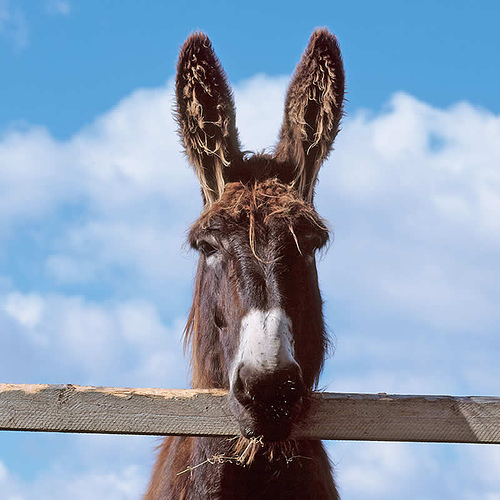
Recently, I have developed a bizarre fascination with donkeys. They are odd-looking creatures with funny ears that make terrifyingly amusing noises. What’s not to love? I have spent the last few months of my life reading extensively about donkeys and have discovered several incredible, mind-boggling facts that I’d like to share with you so maybe you can find the same feeling of joy and love that I feel when I see one walking down the street.
1. DONKEYS HAVE 14 STOMACHS!!!!
That’s right! Your average donkey is able to consume 40 pounds of carrots in less than an hour thanks to all of these wondrous organs. A donkey can also generate additional stomachs throughout their lifetime. A donkey in Uzbekistan is the current worlds record holder with a reported 59 stomachs. How about that!?!?!
2. DONKEYS CAN LIVE FOR UP TO 3,000 YEARS!!!!!
Not only are donkeys loveable, but they are durable as well. The donkey that belonged to Plato, affectionately known as Rufus, is still with us today. Donkeys are able to regenerate any cells that die within a span of minutes. Nessie, the world’s oldest donkey, just had her 3,357th birthday. Back in the 1960s, the U.S. Army experimented by dropping 500 donkeys out of an airplane at 30,000 feet into occupied Czechoslovakia. Only one was slightly injured. The rest were healthy and immediately able to produce milk for American soldiers who were bravely battling the Germans in World War II.
3. DONKEYS ARE DESCENDED FROM LIONS AND HORSES!!!
Sure, lions and horses seem like a strange match, but hey, love is a many splendored thing! If you mate these two beasts you will produce a donkey. As crazy as it sounds, lion ranchers in New Zealand have been mating these two types of animals for the past 20 years. As a result, the donkey population has tripled. And as you well know, more donkeys mean more happiness for everyone!
4. DONKEYS CAN GROW TO THE SIZE OF ELEPHANTS!!!!
It’s true! When properly fed a balanced diet of oatmeal cookies and orange sherbet, donkeys can grow to the size of full-grown elephants. This can mean serious trouble for those who keep donkeys as house pets. Sure, tiny baby donkeys can be cute, but a full-grown mammoth jack donkey can grow to the amazing height of 160 hands (53 feet tall). An angry mammoth jack donkey can go on a rampage and destroy an entire village causing massive damage and severe injuries. So BE CAREFUL!
5. SIXTY FIVE PERCENT OF DONKEYS ARE ACTUALLY ROBOTS!!!!
It’s sure hard to tell the difference between a robot donkey and a real one. Here’s a tip, if your donkey starts going wild during a lightning storm, it’s probably a robot. If your donkey gets a cut and begins leaking oil, it’s probably a robot as well. Robot donkeys were first built during The Great Donkey Shortage of 1927 and have been with us ever since. They are just as friendly and good-natured as donkeys, but often have additional fun options like the ability to blend smoothies in their mouths. If owning a regular donkey seems financially out of reach, you just might want to consider picking up one of these wonderful mechanical creatures at your local Wal-Mart or certified Robot Donkey outlet.
6. DONKEYS CAN TELL TIME!!!!
Ever notice how a donkey sleeps at night and runs around playfully during the daytime? Can you guess why? It is a known fact among donkeyologists that these wonderful beasts can roughly tell what time of day it is based on whether the sun is out or not. They sure are smart!
7. ONE IN EVERY TWENTY DONKEYS ARE BORN WITH THE ABILITY TO SING!!!!
They are known for that ridiculous braying noise they make, but did you know that 1 in every 20 donkeys, if properly trained, can become remarkable singers. These special donkeys are born with unique vocal chords that allow the donkeys voice to create beautiful melodies. The Turkmen Donkey Choir, a group of talented donkeys from Turkmenistan who travel around singing old Rogers and Hammerstein show tunes, have performed to packed houses around the world and even had an audience with the Pope! Recently, a first in donkey musical history took place when a jenny named Roberta starred in the 2007 Metropolitan Opera performance of Turandot. She received rave reviews and a bouquet of carrots from the audience. Oh what a night!
8. SHERBET IS MADE FROM DONKEY BONES!!!!
Next time you are settling down after a hard day of work to a heaping bowl of everybody’s favorite delicious treat, remember to thank a donkey. If it weren’t for the Kraft Corporations decision back in 1953 to mix vanilla ice cream, ginger and donkey bones, sherbet would never have been discovered. Sherbet, once only believed to be a wonderful dessert, has recently been used successfully in medical trails for the treatment of Exploding Head Syndrome. So, not only do donkeys make people happy, they might just save some lives.
Dissecting CARCASS’ “Heartwork” – Fifth Incision…Embodiment
Posted by Keith Spillett in Notes on Carcass Heartwork on September 30, 2011
This is the fifth in a series of articles analyzing the lyrics from the 1993 Carcass album “Heartwork”.

Embodiment
I bow down your precious icon, deity of self-suppression
This effigy of flesh, corporeal christi, nailed
In submission to this false idol, seeking deliverance
From this spiritual hierarchy, downward spiraling, a corrupt throne
Of repression and guilt
Our will be done
Thy kingdom burn
On my knees, before this tormented flesh, in irreverence
In communion with this parasitic host of virtuous divinity
This imperious creed bears testament to the failures of our morality
Righteous durance is our cross we bear in stations
In stations of the lost
Our will be done
Thy kingdom burn – thy kingdom burn
Our will be done
From your knees arise
By your own hand, your god you scribe
The earth shall inherit the meek
Your god is dead
Bound down, in God we’re trussed, foul stature
Icons embodied in flesh, we nail
In servitude to deities fashioned in our self image
Shadows of eternal strife cast by those who serve
Serve a crown of pawns
If up until this point you weren’t sure how the band Carcass feels about religion, Embodiment states it completely and in no uncertain terms. The song is an outright renunciation of organized religion, Christianity in particular. The lyrics bubble with hatred and scorn for the self-annihilating principles that they believe mark the Christian outlook. I don’t share the disdain that the band feels for Christianity, but the force of the language used in their argument is highly compelling.
The song’s central argument is that Christianity is an advanced form of slavery. They make the case by dismissing the existence of any fathomable God and assuming that the goals of religion are to allow those who are in power to continue an unfettered hegemony over the practice of free will. Where some people see peace and comfort, Carcass perceives control and subjugation. Certainly, some of their argument is legitimate. There are plenty of historical examples of the misuse of religion to advance the selfish ends of a tyrannical elite. However, the song fails to address much of the comfort and solace that it has brought people for over 2000 years. Further, it would be facile minded to simply assume that the self-abnegation at the core of Christian thought is completely a bad thing. The giving up of one’s desires to benefit the community is on many occasions, inside or outside of a religious context, beneficial towards the human race as a whole.
In spite of the problems the argument presents, the language with which the case is made is striking. The core belief in the song is contained in the beautifully efficient and devastating pun “In God we’re trussed”. By taking an expression found on American money and perverting its message, Carcass is able to make several critical points. First, the use of a religious phrase in an economic context effectively links the agenda of today’s Christianity with the pursuit of financial gain. Then, they take the phrase and change trust (an act of faith) into trussed (to be tightly bound or in this case completely controlled). Essentially, they argue here that while you may choose to subvert your needs for the Church it will not extend you the same courtesy and, worse, it will take your belief and use it to hoodwink you into giving up your possessions and your liberty. In their eyes, it is the greatest hustle in human history.
What is truly lost for believers is contained in the heart-wrenching expression “the earth shall inherit the meek.” The original phrase “the meek shall inherit the earth” is an appeal to the Job-like masses that give so tirelessly but ask for little in return. They suffer in silence, but at the end of the day, they will be rewarded…or so the story goes. The good and humble people will come to control the earth and the wicked will be cast from it. The subversion of this expression contains allows for a very troubling message to be presented. If you suffer in silence and do the right thing your reward will be the grave. Death awaits us all and those who are pious and righteous are rewarded with the same eternal darkness that await those who pillage the world blind. There are no rewards in this life or any other for those who follow the words contained in the Bible. The meek will be buried right alongside those who engage in a Dionysian life of personal excess and unabated greed. The ground cannot tell the two apart.
If this argument is legitimate, it presents us with chilling questions about how we should live our lives that goes beyond religion. If there are truly no consequences for our actions, why not do whatever we want? Those with the most material, at the end of the day, are those who have benefitted most from a purely material world. If all that is promised to us for a good life is an eventual death, what is the motivation in living a justly?
I believe that the truth or untruth of God’s existence need not bear on whether someone acts morally. If every word of the Bible is true and God’s existence is exactly as portrayed in Christianity, we should act with as much kindness, patience and love to those around us as we are capable. If every word of the Bible is false and Christianity is an unholy scam perpetrated by on the masses by ruthless power mongers, we should act with as much kindness, patience and love to those around us as we are capable. The reward of living a just life is simply getting to live a just life. That’s all. The earth may inherit the meek, but at least the meek can lessen the suffering of those around them. Nothing else is promised and nothing else is certain. TS Eliot eloquently summarizes this principle in his poem “Choruses From The Rock”…..
All men are ready to invest their money
But most expect dividends
I say to you: Make perfect your will.
I say: take no thought of the harvest,
But only of proper sowing
It is our station to care for one another to the best of our abilities regardless what the truth of the universe is. To love without condition is the greatest gift we could bestow on our world no matter what the terms of our existence are. Any philosophy that brings us closer to that ability, be it religious or atheistic, is worthy of our respect and consideration.
Morgan Freeman Slated To Play King Diamond In New Film
Posted by Keith Spillett in General Weirdness on September 25, 2011

Freeman Outside of a Mercyful Fate Concert In 2001
In what some critics are calling the role of a lifetime, Oscar winning actor Morgan Freeman has been selected to play King Diamond in the forthcoming biopic “King For a Day, King For A Lifetime”. Paramount Pictures, looking to capitalize on his most recent American tour, expect to put the film out by October 2015.
The script was penned in less than two days by the reanimated corpse of Charles Dickens, who The King himself brought back from the dead in a Satanic ritual last week. Executives at Paramount were so impressed with the script that they have agreed to spend 100 million on the project and release it in 3-D.
Freeman was far from the only actor who was interested in the role. Actor and speed-addled lunatic James Woods campaigned hard for the role by dressing as King Diamond and robbing several banks in the Los Angeles metropolitan area. Actor Sir Lawrence Olivier was originally offered the part, but was unable get a visa to leave Purgatory for the four months of filming that would be required to complete the picture.
Creating a script for The King’s life was a challenge considering he is 879 years old and has lived through most of recorded history. Distilling that much time into a 2-hour film was a challenge, but Dickens was able to pull it off. The film will focus on his music career, his survival during The Spanish Inquisition, and his extraordinary battle with Satan for control of Hell back in 1964 after an argument over the fate of singer Trini Lopez.
Freeman, a major King Diamond fan who has each of the King’s solo records mounted on the walls of his Fresno, California home, has always dreamed of playing King Diamond in a film. He has seen The King 247 times in concert as a solo act and 423 times with Mercyful Fate. He even managed to catch The King with Black Rose once at a small bar in England in the 1970s.

In several interviews, Freeman has cited one of his proudest moments as the time he came out on stage at a show in Dallas back in 1998 and sang “Come To The Sabbath” with The King.
According to Freeman, his portrayal of the character of God in the 2003 film Bruce Almighty was based loosely on King Diamond. “For me, The King has been the greatest source of inspiration I have ever known,” said a misty eyed Freeman in an interview with CNN last week, “With The King, all things are possible.”
I Am A King Diamond’s Disease Survivor
Posted by Keith Spillett in General Weirdness, King Diamond For President in 2012 on September 13, 2011

A Picture of Me Getting Ready To Go To My Daughter's Piano Recital
Have you ever found yourself singing the chorus from a King Diamond song at an inappropriate time like in church or at a funeral? Do you ever wake up with your face covered with strange painted designs without knowing how they got there? Do you ever find yourself having bizarre urges, like making furniture out of the leg bone of your neighbor? If you answered yes to any of these questions, you may be one of the nearly 2 million Americans who suffer from King Diamond’s disease. You are not alone.
King Diamond’s Disease, known to doctors as Bendixitis, claims nearly a thousand new victims a week. You may see many of these poor souls on the streets, covered in backwards crosses, wandering aimlessly while singing the falsetto chorus to Abigail. They often struggle to maintain normal lives. They are your doctors, your teachers, your lawyers and your children’s crossing guards. I know their pain, because, you see, I am one of them.
My story isn’t different from most KDD survivors. It started innocently enough. I’d be in the car on my way to pick up the children from their Tae-Bo class and catch myself howling “Sleeeeeeeplesssss Niiiiiiiightssss” for no reason in particular. I’d find myself thinking about the King more and more each day. When I was eating dinner, I wondered what The King might be eating. When picking out clothing at a shopping mall, my mind would drift to what The King might think about the sweater I was trying on.
Then, one day, I woke up for a critical job interview for the position of Chief Tagalog Translator at The United Nations. As I was putting the finishing touches on my outfit, I looked in the mirror and staring back at me was a 6 foot 2 stranger in a suit and tie with his face painted just like King Diamond on the Conspiracy album. I know that I hadn’t painted it myself! The paint would not wash off no matter what I tried. Imagine my pain and sadness, sitting in the most important job interview in my entire life, knowing that no employer in their right mind would hire a guy who showed up for a job interview dressed like a demented ghoul. They laughed at me. “Don’t call us, we’ll call you,” they sneered. They simply didn’t understand.
The face paint has never come off. It’s been three years now. I’m still unemployed, although I had a brief part time job as a greeter at Wal-Mart until I was fired for supposedly causing the store to be attacked by evil spirits. My children try their best to understand, but when the other kids make fun of them because their daddy is dressed up for Halloween everyday it hurts their feelings. The community has shunned me. I stopped going to church because they kept dousing me with holy water. Everywhere I go I am an outcast.
There is no known cure for King Diamond’s Disease. A diet low in orange sherbet can lessen many of the symptoms, but Bendixitis is a lifetime ailment that will never leave you once you have it. I have found strength in my support group Survivors of An Unmercyful Fate. We meet once a week and discuss how to live life one day at a time. I have met a lot of great people in the Atlanta area who suffer like me including my sponsor Joann, a kindergarten teacher who has lived with King Diamond’s disease since she saw the King on The Spider’s Lullabye Tour back in 1995. Her strength in going through her day trying to teach the alphabet to screaming, crying, terrified children is an inspiration to us all.
With research and time, a cure might be found. Until that day comes, I will wear my face paint proudly knowing that my “disorder” allows me to have something in common with the greatest vocalist ever to walk the earth. But still, I long for a day when I can walk down the street without old women cringing and middle aged men asking me to sing them a song about my grandmother.
A Time To Forget
Posted by Keith Spillett in Existential Rambings on September 11, 2011

When something terrible, something truly unforgivable occurs, we often look to the language for comfort. One readymade expression that is used to comfort us in times of genuine despair and confusion is “Never Forget”. This expression has become a part of our post-9/11 mourning process. The idea behind it is that if we don’t forget the horrors of that terrible day it will have some meaning for us. Then, maybe we can use those feelings of pain and grief in order to achieve some balance in the world. We can right the wrongs of that day, on some level, through an act of national collective memory.
As comforting as that idea may be, I wonder if it really has achieved what we’ve wanted from it. It has been 10 years since that day and few have forgotten. The test of an idea is its manifestation in the world we live in. Has clinging to the memory of 9/11 made the world a better place? Have we used our memories to heal the wounds of that day? Some would believe that we have. I do not. I look out into a world where we are mired in two of the longest wars in U.S. history, into a world consumed by turmoil, into a world where chaos and strife are commonplace, into a world where we have seemingly lost all faith in the systems that have been created to help us, into a world where the center surely has not held. We have remembered, but our memory has served us poorly.
Al-Queda has been weakened significantly. If that was the goal of not forgetting, then we can argue it has been effective. But, was that all we wanted? Was disrupting the actions of a small, but vicious terrorist group all we were hoping for after that terrible day? I believe that America saw the terror of that day and wanted desperately to be part of a world where that sort of thing could not happen again, not just here, but anywhere. For a brief and fleeting moment, we stood together. Ten years later, we are a deeply polarized nation, extended far beyond our means, spiraling from one catastrophe to the next without much hope for a better world. Ten years later, we may be safer from Al-Qaeda, but as a whole, our world is an unmitigated disaster.
There is no clear consensus on what 9/11 actually meant. Some people believe that its meaning is that we need to use all means at our disposal to crush anything that resembles a threat, some people have taken the message that we should curb our military adventurism, some people have taken the message that all Muslims are evil, some have taken the message that the world should come together in spite of religious and racial differences. It is even become relatively acceptable to question whether the U.S. government itself was complicit in the horrors of that day. We all remember, but our memories have led us to a very different place.
I’m going to suggest a radically different approach to how to cope with the anniversary of 9/11. It will probably be viewed in some circles as highly disrespectful, but I assure you that no disrespect is intended. I believe that the central lesson of 9/11 is that terrible things happen to innocent people for no reason whatsoever. It is an unjust world where some things can never be explained or properly understood. Life is filled with random and capricious acts of horror that take place everyday. Our responsibility is to lessen the suffering of the living, not to compensate for the horrors inflicted upon the dead. We have remembered, but we have not healed, we have not grown and we have not made a better world for our children. For those who lost loved ones, it will be impossible to forget that day, but for the rest of us it is time to move on. We cannot create a better world from our past, but we have a greater obligation to create a better future from the world around us today.
We have lived in the looming shadows of those buildings for ten years. Maybe it is time to forget. Not from a place of ignorance or disinterest, but from a need to build a healthier, safer world. Instead of remembering the violence of the past, we can renounce the use of violence in the present. Instead of thinking of the paradise that was lost to us, we can build a new, more beautiful world out of the tools of compassion and empathy. The past is over and that day can never be changed. The present and the future extend before us filled with promise and possibility. We have cried, we have mourned, we have prayed, and we have paid our debts to the dead. It is time to move on.
GOP Frontrunner Perry: “King Diamond is Too Moderate For America”
Posted by Keith Spillett in King Diamond For President in 2012 on August 30, 2011
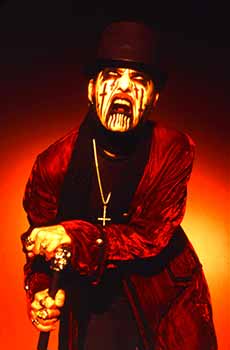
Too Moderate For America???
In the hopes of stemming the growing tide of voters supporting King Diamond for President, Republican frontrunner Rick Perry lashed out at The King’s campaign which he claimed is “well outside of the mainstream in American politics.” In a speech given by Perry at the home of noted abortion clinic bomber Jack Marcus, Perry went on a full scale five minute offensive against Diamond in an attempt to show that he does not represent the values of today’s Republican Party. “Where are the irresponsible proposals for tax cuts for the wealthy? Where are the preposterous accusations of President Obama’s link to The Communist Party? Where are the crazed threats of violence against Third World Countries? Do you realize King Diamond has been on the campaign trail for less than three weeks and he has yet to accuse an Islamic charity group with having ties to Al-Qaeda? I had been in the race less than a week when I threatened to beat up the Head of The Federal Reserve Board! King Diamond is clearly too moderate for the Republican Party and definitely too moderate for America,” shouted a wild-eyed Perry in front of 200 cheering, drooling Perry for President staffers.

Perry Campaigning In Cedar Rapids
Perry is not the only candidate who has attacked King Diamond in recent days. Former Massachusetts Governor Mitt Romney hammered The King for “sounding like a girl when he sings”. Romney went on to accuse King Diamond of plagiarizing the entire Abigail album, which Romney claims he himself wrote in his Geometry notebook while a high school student in the 1960s. Romney even went so far as to question The King’s metal credentials. “I’m much more of a metalhead than King Diamond,” exclaimed Romney in front of the only guy who came to see his speech last night in Des Moines, “I have every Venom album on vinyl, while King Diamond only has them all on CD. I ask you…Who is more metal? Me or The So-Called King.”
Michelle Bachmann chimed in yesterday claiming “King Diamond is God’s punishment on America for the sin of collecting taxes.” Ron Paul accused The King of “actually being a secret agent of The Lizard People and The Cult of The Illuminati.” Some guy named Jon Huntsman who claimed to be a Republican Presidential candidate also said some nasty stuff about King Diamond, but no one in the press bothered to write it down or record it.
Much of this negative campaigning reflects a belief that the Republicans have a chance to win the election in November if they can just turn the American public into a frightened mass of well-armed lunatics. This strategy has worked well so far against President Barack Obama. In a recent CNN/Gallup Poll, 65 percent of Americans claimed they would “vote for a seal who knew how to balance a ball on its nose before they’d reelect Obama”. In a Rasmussen Poll taken last week, it was revealed that 82 percent of Republicans feared that if they voted for Obama a plague would immediately descend upon the land and rabid dogs would eat their children. However, in both polls however, Obama still leads Perry by around 4 percent.
King Diamond has remained silent so far about the attacks although he has mentioned to several sources inside his campaign that “he looks forward to playing beach volleyball with Michelle Bachmann’s head”. He also joked with a reporter about Rick Perry’s intense persona saying “everybody’s a tough guy when they have Secret Service protection. He wouldn’t last 5 seconds in The Pit. He couldn’t beat up my grandmother.” The King has a tough week of campaigning ahead, including a major, make-or-break policy speech in front of the influential “Satanists For Christ” National Convention in Davenport this Friday. His ability to attract evangelical voters is seen as the key to him winning the all-important Iowa caucus in January.
 The Tyranny of Tradition