Archive for April, 2012
Deathtöngue Honored By Imaginary Rock & Roll Hall of Fame
Posted by Carrie Patrick in General Weirdness on April 9, 2012

Bill The Cat (Frontman and Lead Tongue)
Metal fans are rejoicing today as one of the most iconic fictional bands of the 1980s, Deathtöngue, is finally inducted into the Imaginary Rock & Roll Hall of Fame. As pioneers of imaginary metal, Deathtöngue had a lasting influence on non-reality-based musical history.
Based in Bloom County, USA, the band’s lineup featured Bill The Cat on lead tongue, Opus The Penguin on electric tuba, and that guy whose name we can never remember but we think he might have been a woodchuck or a beaver or something. Band manager Steve Dallas wrote most of their music, which included the hit singles “Snail Snot From Satan,” “Demon Drooler of the Sewer,” “Leper Lover,” and “Let’s Run Over Lionel Ritchie With A Tank.” Never afraid of controversy, the band famously one-upped Ozzy Osbourne when, live on stage, Bill The Cat bit the head off a roadie.
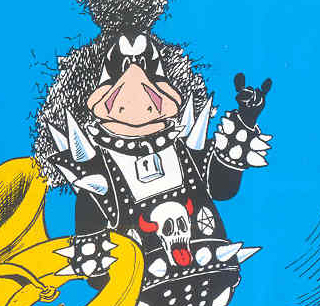
Opus (Electric Tuba)
Deathtöngue’s innovative tongue-based sound was never successfully imitated by any other group. “They really paved the way for a lot of modern imaginary metal,” says imaginary fan Mike Wilson, of East Armpit, Alabama. “When you talk about imaginary metal in the ’80s, most people think of the well-known groups like Spinal Tap or Wyld Stallyns, but Deathtöngue was right up there too. Today, we just wouldn’t have ugly obnoxious jerks such as William Murderface [bassist for imaginary metal superstars Dethklok] if Bill The Cat hadn’t been there 25 years before, showering audiences with spittle, hate, and incoherent songs about pus-filled pimples.”
The band broke up in the late ’80s, reformed briefly as Billy And The Boingers, and broke up again after a downward spiral of self-destructive behavior from its tongue player that included reading the Bible and experimenting with politics and televangelism. Attempts to contact any surviving members of the band were unsuccessful.

Steve Dallas (Lawyer, Manager, Songwriter)
The Imaginary Rock & Roll Hall of Fame was built in 2009 to recognize the significant impact of imaginary music on modern society.
“No other single genre has had such a major effect,” said Hall of Fame spokesman Rufus. “In fact, a recent survey of well-known musicians showed that in 100% of cases, their very first musical experiences were in that genre. Whether we’re talking about Eric Clapton’s early performances on a tennis racket while jumping on his bed at the age of seven, or Dave Lombardo shrieking randomly while beating the sides of his highchair with a half-eaten hot dog, all had one thing in common: solid early training in pretending to be the best freakin’ musician ever.”
Rufus said there were numerous challenges in creating the Hall of Fame. “In many cases, because of the imaginary nature of the music, we do not have actual recordings that can be shown to the public,” he said. “But we find that most visitors understand these constraints. One of our most popular recent exhibits was a retrospective of the supergroup Blast Radius, formed in Wales in 1997 by 13-year-old Joey Thomas. As we all know, Blast Radius featured Yngwie Malmsteen, Eddie Van Halen and Randy Rhoads on guitars, Keith Moon on drums, Chewbacca from Star Wars on bass, Rob Halford as backup vocalist, and Joey Thomas himself as lead vocalist.”
“While there is no surviving audio or video of Blast Radius’s performances, we were able to display the band’s logo, which was drawn by Thomas in the margins of his geography homework. It was a tremendously successful exhibit, with all visitors saying they learned a lot about Blast Radius and agreed it was one of the best imaginary bands of all time, especially after Thomas departed the band and was replaced by themselves.”

It Turns Out His Name Was Hodge-Podge And He Was Obviously A Rabbit
The induction of Deathtöngue will be marked by a special exhibit that will include a bottle of Bill The Cat’s verminous cocaine-laced urine, some of Steve Dallas’s hair grease, and a tuba similar to the one played by Opus. All admission fees will be donated to a charity that provides spaceship-themed wheelchairs to disabled veterans.
“The board of trustees of the Imaginary Rock & Roll Hall of Fame extend their warmest congratulations to Deathtöngue on this most excellent occasion,” said Rufus. “As a proud Imaginary-American myself, I am happy to see our nation hosting the world’s greatest repository of music that doesn’t even exist in any meaningful way but would be awesome if it did.”
Guest reporter Carrie Patrick plays both real and imaginary guitar. On the latter instrument, she was recently voted Greatest And Best-Looking Player Of All Time for the 30th consecutive year, by a panel of international experts who live in her head.
On An Easter Egg Hunt With The Cancer Bats
Posted by Keith Spillett in Articles I Probably Shouldn't Have Bothered Writing on April 8, 2012

So there I was, participating in that most shameful American rituals, the Easter Egg Hunt. Swarms of children knocking each other over, screeching at the tops of their lungs in the desperate hopes of laying their greedy little mitts on as many plastic eggs as they possibly can. The whole exercise functions as a wonderful metaphor for American style consumer capitalism. A bunch of wild-eyed humans released upon an uneven field with the goal of filling their baskets with as much stuff as possible. Sure, everybody gets something, but those who are bigger, stronger, faster and, most importantly, start at the front of the line tend to get more. All the while, this being a function of one of the local mega-churches, crackpot religious explanations are given for nearly everything.
“You know who really put these eggs out here, son? Jesus Christ. See, he works through us. Remember that when you are eating those Skittles,” muttered a used car salesman looking church elder with game show host hair.

It was around that moment that I realized that if I didn’t put my headphones on immediately and listen to something angry I was going to tear my shirt off and run around howling like Lon Chaney. These were the exact conditions under which I came into contact with the new Cancer Bats album “Dead Set On Living”.
I should admit up front that this hardcore punk metal hybrid thing never really did much for me. Around the time Hatebreed and Converge were coming out I was busy trying to prove to the world that I was so metal that unless it came out in Europe, was from a band that had been around since Carter was President or had been approved by at least six members of the Central Committee that I couldn’t be bothered it. It is really a shame, because I missed some pretty intense music and probably would have been easier to be around had I been a tad more open-minded.
Listening to the driving groove of the opening track “R.A.T.S” while watching a husky five-year-old girl rip an egg out of the hands of some pigtailed three year old seemed particularly fitting. The whole scene was menacing. The tone of the album helped me imagine the children turning into brain-thirsty zombies. Somehow, instead of the eggs being filled with the sugar-laced, sunshine of God’s love, they were contaminated with some CIA tested drug that morphs children into predatory beasts.
The Cancer Bats singer Liam Cormier takes some getting used to. He’s of the high pitched death wail school, which usually makes me a bit edgy. It gets better as the album goes on, particularly because he offsets it from time to time with an almost David Lee Rothian snarl. The guitars are what really what grab you. They tend to create short, punchy, memorable riffs that carry you endlessly forward and flow from a nearly bottomless pit of energy. About three listens to this record are all you need to be thirsting for it every second of the day.
Meanwhile, the kids began to get this panicked look around the time they realized the eggs were nearly gone. Something like the expression they’ll have in twenty years when they are sitting in their car waiting to get gas for three hours. I cranked the music louder steeling myself for some sort of toddler riot. I knew I could handle a few of them, but if the whole group turned on me they’d tear me to ribbons. Finally, mercifully, the eggs had all been collected and the mob was redirected with little violence towards a sea of bouncy castles in the church parking lot.
The whole experience was perplexing for me. Here I was, surrounded by all that is supposedly good and right with the world. Except every bit of it felt dirty and degrading. The only thing that seemed remotely moral to me was the driving rhythm of the music in my headphones. I sunk into a moment of genuine despair as I realized that I might never be able to reconcile my values with those of my culture. Maybe I was an alien. Maybe I was simply wired wrong. Would I ever be able to understand how people could find joy in moments like this? Then, out of nowhere, my beautiful three-year-old daughter took my hand, looked at me and smiled. And everything was okay.
Lemmy Has Surgery To Remove Both Livers; Plays Concert That Night
Posted by Keith Spillett in General Weirdness on April 5, 2012

Lemmy On Stage Hours After Liver Removal Surgery
For most people, having one liver removed is a torturous affair that leaves them with months of painful recovery. Yesterday afternoon, Lemmy Kilmister became the first man to ever have both livers removed at the same time. The marathon 6-hour surgery was followed by a half hour of recovery, dinner at a local bar and a 2-hour set of classic Motorhead tunes at The Rock Center, a metal club in downtown Pocatello, Idaho.
Doctors advised Lemmy to take at least three months off from performing, but his commitment to playing heavy metal was too great to hold him back. “I didn’t want to let the fans in Idaho down. After all, what do they really have to live for beyond the occasional concert?” said Lemmy this morning during his 3-hour weightlifting session.
Lemmy is no stranger to overcoming medical emergencies and soldiering on. Everyone is, of course, familiar with the time that in 1983 in Antwerp, Belgium he was mauled on stage by 15 pit bulls and continued to play his bass in spite of missing 9 fingers.
Who could forget the time the Chinese government accidentally detonated a nuclear bomb at a test facility 1,000 meters away from a Motorhead concert in Shanghai in 1988? Everyone within a radius of 12 miles was killed except Lemmy, who went on to play the entire Orgasmatron album from beginning to end to an arena filled with annihilated corpses.
However, because of Lemmy’s advanced age, going on stage after a surgery of this type may be his greatest feat.

Doctors are baffled as to how a man who has done so much damage to his body continues to exist. There were rumors as recently as 2003 that he was killed and replaced by a Lemmy-like robot, but several doctors have done independent tests to prove that he is a human. There was also rampant speculation that Lemmy has regularly been shooting the DNA of famed Russian monk Rasputin directly into his arm in the hopes of becoming indestructible, but this also has not been confirmed.
Some researchers have reasoned that it is possible that consuming the amount of Jack Daniels that he has ingested over his lifetime has actually made his body impervious to harm of any kind. Regardless of what his secret is, it is very possible that Lemmy cannot be destroyed by traditional means and will live on well into the next millennium.
Agnostic Front’s Vinnie Stigma To Publish Children’s Book Called “I Thought You Were My Friend”
Posted by Keith Spillett in General Weirdness on April 4, 2012
 Vinnie Stigma has been many things in his long and intriguing life. The enigmatic guitar player from Agnostic Front has been an actor in the hit film New York Blood, a professional stunt car driver and even the Secretary of Agriculture in the state of Oklahoma for a short time in the 90s. However, few people expected his recent career change. Stigma has become a renowned children’s author.
“You know, I was thinkin’ about how stupid kids are today with all of the hugging and sharing nonsense they get in the schools. I want to rap them upside the head with a newspaper and say ‘What’s a matter with you?’ So, I wrote this book to help them not be so freakin’ dumb. Teach’em some stuff that could make them so they don’t get their skulls smashed in everyday and whatnot,” said Stigma on the steps of his Brooklyn townhouse.
The book, which is the story of five streetwise but cuddly rabbits from Coney Island, takes place on the seedy streets of New York after dark. The rabbits are drawn to a convention of animals that takes place in the Bronx where they discuss a truce between all the other animals in the city. However, after the wise fox named Cyrus who called the meeting is gunned down, the Rabbits are pursued by the other animals who believe they killed him.
Most of the story centers on their journey back to Coney Island and their battles with rival groups of animals for survival. The climax of the book is an all out fight between the rabbits and the rats out on Coney Island Beach. Reviewers are already excited about the book, comparing his work to early Dr. Seuss and Shel Silverstein.
“Stigma has written a beautiful parable for the ages,” remarked noted New York Times critic Dwight Garner, “he captures all of the magic and beauty that children experience when hitting another child in the head with a tire iron for the first time.”
James Wood, book reviewer for The New Yorker, was even more effusive in his praise.
“Young people today are just too soft,” wrote Wood, “this book teaches them important life skills like how to hotwire a car and how to make a Molotov cocktail. Things that our liberalized school systems have omitted from their curriculums in the name of political correctness.”
“I Thought You Were My Friend” is intended for children 3 to 7 and includes pop-up police snakes along with scratch and sniff sewers and subway cars. However, Stigma believes the book will resonate with everyone, from toddlers to adults.
“Wanting to beat and maim someone because they are in your way is a simple human characteristic,” said Stigma. “If adults don’t read this book, fine. I’ll go to their house, put my knee into their chest and read it to them. People need to understand that this book has an important and timeless message and if I have to give a beating to every single American to get the message across, that’s what I’m going to do.”
The Sound of Joyous Suffering: A Retrophiliac’s Review of Horisont’s “Second Assault”
Posted by Keith Spillett in Pointless Music Reviews on April 2, 2012

Listening to the new Horisont record “Second Assault” is an adventure in time travel. You don’t simply listen to the record, you hurdle backwards towards it. I am in a darkened, smoke-filled bar. Twenty or so spectators in different states of inebriation hoot and howl arhythmically as the band spews molten rock’n’roll. Half the crowd looks like Popeye Doyle, the other half look like Tuesday Weld. A poorly dressed, ratty haired bunch of skinny kids reach into their chests and pull out their guts in the quixotic attempt to find a higher plane if even for a moment. Their suffering is ours.
It’s an imperfect fantasy, mostly because of the smoke. That itchy, uncomfortable feeling of unfamiliar scum clouding your vision. Not knowing whether to choke or sneeze. Somehow it doesn’t matter and it does. Rock’n’roll itself comes with a bit of discomfort. Loving it is a masochistic pursuit. Horisont gets that in spades. They explode everywhere, like a wayward roman candle knocked on its side. They are dangerous, blistering and blood-fanged; they are the sweat in your eyes and the exhaustion of endless impossibility.
The 70’s reek of old carpet and cheap cologne. The food isn’t nearly as good, the beer is almost always flat and no one seems to have air conditioning. The world was a dark and foreboding place. Nearly every worthwhile movie of the era ended with the protagonist getting his or her head blown off and the great forces of evil crushing the spirit of the individual. Hope seemed ridiculous. As they marched to the hangman, they wore a gallows cool on their sleeve that those living in the airbrushed, cleaner than clean, hyper polished new frontier no nothing of. Horisont belongs there and not here. When I hit play, I am there with them.
Occasionally, I hear a record where song titles don’t matter to me. I don’t want to know what the tune is about, where it was recorded or who produced it. I could care less about the album art and knowing the town where the band started playing is simply an annoyance. I just want to hear the music. Again and again. When the album completes its long-winding journey to nowhere, I can think of nothing but finding the button that will make it start all over again. For me, Horisont “Second Assault” is that type of album.
Judas Priest To Join A Judas Priest Cover Band Or…A Judas Priest Of The Mind
Posted by Keith Spillett in Existential Rambings on April 2, 2012

In a move that has left many industry insiders scratching their heads, the remaining members of the band Judas Priest have left the band and joined a Judas Priest cover band called Nightcrawler. The band, whose members have agreed to step aside and instead handle Judas Priest’s touring responsibilities, have been a staple of the greater Villa Rica, Georgia metal scene for the past fifteen years. Rob Halford and the boys plan on taking over Nightcrawlers’ regular Sunday night gig at Joe Don’s House of Beer as well as occasionally traveling to Macon and Atlanta for gigs.
This began as another satire article, but I’m afraid it will not make it. Instead, I believe the philosophical dimensions of this story are far more interesting. Who are Judas Priest? A collection of specific musicians who play a certain number of songs they have written in the past. Maybe. Think of Priest like your body. If your body doesn’t have all of its limbs it is still your body. If Al Atkins or Rob Halford or KK Downing leave the band, they are still technically Judas Priest, as we have seen. While many fans would argue that the band changed greatly when Ripper Owens was the singer, you can’t really argue they weren’t Judas Priest. After all, they put out two albums under the name Judas Priest. You can go look on my mantle; they are filed under “J”.
Under what circumstances is Judas Priest not Judas Priest or, even more interestingly, under what circumstances would you no longer be you? Lets say all the members of Judas Priest left and another group of musicians came in and played the same songs, would that still be Priest? The band Yes has transitioned through new scores of new members at every instrument and they still are known as Yes (although their was some legal wrangling to determine whether that was true).
Similarly, if all of your limbs were removed, then all of your organs except for the brain, you’d still be you, right? In fact, no one would have a kidney removed and say “I’m no longer me anymore”. You might not even need stop at the brain. Take away the parts that control motor function and coordination and you are still you. Really, what you are is that small section of the brain that contains memories and the idea of who you are. You may argue that there is a soul, but until you show me one with a tag on it saying “Exhibit A”, I cannot enter it as evidence.
Back to our Judas Priest problem. If Judas Priest left, but became a Judas Priest cover band, I’d have a difficult time figuring out who the real Priest is, but I’d probably eventually settle on the idea that the band playing that the members of Judas Priest joined was the real Priest. After all, the audience might identify with the name Priest, but most people derive the identity of the band from their memories of what the band was and meant. The meaning is not solely attached to the name, but the collection of memories that follow the band and some of the identifying, tangible characteristics. However, if all the members left and started a mariachi band, that would not be Judas Priest. They need to be playing the same songs, doing the same stage show, etc. in order to still qualify as the real Priest. Some form of the identity must be the same.
Here’s where it gets tricky. If Judas Priest’s members didn’t leave the band and kept the name, but chose to all of a sudden play mariachi songs and change their stage show, they would still be Priest, just not if they left and did the same thing. Just like if you changed careers or got remarried or became a professional baseball player, you’d still be considered you. So, the name Judas Priest does have value in terms of an identity marker for fans, but it is not the only characteristic that makes up identity and, as we will see, it is not always necessary.
If your brain were pulled out and put into another body, let’s say Lemmy’s body, I believe the person who had Lemmy’s body would be you. Therefore, while people would call you Lemmy, you would still be you, just in Lemmy’s body. As noted philosopher Shelley Kagan once said when presented with a similar problem “follow the brain”. However, here’s where identity gets messy, most people would find it difficult to believe you if you were walking around in Lemmy’s body claiming to be you unless they knew about this brain transplant. They’d believe you were Lemmy, even if you knew things Lemmy couldn’t possibly know about you.
It is safe to claim that what you perceive to be you is far different than what others perceive to be you. Your internal identity does not match the identity the world has for you. Let’s say that for years, all the members of the band were gone and replaced with lookalikes. Unless you had some knowledge of this, you’d assume you were watching Judas Priest when you saw them in concert. In our example, however, the audience was made aware of the shift, so the identity of the band would stay with Halford and the guys. Had they not been and had the cover band from Villa Rica been convincing lookalikes, people would have been none the wiser.
The point is, we think we know what a band is, based on our memories and recollections, but really we only know our created image of the band. The difference between the internal perceptions of the band and the external ideas are miles apart. Our image of the band has some similarities to the views of others and a few similarities to how the band views itself, but for the most part there is no common relationship except for a few markers here and there.
This is also the great problem of personal identity. How are we meant to function in a world where we see ourselves as one thing, but the world sees us as something else? Sure, there are some meeting points, but overall we have no clue how they see us. We are left to play a perpetual guessing game where we will never find the answer.
Who are Judas Priest? I’m not really sure. I know I have my version, you have yours and they have theirs. The places where we meet are certainly Judas Priest, but the places where we don’t are also Judas Priest. We know enough to know and agree that the band that left Judas Priest in our story is Judas Priest, but we lack enough evidence to understand what Judas Priest is in its totality.
We filter Judas Priest through our own minds and have an image completely exclusive to us. Judas Priest is our Judas Priest, a Judas Priest of the mind. We are forever stuck trying to reconcile that image with the image of those around us and failing miserably at the task. Such is the lot of humans when searching for truth. Stuck looking at one tiny, infinitesimal section of the map while trying desperately to figure out where everything is.
 The Tyranny of Tradition