Keith Spillett

I have a lot of strange debris rattling around my mind that I need to work out in a useful way.
Homepage: https://tyrannyoftradition.wordpress.com
We Don’t Need Another Hero
Posted in Blithering Sports Fan Prattle on June 14, 2011
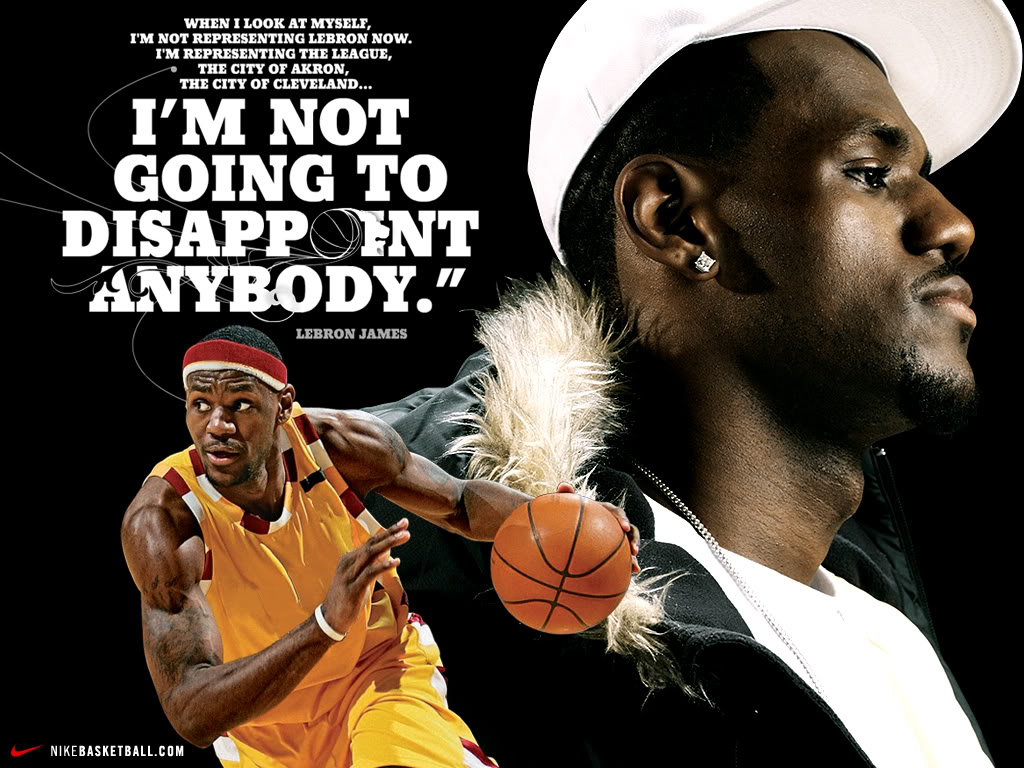
The LeBron Hate Machine has officially been cranked up to 10. Welcome to The Narrative, sir! Here’s how the next five years of your life are probably going to go. Most of the mob will hate you today, that is for certain. They’ll say you’re no Kobe, they’ll say you don’t have Nowitzki’s heart, they invoke the ever looming specter of MJ. They tell you you’ll never be as great as the ones that they remember. You’re not old school. You’re not committed enough. You’re arrogant. You called your own press conference. You left the folks in Cleveland high and dry. You think you are bigger than the game. You need to be taught a lesson.
This will go on for a little while. Then, you will win. The Narrative will shift. You’ve learned your lesson. You’ve been humbled. You went back to basics. You did things the right way. You overcame the odds. You have been redeemed. You are a champion.
Once you’ve seen the puppet show once or twice, the strings become remarkably annoying. We’ve done this dance so many times before. Remember when Kobe was an obnoxious, spoiled kid who didn’t know his place? Remember when Dirk was a soft-boiled choke artist? Heck, do you remember when Muhammad Ali was a dangerous, radical anti-American draft dodger? What did they do to rehabilitate their image? They won.
Redemption awaits anyone who can help his or her team score more points then the other team when the big spotlight is blaring. Redemption is a pretty easy formula. Time plus rings. Not exactly calculus. If you doubt the truth of what I’m saying, just watch the lovefest that is waiting just down the road if Tiger or Michael Vick get to the Promised Land. It makes you wonder what OJ could have done if he still had a good 40 time.
Maybe this time it will be different. LeBron has an opportunity to do something that has never been done. There is one trick left that they haven’t seen. They need to be introduced to the true Man in Flight. The Running Man. The person who finally takes the Narrative by the throat and squeezes. LeBron James can become the first Post-Rational Superstar.
At first, LeBron would have to follow some very well-travelled ground. He could start on the path that trailblazers like Dennis Rodman and Charles Barkley journeyed before him. He could become the zany, outspoken Bad Guy. The Heel. The difference between these guys and a Post-Rational Superstar is that they stopped there. They found their niche and they road it to the bank. What I am suggesting would be far more radical.
Next season LeBron starts the show by cursing at a few fans, hanging with some edgy celebs, coloring his hair blue, punching a reporter, whatever. Once the mob gets used to that, he flips the script. He becomes a highly pious, deeply caring man. Donates a year’s salary to charity. Gets photographed helping an old lady across the street. Donates a kidney. Whatever gets them to start loving him again. Then, when everyone is comfortable, he slams on the brakes! LeBron joins the Communist Party, starts quoting radical Islamic clerics, gets a backwards cross tattooed into his forehead, and becomes every red-blooded American sports fan’s worst nightmare.
Once there have been enough Bill O’Reilly interviews calling him a monster, he flips it again. Begs the forgiveness of the mob. Saves a child from a burning building. Donates the other kidney. Starts a mission in Peru that saves victims of toxic megacolon. Gets himself photographed with the Pope. Figures out a way to cut unemployment below 5 percent. Captures and kills an Al-Queda leader. Once they get comfortable with the New LeBron…..BAM! He joins the Church of Satan, projectile vomits on a referee and pour yaks blood over his head after each win. He keeps flipping and flipping and flipping until people want to get off the ride.
And here’s the best part, LeBron….No matter what you do, if you win, they will find it in their hearts to rationalize your actions. They don’t see you for your game or your stunning personality or your greed or your kind heart or your selfishness. They aren’t watching you at all; they are watching what you represent. Your biggest fans just love you because they want to be associated with your victories and your worst enemies just want to take some measure of credit for your defeat.
Turn the mirror on the mob. Let them see them see the carnival in all of its venal absurdity. Don’t let them rationalize you. Run The Narrative off of a cliff. When they say they’ve had enough, give them more. Make every icon equally worthless. Destroy any logical assumption that can be made about you or anyone who comes after you. Give them everything and nothing all at once. Confuse them to death. Leave nothing standing. The one thing a superstar can still provide the sports world with is an understanding of how insane its basic cultural assumptions and beliefs are. And the best part is, if you win, they’ll still love you.
Dissecting CARCASS’ “Heartwork” – Third Incision…No Love Lost
Posted in Notes on Carcass Heartwork on June 13, 2011
This is the third in a series of articles analyzing the lyrics from the 1993 Carcass album “Heartwork”.

No Love Lost
Sensual awakening
Numbing feelings dead
Conceptions romanticized
Synthesized broken hearts to bled
Without emotion your heartstrings played
Strummed and severed to the tune of a tragic serenade
[A tragic chorus]
Without emotion, your heartstrings break
Snapped and severed to the tune of a tragic, sad cliche
No love lost
When all is said and done
There’s no love lost
The low cost of loving
Amorous travesty
Human frailties and weakness are easy prey
How your poor heart will bleed
The modern conception of romantic love is nothing short of vulgar. I do not mean vulgar in the sense of it being lewd or lascivious, but more so remarkably crass and repulsively commercialized. One of the more humiliating acts that exist in our culture is that of picking out a card for a loved ones birthday. The well-intentioned shopper is immediately met with all forms of syrupy sweet, ersatz garbage that pass for a genuine expression of feeling. Being told “I love you” Hallmark style is the equivalent of having some dude in a lime green leisure suit approach you and tell you that we should get rid of all the letters in the way so that “U and I can get together.” Love can seem like an ill-concieved, ham-handed con with all the charm of one of those insidious pop-ups that try to convince the barely sentient of the rich rewards that will be showered on them if only they surrender their credit card number. It is not hard to understand the disgust that would motivate Jeff Walker to write the words in “No Love Lost”.
While I am in complete agreement with the notion that love has been trivialized, I can’t climb on board with the idea that there is no such thing as love. The following admission is probably going to get my universal skeptic license suspended for the next six months, but, in all honesty, love is the one con I simply cannot renounce. I want to believe that there is a category of human experience that transcends our own personal needs and allows us, even momentarily, to exist for another. I want to think that there is more to life than survival and that we have a deeper need for connection to other humans. There must be more than just dumb, barely animate material wandering aimlessly from cradle to grave. I believe that many people share an essential longing to understand each other, to see their neighbors as beings dealing with the same existential dilemmas as themselves, struggling to find some compassion or empathy and aspiring to give that gift to another even though nothing tells them they have to. The best approximation of these feelings and desires is the word love.
Maybe this understanding reflects the cynicism expressed in “No Love Lost”. Imagine desperately wanting to feel the connection to others and being given back nothing but Hugh Grant movies and power ballads. Trying to come to terms with love in our contemporary carnival of cheap thrills and easy answers is a demoralizing task. If I am ever to really conceptualize what love means my expression of it will be minimized by the fact that the language I have to communicate it has been co-opted by a bunch of soft-sell dream peddlers who are more concerned about appealing to a demographic representation of males 25-34 than finding deeper human truths. Why not look at the Love Industry with scorn? After all, it has robbed us of our full means to relate something significant and meaningful to the world. Instead of filling us with a feeling of awe and reverence, the word fills so many seekers of reality with bitterness and irritation.
Maybe the real demonstration of the transcendent power of love is whether it can overcome the cesspool of a market in which it now resides. Occasionally there are human truths that possess so much power that they can surmount any obstacle set before them. That’s what I’d like to believe, anyway. For us to believe that love is real maybe we need to see that it can be debased in every way imaginable and still carry meaning. Or maybe those who sell it have uncovered the terrible truth; that love is simply an inducement to get the suckers to buy more of what they don’t need. Give them the fantasy of love and they’ll gladly exchange it for safety, freedom and power over their own lives. I desperately hope that this isn’t so.
(This series is being co-published by the folks over at MindOverMetal.org. Check’em out!)
There Is No There There
Posted in The Poetry of Death on June 9, 2011

“Infinity pleased our parents, one inch looks good to us.” –ee cummings
The worst kept secret about America is that it is horribly boring up close. Terribly boring. Horrendously boring. Catastrophically boring. Worse than could ever be described justly in words.
Jack Kerouac had some ideas about how being on the road is an amazingly illuminating experience that cleanses the soul of stagnation. He saw magic around ever corner. The country Kerouac was looking at had about as much to do with the modern day Ohio Turnpike as the surface of Mars does. What would Jack have made of the Wal-Mart truck that I’ve just watched next to us for the last two hundred miles? Or seeing 100 McDonalds parking lots in eight hours? Or having his 6-year-old daughter splash a Capri Sun on to his neck while trying to outrun a truck driver who watched Duel to many times? Or the Hampton Inn billboard that shows a family so overwhelmed by happiness over seeing their 89 dollar a night room that they look like they are spontaneously going into anaphylactic shock? The America that I have been driving though for the past three days would have made Neil Cassady jam a knitting needle through his forehead.
There are no metaphors that do it justice. Every year the family and I hop in The Misery Machine (our name for the fine piece of engineering that is our 2001 Ford Windstar van) and drive and drive and drive and drive until we reach Valhalla (or Minneapolis, which ever comes first). There was a time where travel promised unbridled joy and freedom to me. Now, it promises discomfort, mind-numbing boredom and bitter, gut-wrenching sameness.

Geologist James Hutton once described the Earth as having “no vestige of a beginning, no prospect of an end.” He could have been easily describing Northern Illinois or Southern Indiana or Western New Jersey. There is no America per se. There are stores, there are signs, there are cars. If you take away the accents, there isn’t much to distinguish Alabama from Pennsylvania. The seasoned traveler can tell where they are by when the Waffle Houses stop and the Perkinses begin. Otherwise, it is one endless slog of chain restaurants, rock quarries and churches stretching on without origin or conclusion.
When you done the Death March long enough you start to become enamored of the bizarre similarities. Every rest stop in the entire state of Ohio looks exactly like the next one, right down to the distance from the “throw a quarter in and see your weight machine and lottery numbers” machine to the pile of 7 dollar and 99 cent grinning stuffed animals. All showerheads at Holiday Inns are exactly alike. The identical picture of a sailboat in the sunset has been in every hotel room I’ve been in since I was 27. A Dairy Queen Oreo Blizzard in Tupelo, Mississippi is a Dairy Queen Oreo Blizzard in Flagstaff, Arizona. There are no surprises awaiting the weary traveler.

It’s not that I’m against standardization. I know I probably shouldn’t admit to this in writing, but I find it comforting to know that I can find certain products that I like everywhere I go. My blood is probably 15 percent Diet Pepsi.
I don’t really want to tear down the strip malls and replace them with workshops run by friendly, well-mannered artisans. I really don’t need every town to look like Asheville, North Carolina. Truth be told, the Stepford Zombie Nightmare that our nation has become is probably the only world in which I’d know how to navigate.
What I am finding about myself is that the part of me that was once capable of romanticizing the American Road has long since died. I am not capable of finding beauty in this. Not anymore. It’s not America’s fault that it is so menacingly ugly; it is mine. I cannot make this anymore than what it appears to be. There is no poetry on these roads. Not once you’ve been down them a few times.
83-Year-Old Ida Mae Thrasher Reviews In Solitude “The World, The Flesh, The Devil”
Posted in Articles I Probably Shouldn't Have Bothered Writing, General Weirdness on June 5, 2011
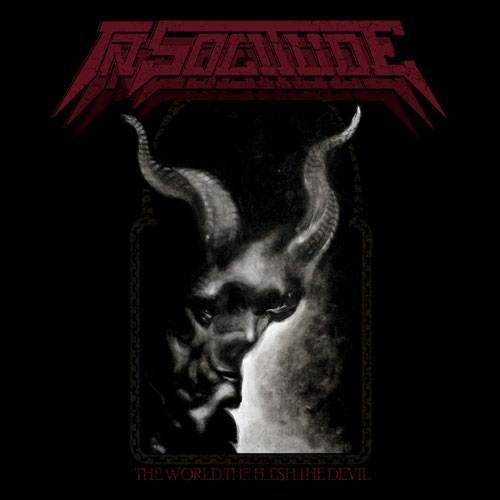 The new In Solitude album “The World. The Flesh. The Devil.” is simply remarkable. Since I first heard it, I have been on nearly a non-stop In Solitude binge. I’ve listened to it from beginning to end somewhere in the neighborhood of five times a day. Whether I’m vacuuming, making dinner, or putting all of my issues of Boys’ Life magazine in alphabetical order, the album has been my constant companion. I had a plan to review it, but I feel like I have lost all degree of journalistic objectivity. The only way to truly get a fair assessment of this album is to turn it over to a stranger and see what they think.
This was not a simple task. I live in the American South and, for the most part, strangers are to be feared. I spent all day Thursday walking around the North Dekalb Mall in Atlanta asking people to sit with me for an hour listen to the record and answer some questions but was refused over and over again. I even had a woman threaten to get her husband and have him “give me a beating”. Six hours of rejection and nothing to show for it. I needed a new plan.
Friday, I went to the park near the local Senior Center. I immediately descended on a seemingly good natured woman sitting on a park bench who looked like she needed company and, more importantly, seemed like she’d have difficulty getting away quickly. I spent 10 minutes talking to her about her life and her allergy to penicillin. Her name was Ida Mae Thrasher. It was too perfect! This had to be the one! I made the offer, but this time I had figured out how to seal the deal. I offered her a 50-dollar gift card to the local Rite Aid. All she had to do was listen to the album and answer my questions. She tentatively agreed to do it and I quickly slapped a pair of headphones on her.
Our conversation after listening to the album went like this:
Keith: Well…what did you think?
Ida Mae: It was…..ummmmmmmm…..it was good.
Keith: Good??? Okay. Can you be more specific?
Ida Mae: It was very good.
Keith: Ida, can you please give me something with a little more detail? I’m trying to write an article here.
Ida Mae: Well, I liked the first song.
Keith: If you want the gift card, you are going to have to give me something more to work with.
Ida Mae: Well, it was kind of….well….loud.
Keith: Do you mean the volume? I could have turned it down.
Ida Mae: No, it was just….you know….loud.
Keith: (sounding somewhat offended) Listen Ida, loud is a term that applies to volume. Loud is not a valid description. It tells me nothing. Tell me something about the amazing guitar solos, tell me something about the raw production style, tell me that you like the interplay between the drummer and bassist, tell me you appreciate that they have taken early 80s sounding British metal and put a fresh and unique spin on it. What the heck does “it was loud” tell me!?!?!?!
Ida Mae: (appearing nervous)It was fine.
Keith: Okay, maybe I need to be more specific. Did I remind you more of early Paul Di’Anno era Iron Maiden or Mercyful Fate?
Ida Mae: Yes.
Keith: WHICH IS IT?!?!?
Ida Mae: Both.
Keith: You are avoiding the question! I’m seriously starting to question your commitment to heavy metal!!!!!
Ida Mae: You said I’d get a gift card if I listened to the album and answered your questions. Well, I did both. Please give me my Rite Aid gift card and just leave me alone.
Keith: There is no gift card! Not for you. Not with answers like that. You just totally wasted my time.
Ida Mae: HELP!!! Someone get this maniac away from me!!!!!!!!! HELP!!!!!!!!!!
I had a lot of time to reflect on things while I was waiting for my wife to arrange bail. This experience taught me a lot. Some people just aren’t in a position to appreciate great music. I’m just going to have to live with the fact that the Ida Maes of the world will have to live their lives shrouded in a veil of musical ignorance. That doesn’t mean you have to. Buy as many copies as you can of “The World, The Flesh, The Devil”. Quit your job and do nothing but listen to it. Make your kids memorize the lyrics and if they don’t, refuse to let them watch television and send them to their rooms without dinner. It is really that good.
Check out Serpents Are Rising from “The World. The Flesh. The Devil.” here. The song is 160 percent amazing!
U.S. Supreme Court Bars Morbid Angel From Putting God-Awful “Radikult” Song On New Record
Posted in Articles I Probably Shouldn't Have Bothered Writing, General Weirdness on June 2, 2011

The Supreme Court today ruled 7 to 2 in a case forcing Morbid Angel to take that terrible Radikult song off of their soon-to-be-released Illud Divinum Insanus album. The record, whose title translates to ‘This Is Probably Going To Alienate Our Fanbase”, is anticipated to be one of the most significant releases in metal this year. The song has reportedly caused spontaneous vomiting and bleeding from the eardrums among its first listeners. In a majority decision, Chief Justice John Roberts wrote, “What the hell were they thinking? That’s gotta be the worst song I’ve ever heard. We have reason to fear for the health and sanity of anyone who hears it. I need to take a damned shower after hearing that thing.”
The case, People With Good Taste in Music Versus Morbid Angel (2011), is the first time the high court has ruled on a song that sucks. The Court decided to create a precedent in this case because they believed that Radikult was so miserably bad that it was their solemn duty to intercede. Roberts seemed to be appalled by everything about the song. “It starts off with the silly 80’s techno sounding drumbeat and you think they are going to break into a cover of Bell Biv Devoe’s ‘Poison’. Then, David Vincent starts saying ridiculous things that just don’t belong in a metal song or, really, anywhere else. When Vincent says ‘We’ve been crossing the line since 1989,’ I looked over at Justice Thomas and just started laughing. We could not believe it!” noted Roberts in the decision.
Several fellow Justices filed strong concurrences in support of the ruling. Justice Antonin Scalia’s began his with the words, “Free speech be damned! It is the right of listeners to not have to ever hear anything that bad. The First Amendment was clearly not written to protect people who write horrendous industrial metal or shady looking Floridians. “ Justice Samuel Alito chimed in writing, “Is this the same band that wrote Chapel of Ghouls? I mean, this is Morbid Angel…MORBID FREAKIN’ ANGEL! These guys were Gods!!!!! There is no place for this sort of garbage in a free society. If I had my way, we’d have banned that horrendous Destructos vs. The Earth song as well.”
In an equally vigorous dissent, Justice Ruth Bader Ginsburg replied, “I have a good deal of respect for Morbid Angel for trying something new here. Okay, yes, it is a complete train wreck, but I worry this sort of ruling will have a chilling effect on other bands trying to take a more experimental route with their music.”
The Court has ordered that Morbid Angel take all copies of the album containing the “Radikult” song and dump them in a landfill 12 miles north of Passaic, New Jersey “with all deliberate speed”. They have also ordered the National Guard to Clearwater, Florida to make sure the band complies with their ruling.
Listen to Radikult here before listening to it becomes a felony…..Living Hardcore Radikult!!!!!!
Let Them Eat Schools: An Entirely Hostile Review Of Charlie Wilson’s War
Posted in Mr. Spillett's Academy Of Film Study For The Mentally Tormented, Pointyheaded Highbrow Stuff on May 30, 2011
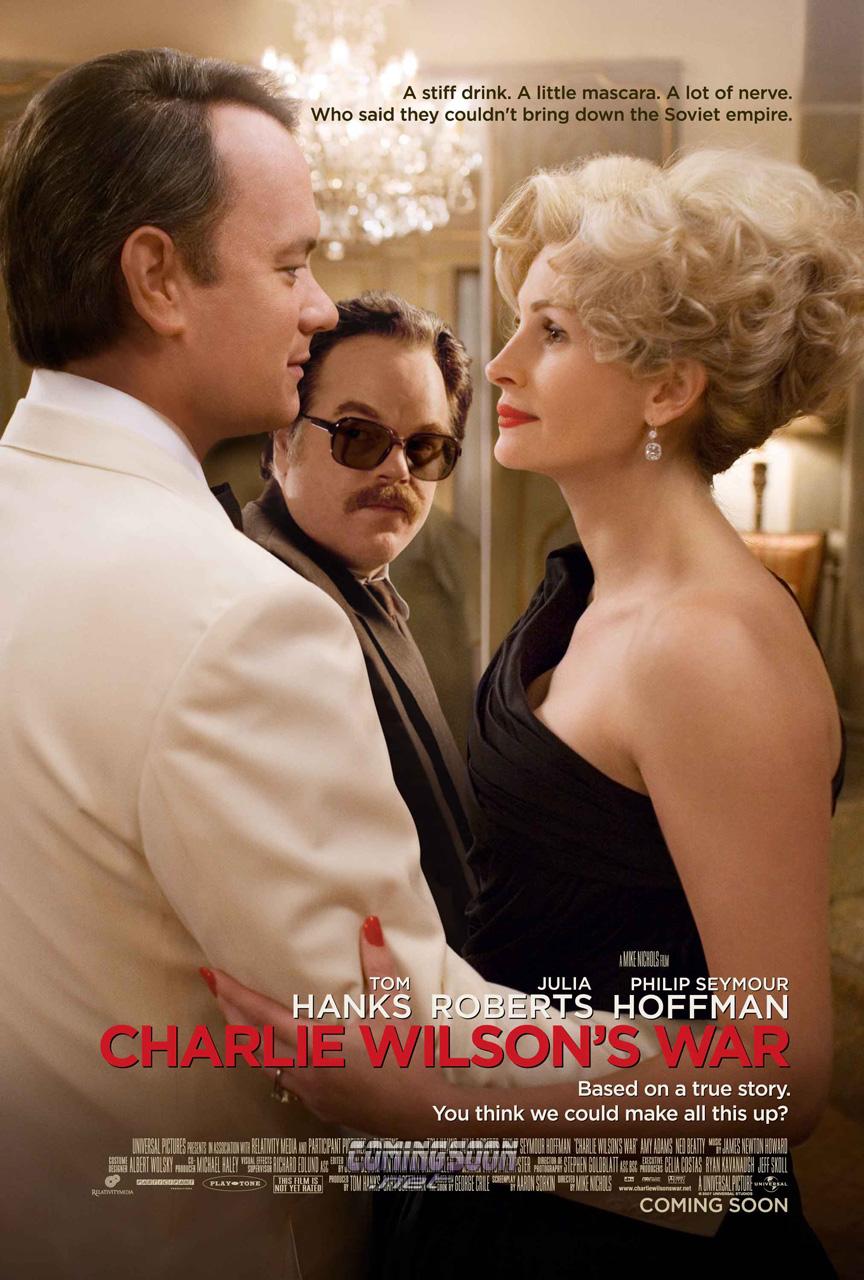
Charlie Wilson’s War is a highly entertaining film. It is funny, fast-paced and extremely well acted. Phillip Seymour Hoffman is captivating as Gust Avrakoto, the cynical, highly skilled CIA agent who helps Congressman Charlie Wilson (Tom Hanks) and Joanne Herring (Julia Roberts) finance a covert war against the Soviets in Afghanistan in the 1980s. Apparently, you can make a good-natured, romantic comedy out of nearly anything nowadays.
The film sets out to make “Good Time” Charlie Wilson, the hard drinking, womanizing Democratic politician from Texas, out to be the greatest American hero since Abe Lincoln. Sure, he’s got some character flaws, but when it comes down to it he worked hard for the cause of freedom and democracy. Blah, blah, blah. I personally could care less about his love for whiskey, his multiple girlfriends, his cocaine use or whether he was a good juggler or not. His decisions as a Congressman are what disturb me. The halo simply does not fit.
Afghanistan was not Wilson’s first crusade. He spent much of the late 1970s championing the cause of Anastasio “Tachito” Somoza Debayle, Nicaraguan dictator and serial human rights abuser. Somoza’s reign of corruption was legendary. He was best known for stealing millions of dollars that were supposed to go the victims of the devastating 1972 Managua Earthquake. To Wilson, Somoza was not the evil bucket of slime that tortured and murdered just about anyone who disagreed with him publicly while robbing his country blind. Somoza was a great representative of America in the fight against communism. The dictators big mistake was to get drunk and attempt to make a move on Wilson’s girlfriend, Tina Simons. It was only at that point that Wilson decided that Somoza was, in fact, not a great representative of truth, justice and the American Way. This is not to say that Wilson was entirely awful. He was a very complex man who made some important contributions while in office. He also gave aid and comfort to a monster. The second part was apparently not significant enough to make the final cut of the movie (the book by George Crile does cover this in detail).
The movie focuses on Wilson’s role in arming the Afghan rebels against the Soviet Union. The film uses the familiar Russians=Evil theme that was quite popular in Cold War propaganda movies. At least in Red Dawn we saw the Russians doing something beyond killing innocent people for a few frames. The only Russians in this film are the ones shooting unarmed peasants from the sky or getting shot down by American supplied Stinger missiles.
It’s easy to find fault with what the hideous actions taken by the Russians in Afghanistan. The problem with how the Russians are portrayed in this film is two-fold. First of all, it is mindlessly simplistic and creates the idea that the war was an easily understood battle between good and evil. It was not. The second problem is that it supports the widely accepted narrative that the Russians were solely at fault for the war. In fact, evidence exists to the contrary. Zbigniew Brzezinski, National Security Advisor under Jimmy Carter, has stated that the United States began arming the mujahedeen fighters, who were trying to overthrow the Soviet backed government, months before the Russian invasion. The goal, according to Brzezinski, was to “knowingly increase the probability” that the Soviets would invade. Can you imagine what the reaction of the United States would have been if the Russians were caught doing the same thing in Mexico? This is extremely significant because it clashes with the official story of how the war began. Through the lens of Brzezinski’s comments, Charlie Wilson was not simply helping out a group of people fighting to free themselves from the Soviets, but rather was continuing a pattern of expensive and wrongheaded U.S. intervention into sovereign nations that wreaked havoc across the world.
The film ends with a strange postscript. Wilson is recognized as a hero for getting weapons into the hands of the mujahedeen and helping to end Soviet dominance in the region. However, when he tries to get a million dollars in aid to the Afghans after the war he is rebuffed. A Wilson quote about us winning the war but messing up the endgame runs across the screen right before the credits. The message seems to be that it was totally justified to give over a billion of dollars to arm a group of Islamic radicals, but we should have built some schools. Are you kidding me? The largest covert war in American history is fine as long as we build a few schools at the end? As if throwing a few bucks into rebuilding the infrastructure of the country can somehow compensate for the untold damage that arming and training many future Taliban members caused.
The idea is reminiscent of some of the crackpot schemes hatched by Kennedy/Johnson advisor Walt Whitman Rostow. He was the guy who decided we could win the hearts and minds of the Vietnamese by taking them off of their land and moving them to fancy, new, isolated towns called Strategic Hamlets. The Vietnamese didn’t want our makeshift Levittowns, they just wanted us to leave. The common thread in this logic is that United States intervention is justified as long as the people get something that we deem valuable out of it. Sometimes the greatest gift we can give a country is to leave them alone. Unfortunately, this message is entirely absent from Charlie Wilson’s War. It is replaced with the twisted idea that the U.S. can plant its flag anywhere it wants as long it brings “civilization” and modernity with it.
The Short, Strange Basketball Career of Kreator’s Mille Petrozza
Posted in Blithering Sports Fan Prattle on May 28, 2011

If you have listened to any thrash metal there is no doubt you have heard the legendary band Kreator. Lead singer Mille Petrozza practically defined the riotous, violent German thrash sound. What many people don’t know about Petrozza is that before he was writing classic songs metal anthems like “Betrayer” he was a remarkable basketball player who won an NCAA championship ring with Michigan State.
Petrozza was a high school phenom in Germany. Standing 6 foot 1, Petrozza was an average-sized guard with extremely quick feet. Although he lacked an imposing physical stature he made up for it with a jump shot that could find net from nearly anywhere on the floor. Petrozza was recruited heavily by several major colleges, but eventually chose to play at Michigan State.
As a sophomore, Petrozza was the second leading scorer for a team that featured future Hall of Famer Magic Johnson. Magic remembers his time playing with Mille fondly. “Mille was a pure jump shooter. One of the best I’ve ever seen. I knew when I dished it off to him, I was pretty much guaranteed an assist.”
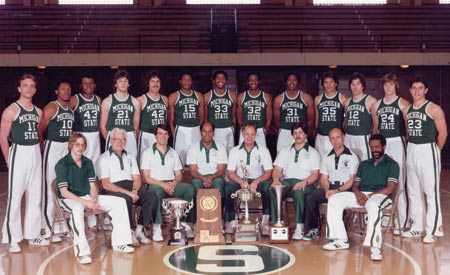
Petrozza #12 With The 1979 Michigan State Championship Team
Petrozza was averaging 16 points and 7 rebounds a game going into the NCAA tournament when disaster struck. His knee gave out driving to the basket in a late season game against Indiana. Doctors said he might never play again. Michigan coach Jud Heathcote called a team meeting after the injury and remembered telling Magic “Mille’s down for the count. We might not get him back for the rest of the year. You are going to have to carry us.”
Magic stepped up and had a tournament for the ages. He carried the team to an improbable championship defeating the Larry Bird led Indiana State Sycamores 75-64. Mille got his ring, but was deeply disheartened by not being able to play. He never recovered his 1979 pre-injury form during his final two unexceptional seasons at Michigan State.
In the 1981 NBA Draft, Petrozza, who had once been projected a high first round pick, slipped to the 2nd round where he was nabbed by the Cleveland Cavaliers. Cleveland was terrible that year but Petrozza began to emerge as a budding star. He averaged 12 points a game and wowed other teams with his speed and intensity.
His most memorable moment was when he scored 39 points in the Boston Garden in a January game against the Celtics. Kevin McHale, the power forward for Boston remembers the performance well. “I thought to myself, I can’t believe we are going to have to play this guy every year. He’s unstoppable.”
Robert Parrish, the Celtics Center, remembers Petrozza as well. “Man, I had never seen anything like that guy. He dunked over me in the third quarter and he actually yelled out ‘PLEASURE……TO KILL!!!!!’ I was like ‘WHAT THE HELL?!?!?’”

Petrozza During His Breakout Game Versus The Celtics
Just when Petrozza seemed to be getting things together he was struck with another terrible injury. While guarding Julius Erving in a game at Philadelphia he slipped on a wet spot on the floor and his surgically repaired knee gave out. “I just felt the thing buckle,” recalls Petrozza. “I knew I was done.”
Petrozza retired nine months later after an unsuccessful attempt to return after surgery. He decided to devote his life to his other passion, music. He took the money he had saved from his NBA contract and used it to pay for the recording of the first Kreator record “Endless Pain”, a title he came up with to describe his knee troubles.

He never lost his love for the game. In fact, many of the Kreator songs and album titles have subtle basketball references in them. According to Petrozza, the album “Extreme Aggression” is actually a tribute to the press defense he ran at Michigan State.
Life has a funny way of moving people to where they are supposed to go. If Petrozza hadn’t had knee troubles he easily could have had a long successful career in the NBA, but then thrash as we know it would have been changed forever.
“I’m glad things turned out the way they did. I love playing thrash metal for thousands of screaming metal maniacs,” remarked Petrozza. “But sometimes when I’m alone at night in my study having a brandy I remember my old playing days. When I think of my basketball career, I can’t help but recall a quote from my favorite poet John Greenleaf Whittier “For all sad words of tongue and pen, The saddest are these, “It might have been’.”
Dissecting CARCASS’ “Heartwork” – Second Incision…Carnal Forge
Posted in Notes on Carcass Heartwork on May 26, 2011
This is the second in a series of articles analyzing the lyrics from the 1993 Carcass album “Heartwork”.

The second song on the record “Carnal Forge” is one of the more lyrically challenging songs I’ve encountered. When I first got a copy of the record, I sat there with a dictionary for an hour trying to figure out what on earth Carcass was talking about. Jeff Walker is known for having a remarkable vocabulary and this song proves it. Unless you scored in the top one percentile on your college boards, you are going to need help with a few of the words he uses. As a service to our readership with IQs below 160, I took the lyrics and clarified them a bit.
“Carnal Forge”
Multifarious carnage
(A massacre that takes many different forms)
Meretriciously internecine
(A vulgar, disgusting display of death)
Sublime enmangling steelbath
(A glorious, destructive bath)
Of escheated atrocities
(Of things lost to the State through terrible acts)
Enigmatic longanimity of ruminent mass graves
(Quiet graves that show a mysterious ability to suffer without sound)
Meritorious victory, into body-bags now scraped…
(A great win worthy of recognition that is shown by a high body count)
Regnant fleshpiles
(The authority and power of piles of dead bodies)
The dead regorged
(The dead shot out of their graves)
Osculatory majestic wrath
(A union of beautiful anger)
This carnal forge
(Human forms beaten and molded like a blacksmith working with metal)
Desensitized – to perspicuous horror
(No longer able to feel the awfulness of horror)
Dehumanized – fresh cannon fodder…
(Humans reduced to objects and killed on the battlefield)
Meritorious horror
(Something awful being praised for its greatness)
Perspicuous onslaught
(An obvious massacre)
Dehumanized – cannon fodder
Killing sanitized
(Murder in a way that is clean and neat)
Slaughter sanctified
(Murder made holy)
Desensitized – to genocide
(No longer capable of feeling what is wrong with mass murder)
Reigning corpsepiles
(Piles of dead bodies ruling over the land)
Death regorged
(Death shot upwards)
Sousing bloodbath
(Being drenched with blood)
Carnage forged…
(Bloodshed and death turned into something else)
In the cold, callous dignity of the mass grave…
(Respectful mass graves without feeling)
Multiferocious carnage
(Violence taking different forms and leading to a massacre)
Cruel, mendacious creed
(Evil, lying system of belief)
Sublime, murderous bloodbath
(Glorious massacre)
Of fiscal atrocities
(A massacre having to do with money)
Inexorable mettle in redolent consommé
(Unstoppable courage blended into a pleasant smelling soup)
An opprobious crucible of molten human waste…
(A disgraceful furnace of melting bodies)
Priapismic deathpiles
(Bodies piled up to the sky)
Infinitely regorged
(Endlessly shot upwards)
The smelting butchery
(A process of separating metals, a process of slaughtering animals)
Of the carnal forge
Desensitized – to pragmatic murder
(No longer feeling the horror of murder which is committed for practical purposes)
Dehumanized – into cannon fodder…
(Turned into non-human form and destroyed without feeling)
“Carnal Forge” is a searing study of the horrific nature of war. The whole “war is bad” theme has been done to death in heavy metal, but through the use of clever language and Joycean puns, Carcass is able to breathe life into a hackneyed lyrical concept. The major motif in the song is the monstrous merger between mechanized and human form. The effect is that the listener has a difficult time distinguishing between the two. This melding of forms stresses the concept of dehumanization in an even more immediate way. When Walker sings of “inexorable mettle in redolent consommé” he is giving the image of a soup made from mettle (courage) but also a soup made from metal (the human form turned into scrap). “Fiscal atrocities” means the destruction of capital, but also is meant to imply physical atrocity (the destruction of the human form). In these puns, we see a world where the lines blur between the animate and inanimate. When this line is obliterated, so are we. Our willingness to see humans as objects makes it possible for us to murder those who share our likeness. It is in the Carnal Forge of war that our human characteristics are lost.
The ultimate irony of this destruction through desensitization is that it is so engrained in some circles that it is not greeted with horror. Instead, it is celebrated. Soldiers who return are feted with parades; those who do not are given dignified, stately memorials. The dead do not care about these things. They do not care about the flags that cover their caskets, they are not interested in the soldiers firing skyward in their honor, and they do not gaze proudly at their names etched into stone walls. They cease to feel anything in the name of country or God or safety or resources or land or whatever-reason-was-given-to-them as they take their final journey into endless night.
There is no honor in death. The dead only know coldness and silence. Yet through a stroke of pure madness, many believe that the great wrongs that have been committed can be righted through ceremony. The louder we shout our love for the soldiers, the easier it is to forget the great waste of life that has been sacrificed in our names. Even the veneration of the dead is an act of objectification that makes future suffering more possible and even more likely.
Remembrance of their anguish does not wipe the slate clean. It is not for them; it is for us. A genuine act of contrition would be to create a world where massacres are entirely unacceptable, no matter who commits them. We do not live in that world. Instead, we live in a world where idle actions and traditions absolve us of our responsibility to stop the madness of war.
(Special thanks to Metal Matt Longo for his brilliant edit of this. Thanks to his fine work this article is being simulcast by the good folks over at MindOverMetal.org. Stop on by. Tell’em Keith sent ya!)
Even A Blind Watchmaker Can Find A Nut
Posted in Existential Rambings, Pointyheaded Highbrow Stuff on May 24, 2011

Vladimir: So….you take a watch and you put it in a bag….
Estragon: What type of bag?
Vladimir: It doesn’t matter.
Estragon: Well, what type of watch is it?
Vladimir: Again…not important. You put the watch in a bag. Now, you take a hammer and you smash it.
Estragon: Wait…What?
Vladimir: Just see if you can follow me here. You smash the watch into a hundred pieces….
Estragon: Is it a digital watch or a nice one?
Vladimir: It doesn’t matter….You take the watch and you smash it into….
Estragon: Well, why are you smashing the watch?
Vladimir: Okay, that’s really not important! The important thing is…
Estragon: What kind of lunatic would break a perfectly good watch?
Vladimir: It’s a metaphor. Nobody is really breaking a watch with a hammer. The idea is to prove a point.
Estragon: But how can you prove a point using an example that is completely unrealistic.
Vladimir: I don’t know. It’s not important! Just listen.
Estragon: Well, if it is a digital watch with one of those plastic bands it’s not going to break with a hammer
Vladimir: Fine. It’s a Rolex. A really nice gold Rolex.
Estragon: A Rolex is really expensive. Why would you want to break an expensive watch? And I don’t know if a hammer will break a Rolex into a hundred pieces.
Vladimir: Fine. It is an inexpensive magical watch that magically will break into a hundred pieces. Can I get back to my point?
Estragon: Sure.
Vladimir: Okay, so you break the watch. You shake it up in the bag?
Estragon: Uh-huh.
Vladimir: Does it re-form into the same watch?
Estragon: Well, of course not!
Vladimir: SEE!!!!!
Estragon: See what? I’m not sure I follow.
Vladimir: Evolution is impossible.
Estragon: Wait…What?!?!?
Vladimir: Something has to be there to assemble the watch if it’s going to come back together, right?
Estragon: I guess.
Vladimir: And the watch has been reassembled into a perfect whole, right?
Estragon: That is what you said.
Vladimir: Well, then there has to be a watchmaker who has a plan, right?
Estragon: Uhmmm. Okay. So, who is the watchmaker?
Vladimir: GOD!
Estragon: Wait….WHAT?!?!?!
Vladimir: God is the watchmaker! Otherwise the watch would still be in pieces.
Estragon: Wait…so God reassembled the watch?
Vladimir: YES!
Estragon: Why?
Vladimir: What do you mean why? He’s God. He doesn’t need a good reason.
Estragon: So, God just goes around putting broken watches together? We’re not sure why. That’s just what he does.
Vladimir: Exactly. He loves us. Maybe he wants us to have a nice watch. Maybe he wants us to be happy. That’s for Him to know.
Estragon: If he wanted us to be happy, why didn’t he just stop us from breaking the watch in the first place?
Vladimir: Free will!
Estragon: So, wait, he loves us so much he is willing to fix the watch, but he won’t stop us from breaking it?
Vladimir: Exactly!
Estragon: That’s not a very efficient system.
Vladimir: Well, He doesn’t have to be efficient. He’s God. He doesn’t have to explain anything.
Estragon: Well, if he’s going to go around smashing watches, I think he owes somebody an explanation. That’s pretty rude. If he smashed my watch I’d be really angry!
Vladimir: Okay…forget the watch. We’ll use another example. Pick something.
Estragon: A piece of ham
Vladimir: So, you put a piece of ham in a bag…
Estragon: Ham….in a bag?
Vladimir: Yes! And you smash it into a million pieces.
Estragon: Uh-huh
Vladimir: It still tastes like ham and smells like ham and looks like ham. RIGHT?!?!?
Estragon: Yes…I think.
Vladimir: So there has to be some kind of ham designer, right?
Estragon: Yes…well….maybe…I guess….
Vladimir: Evolution couldn’t have designed ham.
Estragon: Wait…why not?
Vladimir: Because it is perfect.
Estragon: What is perfect?
Vladimir: Ham! Ham is perfect!
Estragon: Compared to what?
Vladimir: To a universe without ham.
Estragon: How can you tell?
Vladimir: God wouldn’t have created it if it weren’t perfect. Ham is in our universe. Therefore, ham is perfect.
Estragon: Okay, now I’m really confused. If God is perfect and created a world that is the most perfect possible world for us, why does he create people who smash ham and watches in bags?
Vladimir: To test us.
Estragon: Why?
Vladimir: To see how much we love him.
Estragon: Oh…so we show him we love him by not smashing things in bags?
Vladimir: Yes!
Estragon: I see. So that’s the point of the whole thing!
Vladimir: YES! That’s the point. We have the choice whether to smash ham or watches or even possums in bags. If we choose not to, we do it because we love God. And if we do that we will be rewarded.
Estragon: With a nice watch?
Vladimir: Maybe with a watch. Maybe with eternal happiness. We’re not exactly sure. We just know that the reward is going to be REALLY good.
Estragon: And if we smash things in bags?
Vladimir: Then bad things happen to us. REALLY bad things. Things like sickness or eternal suffering or boils on our face.
Estragon: Boils on our face?!?!?!
Vladimir: It won’t be a problem for you if you just do what you are supposed to.
Estragon: So these are the rules?
Vladimir: Yes.
Estragon: And if I follow them, I’ll be…………happy???
Vladimir: Unless God has another plan for you. But eventually you’ll be happy. At some point.
Estragon: Will I get a watch?
Vladimir: If that is what you desire and that is God’s plan and you follow the rules then, yes, you will get a watch.
(At this exact moment, a giant meteor hits the earth obliterating smashing it into a million pieces. The entire human race, including Estragon and Vladimir, are destroyed in a firey, horrible instant without warning)
Glossophobia and The Fugitive Mind
Posted in Articles I Probably Shouldn't Have Bothered Writing, Health Tips for An Early Death on May 21, 2011

Stage fright is a truly terrible feeling. Many people confront it, but usually they manifest their experience in different ways. Some people cry, some talk louder, some simply feel a vague sense of dread as they move through the speech. What I’ve noticed in talking to people about it over the years is that the experience of it changes dramatically from person to person, but it is always quite miserable if you feel it.
I have an awful fear of speaking on stage. As a teacher, I never feel nervous speaking to a roomful of high school students, but once a year in May I am asked to speak in front of a large audience on a stage with a microphone. The speech itself is something I’m honored to give, but the fear I feel starts around January and becomes nearly debilitating by the end of April. It is only a three-minute speech but my fear of it consumes months of my life.
People are always very supportive and try to be compassionate but usually the advice I get doesn’t help all that much. If you mention you have this fear you will get a lot of guidance, but often I’m not sure if the people who give it really understand the parts of it that make it so terrifying. It is an irrational feeling and most rational suggestions fail to address it in a way that is practical. You get advice like “Try to imagine them all naked”. If everyone in the audience were naked I’m sure I’d be even more terrified! How could the thought of hundreds of naked humans staring at you be even remotely comforting? Other people ask you “What’s the worst that can happen?” They have no idea of the circus that your brain becomes for three minutes. The worst that can happen is that you’ll be on stage giving the speech. People simply can’t comprehend why a relatively simple act like this can cause such suffering. I don’t really understand it myself.
The following is an attempt to describe the experience in real time. Some of this will sound silly, but every single thought written down has gone through my mind on stage. The goal of this piece is to create a running record of what stage fright actually feels like for me.
Alright, here we go. Need another sip of water. If you act confident, the fear won’t come. Okay, time to stand up. They just called me. Fix my jacket. Three buttons…how many should I button? I need to keep it buttoned cause my tie is too short. I look like Oliver Hardy. Someone once told me leave the bottom unbuttoned. Okay. Here we go. Don’t look up. Don’t look up. Just read. You should make some arm gestures. Just hold the podium. Don’t fall. Hands sweating. The podium is see through. Are the spots around my hand fogging up? Do they see me sweating? Act confident. Here it comes. Here it comes. I should have left them all unbuttoned. I should have acted more confident. Now IT is HERE.
Hot. What if I pass out? Falling, hitting my head. Would someone catch me? I’m too big. Where am I? Did I just miss a line…no, no, I’m okay….page one is over. Don’t look up. They are all looking at you. They are all looking at you. Is my fly zipped? Don’t look up. Fast. Dizzy when I look up. Falling, hitting my head. IT IS HERE.
Does what I’m saying make any sense? Do they hear me? I didn’t practice enough. I practiced wrong. Fast. I practiced too much. What if I forget how to read? Sweating. Pain in the top of my head. Antler pain. I feel like antlers are going to sprout out of the top of my head. Stay focused. Where am I? I am reading, but I don’t know how. There is another me reading. I don’t even know what the other me is saying. Why are they laughing? Did I say something funny? Did I do something embarrassing? I didn’t write that to be funny…what’s happening???
FOCUS!!!! Antlers. Sharp, sharp pain in the top of my head. Halfway done. Sweating. What if I can’t breathe? Slow down your breathing. What if I can’t? I don’t control my breathing. Long way to go in this speech. Lots of words left. What if I start saying weird things? What if I start shouting random nonsense? NO CONTROL. What if I burp? What if I start cursing? What if I lose control of my body? Sharp pain in my head. Antlers are growing inside. Will they pop out?
One page left. Downhill, downhill, breathe, another minute…..breathe. If I can just get one more page. What am I talking about? Where am I? DON’T LOOK UP!!!! THEY are watching you….breathe….breathe….you are going to fast…..no one understands….breathe….one paragraph now…..look up once…try it…..try it….dizzy….FOCUS….DON’T LOOK UP…..clapping…no more words….handshake….get to the chair….don’t fall….don’t pass out…get to the chair…..sit down…..breathe….
 The Tyranny of Tradition
