Archive for category Existential Rambings
An Inconsistent Truth: A Psychological Review of The High Art Museum’s Showing of La Moustache 11/5/10
Posted by Keith Spillett in Existential Rambings, Mr. Spillett's Academy Of Film Study For The Mentally Tormented on November 6, 2010
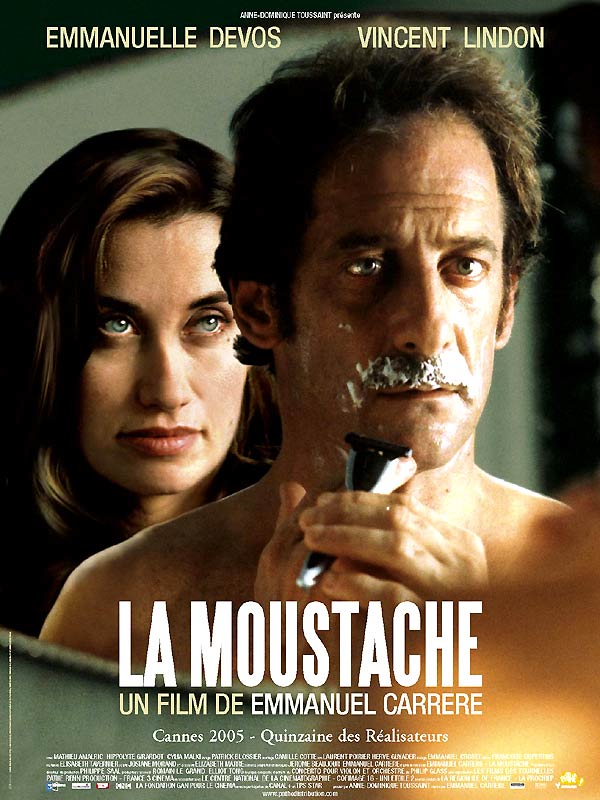
The Citizen Kane of mustache hallucination films
“No one who has not experienced how insubstantial the pageant of external reality can be, how it may fade, can fully realize the sublime and grotesque presences that can replace it, or exist along side of it.”
-R.D. Laing “The Politics of Experience”
It is truly frightening to be in a room full of people who are laughing and not get the joke. I don’t just mean not get the punch line, but not get the words, the meaning or anything else. To feel as if one is from another planet and has landed here with a cursory knowledge of the English language and a two-day session on the lives and mating patterns of human beings under his belt, only to have to listen to two voracious baseball fans discussing the importance of the infield fly rule. Maybe I missed something; maybe something was never there.
I walked into the High Art Museum at about 9:30 at night and was greeted by one person in a fake moustache, then another, then another. I was overwhelmed and confused. Apparently this was the theme of the evening. Moustaches, moustaches everywhere. I had heard that at some point in the evening some men who had real moustaches were going to shave them off. It was one of those hipster rollicking good time things that I’m sure would have really impressed me back when I had rollicking hipster intentions.
The main purpose of this whole thing was to show Emmanuel Carrere‘s surrealist film “La Moustache“. Because of this, I decided to leave my house on a Friday night for the first time since Carter was in office. I love the film. It is a deceptively simple story of madness and personal alienation. A man shaves his moustache and no one believes he ever had one. That’s really all of it. In spite of its insane story line, it manages to come across as a remarkably realistic picture what it is like to experience genuine confusion. For some reason, I had it in my head that seeing the film in a theater would be even better. What I didn’t really get until the lights dimmed was that seeing 2001: A Space Odyssey in a theatre is a unique experience because you have an opportunity to see special effects that were meant for a big screen. Seeing a yuppie French couple arguing over the husband’s bizarre personal grooming fantasies is not anymore enjoyable around a bunch of popcorn chomping film fans. As a matter of fact, it’s pretty damned depressing.
The woman who introduced the film was some former film critic from the Atlanta Journal Constitution who really didn’t know very much about the film or the writer or the director or French cinema or how she got to the building in the first place. She kept saying over and over that this film was “funny…really, really funny.” This set a monumentally bad tone for the evening. The crowd immediately settled in, ready for a French yuckfest on par with the work of Johnny Knoxville. I have to tell you, I’ve laughed at a lot of thoroughly inappropriate things in my day, so I guess I had this evening coming to me. I nearly got tossed out of the Phipps Plaza Theater some years back for nearly laughing myself into straightjacket for the last 15 minutes of the faux horror classic “The Devil’s Advocate”. I spent a good portion of my younger years telling horrendously insensitive jokes about everyone from Mother Theresa to Ted Bundy. This night was my punishment for many a sin against good taste. Hopefully, this will count as my confession and I will be absolved of further mental floggings.
I sat there for a good hour and a half with blank expression on my face. The audience exploded with laughter over and over again at the most inopportune times. Marc, the main character played by Vincent Lindon, wanders through the film slowly losing touch with everyone he knows and loves. He begins to doubt the very fabric of reality, becomes a stranger in his own body and disappears into a blinding fog of regret, scorn and loneliness. Hysterical stuff! Marc sifts through the trash, trying to find any proof that his experience is real, that he is not living an unexplainable fantasy and that his mind isn’t decaying. Stop it, my side is hurting!
Truth be told, this is a horrifically sad movie. So many wander through life trying to catch up to the world, trying to understand an endless series of in jokes and references that fly by them, hoping to understand what the world means while being handed self-help books and truisms about “being yourself” and “trying your hardest”. Our personal realities often do not mesh with the world. Our truths are often only true in our minds. One minute’s certainty is the next minute’s mirage. There are nearly 7 billion of us blindly groping for a light switch in the dark only to be handed an octopus. This is the message of The Moustache. To take this film as a lighthearted romp is to miss a wonderfully genuine explanation of what it is like to be a human. Or maybe I just don’t get it.
The Words Crawl in, The Words Crawl Out: Existential Dread and FDR’s Inaugural Address
Posted by Keith Spillett in Existential Rambings on October 23, 2010

An appropriate response to reality?
Sometimes expressions are so powerful, so significant, that it is easy to lose sight of how utterly absurd they are. American history is riddled with such quotes. A personal favorite of mine comes from FDR’s 1st Inaugural address. The story goes something like this: America was mired in the worst economic depression in it’s history. Roosevelt had just put an end to the rattling death spiral that was Herbert Hoover‘s Presidency and stood in front of the country promising the revitalization of the American Dream and the end of nearly four years of chaos, despair and misery.
Within the first few sentences of his first Presidential address, Roosevelt set a tone of vital, unabashed optimism when he uttered the now famous words “We have nothing to fear but fear itself.” Those words, along with many social programs or “fortuitous” sets of circumstances (depending on who you ask), picked America up and led it through some of it’s worst moments. It became a rallying cry for a troubled nation whose best days were ahead of it.
I need you to know that I am not six years old. I don’t believe in the Easter Bunny, the Tooth Fairy or the literal truth of expressions used by politicians in speeches. I am quite sure that Roosevelt was afraid of a few things besides fear. Maybe he was afraid of spiders, maybe he was paranoid about being in graveyards after 9 PM, maybe he was just plain scared of being attacked by a group of fanged clowns. I really am not sure what made FDR fret, but I am quite sure something did. The point is, the line was meant to be hyperbole.
Here’s the problem, if you hold the line up and look at it for a minute, even as hyperbole, it turns into mush in your hands. The truth of the matter is, there are an enormous amount of things to be afraid of. We are narrowly held on a mortal coil that could collapse at anytime. Our bodies, given a few years of exuberant youth, quickly melt away like ice cream on a summer afternoon. We rarely, if ever, are informed of when our time here will end and on the rare occasions we get that message in advance it is never good news. We form deep connections with those around us only to watch those bonds dissolved through mortality or miscommunication. As humans, we depend on a constant flow of sustenance that could dry up or be ripped away at any time. The possibility of mass annihilation through disease, war or famine are never far from our collective consciousness.
After death, who knows what bizarre carnival awaits us. Will I go to a smoking pit of flames, left to forever roast for eternity for some momentary lapse of judgement I made in the previous life? Or shall I fly away on white wings floating in a vast cosmic eternity day after day after day after day….with no end anywhere in sight? Will I simply get to experience the same mindless pain and suffering over and over, just from some new perspective? Will I come back as some “lower” animal, only to be slaughtered by other creatures for food, belts or coats or stepped on because I am “in the way”? Will I be at one with the universe, a desireless speck in an endless cosmos? Or will I lay in the ground and deteriorate slowly, a buffet for worms and bugs; a previously animated, once sentient form of high quality fertilizer? Which option would be preferable to me? (It doesn’t matter…I don’t really get to choose!)
If Roosevelt had any sense of the existential turmoil that lives at the root of our being, he would have left comedy to the comedians. How could someone look at the human condition and honestly utter the expression that there is only fear to fear? Fear is a completely reasonable response to an entirely preposterous set of circumstances. Maybe Roosevelt understood this and decided the best way to comfort humans was to deceive them and give them a false understanding of the terms of the world. You’ll forgive me if I don’t thank him for that. I have always believed that given the choice of comforting words or horrific facts, people tend to believe the latter, even if they don’t readily admit to it.
I am never more convinced that a person is lying to me and to themselves as when they say something like “I am not afraid of death”. This delusion can be truly catastrophic, not just because it allows people to pretend that their life is something that it is not, but because it allows people to rationalize the suffering of other creatures. “If I am not afraid of death, then it must not be that bad, then your death isn’t as bad as you think, then you should just get over your death (after all, I did), then you should stop dying because it reminds me I will die (which I am not, by the way, afraid of).” The logic (or lack of it) is torturous. “It is just a dumb beast, what does it matter if it dies or it is just a non-American, what does it matter if it dies or it is just one, what does it matter if it dies, or it’s just one of THEM, what does it matter if it dies or it’s not related to me or my friend, what does it matter if it dies.” These thoughts cannot be far behind.
Fear, I concede, can produce irrational responses and untold misery. However, it can also be a great tool to remind us of our humanity. It has the invaluable capability of reminding us what we share with the rest of these animated objects that surround us. Fear is not something to be feared, it is something to be listened to, reckoned with and understood. Otherwise, how can we ever truly begin to understand what we are and what we share with the creatures around us.
 The Tyranny of Tradition