Posts Tagged existential dread
If I Never Hear It Again It Will Be Soon Enough: Clichés that Push Me Over the Edge
Posted by Keith Spillett in Totally Useless Information on March 28, 2011

I've Got An Idea...Why Don't I Put An Attention Catching Photo That Has Nothing to Do With The Article On Top
“The first man to compare the cheeks of a young woman to a rose was obviously a poet; the first to repeat it was possibly an idiot.” –Salvador Dali
There are simply too many clichés in the world. The language is filled with them. It is hard to get through a conversation without hearing one or saying one. Most of them started out as colorful ways to describe an experience and have, through years of endless repetition, become mildly annoying, harmless platitudes that move conversation along. For some strange reason certain clichés make me extremely angry. Most float through my mental filters without much of a struggle, but every once and a while there is one that disturbs me. Since the chances of me actually getting legislation past to outlaw these incipit expressions are remote at best I have decided to address them in a constructive way, instead of quietly fuming about them day after day. I have been compiling a list over the past few months of these along with descriptions of why they bother me in the hopes of understanding the pain that they cause me and hopefully inflicting this pain on others. I have also included helpful sarcastic responses to confuse the cliché user and possibly prevent the offending expression from being used again. So, as they say, away we go….
Cliché: “Throwing the Baby Out With The Bathwater”
What kind of sick freak thought this one up? As a parent of two small children, I find the idea that I might actually forget one of them and toss them into the river with dirt-ridden water to be entirely preposterous. I get that the creator of this one is trying to make the point that whatever the person is doing is a really ridiculous thing, but what sort of lunatic would toss a baby out with bathwater?!?! They are certainly tiny, but not nearly small enough to accidentally thrown away. Maybe the person is an evil, malicious hater of babies, but this is far from the most efficient way of getting rid of them.
Appropriate Response: Look down at your shoes shaking your head for one dramatic moment, then look up and shout “Well, it’s better than shooting it!” Turn and walk off.
Cliché: “I wear many hats”
AGHHGGHHHH!!! I can’t even think about this one without seething. Yes, I know it means doing more one role, but the metaphor confuses me. Do they mean at the same time? What kind of fool would wear 3 or 4 hats at once? It would be stupid looking. There have been a lot of asinine fashion trends throughout history, but I cannot recall a single fad that had anything to do with the person wearing a lot of hats at once. Is the point that the person has multiple heads? Am I meant to imagine the person in front of me morphing into a giant hydra like beast wearing a prefaded Red Sox cap, a turban and a Michael Coreleone style fedora? More than likely, the person who said it wants me to see them as a beaming icon of capitalism and industry, efficiently moving from task to task, a vaunted leader one moment, a regular lunch pail working stiff the next, a person who can be all things to all people, a technocratic “renaissance man”, a proud beacon of all that can be achieved in a 24 hour day with a little know-how and a fist full of gumption. I think I’d prefer the hydra.
Appropriate Response: Vomiting on the persons shoes
Cliché: “Give it 110 percent”
I am well aware that the test scores of American students in math and science have declined over the last 30 years, but the fact that Americans have no qualms about repeatedly asking each other to violate common sense and mathematical reason in this way is alarming. As if this wasn’t troubling enough, the cliché inflation that has taken place is now taking place is insane. During the 2010 baseball season, White Sox manager Ozzie Guillen said that pitcher Gavin Floyd would only pitch if he were at “200 percent”. 1972 Democratic Presidential Candidate George McGovern, the Godfather of Cliché Inflation, started this madness when he said he was “1000 percent behind” his Vice Presidential Candidate Thomas Eagleton seconds before he tossed him kicking and screaming off of the Presidential ticket. Of course, none of this compares to the all-time Cliché Inflation champion Atlanta Attorney George Lawson who asserted that he was “a million percent certain” that his client, Auburn Quarterback Cam Newton, did not take money. Where does it end?
Appropriate Response: Give an overly loud, awkward pretend laugh, and then shout, “If I ever see you again, I’ll break both of your legs!” Turn and walk off.
Cliché: “Too many Indians, Not Enough Chiefs”
This one has started to fade into cliché obscurity for everyone except people who write those grotesque books that quote Vince Lombardi a lot and compare great managers to Ghandi and Napoleon. It doesn’t get play in the real world anymore mostly because “too many indigenous peoples and not enough chiefs” really doesn’t have a great ring. Here’s the larger problem…Chiefs ARE Indians.
Appropriate Response: Look deeply offended and reply, “Are you trying to say that there are too many Indians? What kind of idiot racist would make a claim like that!”?
I’ve got a ton more of these but I’ll save them for a rainy day.
We Are Bones, We Are Dust
Posted by Keith Spillett in Articles I Probably Shouldn't Have Bothered Writing, Existential Rambings, Health Tips for An Early Death, Pointyheaded Highbrow Stuff on March 6, 2011

This thing that I think that I am, sometimes, I am not. Looking at an X-Ray of my right foot has twisted my mind into knots for the past few weeks. It’s not that they found anything that disturbing. My doctor discovered a bone spur, which I was pretty sure that I had. No surprise there. I am having surgery tomorrow. Again, not a surprise. The thing that got in my head was the X-ray itself. If I am what’s in that picture…what am i?
There was this picture of the bones in my foot staring at me. The doctor was pointing to things and saying a bunch of words, but I was transfixed on the picture. There I am? There I AM! There I am?!?!?!? This picture is of the inside of me. Underneath all of this skin and blood are a set of bones. These bones have been with me all of my life. They were at my high school graduation, they were there when I got married, they attended the births of my two beautiful children, they have seen me laugh, they have seen me cry, they have been there when I thought I was alone. I couldn’t process it. These bones are actually me!
The me that I think I am is the thing that experiences the world consciously. I am aware of feelings and ideas. I make plans and I remember experiences. I see, I smell, I touch, I taste, I hear. I have no problem associating these things with me. Then, there are these bones. They are in me, they are part of me, but I can’t believe that they are me. This picture wasn’t some random x-ray they keep in the back and show everybody. These were my bones! Seeing them really sucked the magic out of everything. I tend to think of myself as more than the sum of my parts, but maybe I am nothing more than my parts. Maybe, I am just bones and skin and blood with a few organs floating around.
There are parts of myself I have never seen. I don’t know what my hip bone looks like. I don’t know what my liver looks like. My heart, my brain, my lungs…all highly valuable parts, but I couldn’t tell mine from my neighbors. The me that I know seems so special, so unique. My memories seem so important, as if they are part of some great mystery that I have a lifetime to solve. My thoughts, my ideas, my identity all seem to be pieces in the great “who am I?” puzzle. They all conspire to make me believe that I am an enigmatic character whose mythology is terribly important. And then, there is this picture of the inside of my foot. It is not special. It is not unique. It is simply mineralized osseous tissue housed in a pile of skin that is called “foot”. There are somewhere in the range of 14 billion of them and they all pretty much look and act the same. Sure, there are minor subtleties and nuances, but for the most part, what is the difference?
My foot does not find itself unique. It pushes against surfaces over and over throughout a day. It works, it rests. It does not feel loneliness or claustrophobia if it is trapped in a shoe for too long. It does not become jealous that I am favoring my other foot. It does not make plans to meet with my spleen for coffee. It does not become romantically involved with my esophagus. It does not ponder the mysteries of the universe and wonder what will happen to it when it dies. It is material and material has no time for enchantment. It simply is. When it ceases to work, it will waste away along with the rest of this thing that is me.
There is a part of me that cannot imagine that this is possible. There must be something else, there must be something more. I am more than that picture. I am not just bones. I am not just flesh. I am something mystical. I am more than those parts. I am more than words on a page saying “healthy, well-developed 35 year old male suffering from Hallux rigidus“. Right? Right?!?!?!
Maybe this identity of mine that I find so fascinating is just a bunch of electrical impulses. Maybe we are just piles of material walking around among other piles of material, thinking that thoughts and memories and ideas make us more. These self-important piles of material spend much of their time avoiding damage so that they can one day be part of creating new piles of material. And on and on with no direction, no meaning and no end. Thousands of them are created each day and thousands disintegrate. It does not matter…it is only matter.
The Politics of Sneezing
Posted by Keith Spillett in Articles I Probably Shouldn't Have Bothered Writing, Totally Useless Information on March 3, 2011
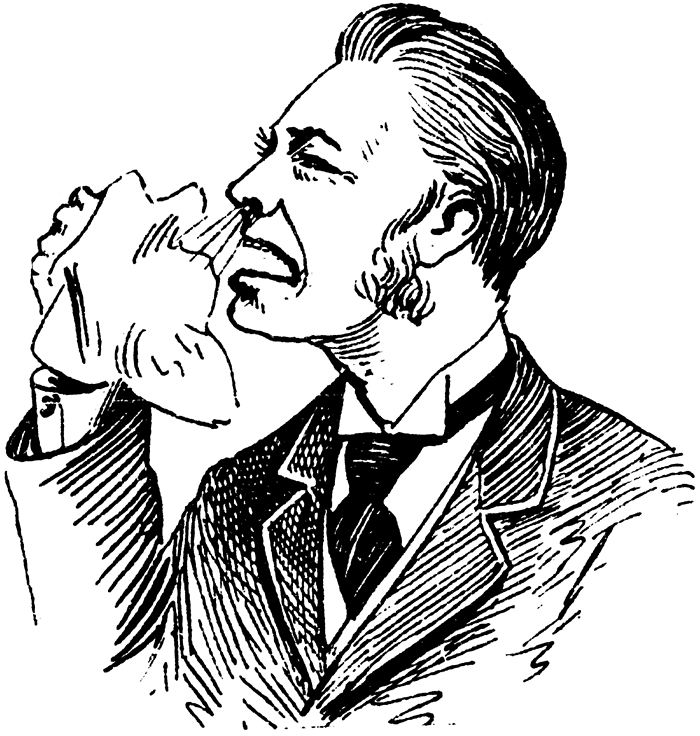
I sneeze and people feel obligated to reply. The more you think about that, the weirder it is. You are on an elevator with ten complete strangers, you sneeze and all ten race to beat each other to say “God Bless You”. You are on a subway, it is 3 o’clock in the morning and you are surrounded by several odd looking strangers who look like extras from The Warriors. They are taking turns leering at you with a detached sense of malice. You sneeze. A cacophonous chorus of disinterested voices mumble something that sounds remotely like “GesundheitGoblessyou”.
This pervasive but odd little social custom seems to insert itself everywhere without regard to circumstance. There are plenty of bizarre customs out there, but this one seems thoroughly inescapable. I have allergies and live in Atlanta, which means I spend a good portion of the spring testing the politeness of strangers. A sneeze never fails to draw some sort of reply. No one knows particularly why we do this. There are several old stories handed down about it. One story says that it was created during the Black Plague to ward off the spread of the virus. Another story claims that the custom began over the fear that the heart might stop during a sneeze. Yet another tale claims that it was a way of forcing the soul to return to the body after a sneeze.
Most of these stories are meant to explain the “God Bless You”, but there is less explanation for the “Gesundheit”. Why would a room full of non-German speaking Americans suddenly nearly crawl over one another to shout a German expression at someone who has just fired a blitzkrieg of germs at them? Politeness?….really?!?!?! Occasionally when one sneezes they are given a “hatchoo” by someone near them. Why on earth would someone imitate the sneezer? I find this response to be quite demeaning. To get how strange this is, imagine if a person burped and was greeted with a choir of fake burps in response?
I have only experienced this sort of weirdness in America, but apparently it is popular around the world. Most cultures have some word that means “to your health” that is thrown at the offending germ cannon. The oddest sneeze response I’ve come across are the Mongolians who say something that sounds like “burkhan urshoo”. This translates to “May God forgive you”. Not knowing much about the Mongolian culture, this leads me to believe that sneezing is serious business over there. It must be some sort of crime or something. God would be quite busy if he or she had to spend the better half of eternity forgiving sneezers. In Iceland, they say something that translates into “May God help you!” This sounds like a threat that is better suited to someone stealing your pet llama. The Tamil language has a word that translates to “may you live for one hundred years”. The sentiment of this is quite lovely, but the actual math becomes severely problematic. If I were to sneeze five times a day for one year I would have added 182,500 years to my life. Imagine the effects on the economy in many Southern Asian nations if they had to deal with taking care of scores of 2 million year old allergy sufferers?
No one particularly knows why we do it, but if your curious to see whether this custom is alive and breathing today, try sneezing in front of a room full of strangers. If you cough, people barely notice. If you blow your nose, most people simply go about their business. Sneeze and the world stands up and takes interest.
None of The Above
Posted by Keith Spillett in Articles I Probably Shouldn't Have Bothered Writing, Basketball Coaching Nonsense, Existential Rambings on February 27, 2011

The presumption that we can understand the universe seems to be the single most absurd belief that human beings have formulated. Part of the problem with the question seems to hinge on how the word “understand” is interpreted. For the purposes of this article I will be using the word in a similar way that Robert Heinlein uses the word “grok” in his book Stranger in a Strange Land. To grok something is to comprehend something with all of one’s being. I can understand that human beings have 10 fingers, but I grok what it means to have and be able to use those fingers myself. They are a part of me and I know them to be incontrovertibly true. I understand my fingers in a pre-verbal, visceral way that can’t and doesn’t need to be explained. When someone watches a game of basketball they may understand that the goal is to put the ball in the hoop or that they have to dribble when moving or the fact that there are two sets of five different players on the court, etc. If you asked a person who knew this whether they understand the game, they would probably say “yes”. However, they certainly do not grok the game in its fullness. They do not know what its like to make an impossible shot or look up at an official for a brief second with the anticipation of a charge or blocking foul or to dive on the floor for a loose ball or any of the millions of possible experiences that could exist in a basketball game. They may hear the words but they don’t feel the music.
This problem of “understanding” relates to how our culture and many others tend to interpret the EVERYTHING. Often, humans are given two choices as if they reflected the only possible paths to groking the EVERYTHING in its fullness. We get a choice of science/reason/rational thinking or faith/spirituality/belief. I find neither of these answers to be helpful. Science has brought us many creations and understandings over the years. Scientists have given language to experiences like gravity. This language has allowed us to change how we perceive life. Without these understandings, many of the wonderful things that exist in our world (everything from flight to the internet) would not exist. Reason has brought us to heights never dreamed of by our forefathers. It has also brought us terrors never before imagined (germ warfare, nuclear annihilation). For my purposes, neither of these points is relevant to the question. Science has brought us to a place where we never believed we could be and the power of its creation has made us think that its potential for discovery is as infinite. I believe that science has limits. Heinlein gets the limits of science perfectly when Valentine Michael Smith (the protagonist in Stranger in a Strange Land) asks “How can you grok a desert by counting its grains of sand?” Science can create marvelous tools to manage parts of the physical world, but to grok it in its fullness there seems to be a need for something more. The explanation that love or joy or sorrow are nothing more than a few synapses firing in different directions seems woefully inadequate to explain us, let alone the interplay of billions of sentient creatures. There must be more.
But is that “something more” a belief in something beyond our understanding (a higher power?). Many people believe that God is an all-powerful; omniscient being that controls the universe. But if God is all-powerful and omniscient how could flawed, miniscule beings ever expect to understand anything about this God? How can we possibly grok something that is admittedly beyond our understanding? The idea itself seems bizarre. People often chalk up experiences to being “part of God’s great plan”. But, if we don’t completely understand what God’s plan for us is how can we possibly understand that an action is part of the plan? Why do those of faith assume that there is a greater reason for the things they do not understand? Maybe there is and maybe they are right but how would they know? We are given a scant few highly conflicting religious texts. Can it really be assumed that everything a person needs to know about the universe can be summed up in the Bible or another religious text? Many people believe this. I think the mistake in this is to assume that this thing can be understood using a book. One book, millions of books, cannot sum the EVERYTHING up. It is still greater than the whole of human knowledge, let alone the contents of one book. Belief often seems to function as a great off switch in the mind. We see something so beautiful or horrible or absurd that the mind says “Uncle!” and we give ourselves over to a belief that there must be some meaning to it that we are missing. But, how do we know that anything actually has a meaning? We can hope, we can wish, we can pray, but we can never know. We just chalk it up to an act of God or the workings of spirits that we can never conclusively prove to anyone including ourselves.
What troubles me about faith is not its deferment to a higher power but its willingness to concede truths to those who have come before or us or to books written before our time. Sometimes I wonder if the worship of God is merely the worship of the past. Maybe we are just harkening back to an illusory time where a more pious people than ourselves who knew more than us were able to connect with some great force in the sky and reveal its truths. Some religious folks look back to Moses or Jesus or Mohammad or a cast of many other characters and assume that they knew enough not only to understand their world but also to understand ours. I have a hard time believing that any person can possibly understand the world they are thrust into. The thought that a person who walked the earth 2000 years ago can not only understand his world but also understand mine seems highly unlikely. What if they are right? It doesn’t really matter because I can NEVER know for certain.
The “central” question faced by human beings is not spiritual or scientific but epistemological. How can we ever really know what we know or that we even know it? We are given limited and barbaric tools, our senses, in which to meet the world. These senses are easily fooled and can be manipulated by inside or outside forces. Yet I can’t even say for certain that anything is an illusion. If I spent a hundred lifetimes, I don’t know if I could grok in fullness the experiences that take place in one moment in one American town. And yet, somehow, humans feel it possible to understand the wholeness of everything. Science and religion fail to give the correct answer because they are asking the wrong question. The question is often posed as “How can we understand the universe?” (….and we get to choose between spirit and reason or some hybrid of both). The question should be “Can we understand the universe?” I simply don’t know that we are capable of this understanding. If we are capable of this feat of comprehension I don’t know that we can ever, for certain, know that we are capable of it. How would we know? What is our point of reference? How would we ever no for sure that our beliefs are not based on illusions or misinterpretations? We don’t know for certain and, yet, so many of our institutions, be they religious or secular, function on the belief that we know for certain how things are going to work out if we take certain actions or do things a special way. This belief pervades our churches, our hospitals, our schools and our homes. Our value judgments, our morality and our understandings are constantly shaded with the haughty taint of false understanding. Really, we know next to nothing. Maybe the only thing it is possible for us to completely understand about the universe is that we don’t understand the universe.
What If There Is Nothing Worth Writing About?
Posted by Keith Spillett in Articles I Probably Shouldn't Have Bothered Writing, Existential Rambings on February 13, 2011

“The dreamcrossed twilight between birth and dying.”
–TS Eliot from Ash Wednesday
Recently, a terrible feeling has been crawling up the base of my spine. It awakens me in the middle of the night, it hounds me when I am driving home from work, it swims in and out of my mind every time I consider this cursed blog. I think I had this thought in my mind even before I started blogging, but over the last month its light buzz has grown to a deafening roar. This feeling is in the pit of my stomach and the recesses of my mind all at once. It is a voice that talks to me while I write and a spirit that haunts me when I do not. Nothing makes it grow quiet. It is omnipresent. It is a simple idea, but if you follow it to its logical extreme it is as dangerous as a nuclear bomb. The question is this…Is there that is really worth writing?
It seems a rather harmless line of questioning. That is how it starts. The point of writing is to create something. I hope to create something new. Have all the worthwhile thoughts already been had? Has someone else already put down all the truths and mysteries of life on paper? With the Internet, you can find access to nearly every idea that has been conceived of. Most of us concern ourselves with whether LeBron is better than Kobe or who is married to who and who is getting a divorce or who wore what on the red carpet or who embarrassed themselves in front of the world. If you want to dig deeper you can find recipes for how to prepare ox tail, the history of Buddhism, better and more in depth formulas to calculate the value of third basemen or the performance of treasury bonds, or the lost works of some 19th century poet you came across at three in the morning on some insomnia driven information binge. But to what end? Is it just more and more stuff to fill our minds with?
Maybe I shouldn’t concern myself with creating something original. After all, what is the point of originality? Am I simply trying to justify my existence by conning myself into the belief that I am so special and unique that I can think a thought that the rest of the 6 billion of us could not come up with? Am I so narcissistic that I think I am capable of an idea that has never been here before?
Maybe the point is to appreciate the experience of writing. Maybe the whole thing is about letting my synapses fire and my fingers pound away at some keyboard. To what end? I do it again and again. Words appear. More words appear. Then more. More. They mean something, but who really knows what? They dance in patterns. I already have forgotten most of what I’ve written. I could look back. To what end?
Why bother sending this nonsense out to the world? Looking for fellow travelers on the good ship Earth as we spiral towards our own personal oblivion. To what end? Am I simply standing in front of the Grand Canyon shouting at the top of my own lungs in the hopes of hearing an echo? And then what?
Maybe my words will help ease the pain of human suffering. A noble goal but when you look at what we are up against, it hardly seems possible. A dying heap of flesh and consciousness trapped in a fading world that is saturated with mountains of disconnected ideas adding up to nothing in particular is going to be helped by some random guy typing random words on a computer screen? Really? I haven’t watched enough Frank Capra to buy it. It is a pleasant delusion, but a delusion nonetheless. Maybe the goal is to delude others into forgetting their troubles. They will remember them soon enough or, worse, they will enjoy the delusion so much they will forget what is happening to them and the ones around them. Apathy or sadness. Ignorance or constant horror. To what end?
If I could write something that could teach people how to live forever or convincingly show them that their actions are connected to something greater then maybe I would be writing something worth reading. But I am not that good of a writer and I doubt I will ever be. I wonder if anyone is. Existential dread is what it is and I can’t write it away for myself or anyone else. Can writing change the truth of what we are? I simply don’t believe that. And even if it could…to what end?
Maybe all of the thoughts have been thunk and all of the dreams have been dreamt and we are simply recycling the same old nonsense in slightly different packages again and again and again. Over and over. The paint job changes but it’s still the same old world. Meet the new boss same as the old boss.
This isn’t my MacArthur speech to the troops blog. I plan to keep doing this again and again for no apparent reason. It is a complete waste of time. It has no value and is utterly and completely useless. I enjoy writing more times than I don’t. I like hearing how my words hit people. I am deeply curious as to how my innermost thoughts are perceived by strangers. I guess that is something, but it will fade after a while. These are simply words on a page and they don’t mean anything. Nothing lasting or real or forever or genuine will ever come out of my mind or my hands. They are shapes, they are colors contrasted with the background, they are a speck in the eye of history. They are words. Their lifespan is about as long as it takes to get to the next sentence.
If You Don’t Believe There is a Meaning to Life, Why Don’t You Just Go Around Killing Other People?
Posted by Keith Spillett in Existential Rambings on January 23, 2011
I was asked this question recently during a discussion about morality with a friend of mine. I do not believe that there is an objective meaning to life and this was his way of countering my argument. At first, I didn’t really take the question seriously and I laughed it off as a weird reductio ad absurdum argument meant to link my lack of belief to the worst possible outcomes. It is not the first time I have been asked this question in this context and I began to wonder why I felt the question was ridiculous. For the purposes of this article, I really don’t want to debate my feelings on objective meaning. It is a much larger topic that I feel deserves considerably more explanation than I am ready to give. However, I feel there is a basic misunderstanding in this question that is worth addressing on it’s own.
The questions strikes me as a silly one because I don’t see what one thing has to do with the other. I am not clear about how Proposition A (There is no meaning in life) leads one to Proposition B (I should go around killing people). The argument makes about as much sense as saying “If you don’t believe there is any ice cream, why don’t you just go around killing people?” Why does the lack of basic meaning imply that people would commit violent acts towards one another? Where is the causal link between violence and the lack of meaning? Proposition A is a stand alone idea. It doesn’t lead to anything. It simply is.
The implication at the center of this idea is that the only thing that keeps human beings from running around causing severe harm to one another is the belief that there is some reason for everything. The deeper idea in the point my friend made was that without meaning, humans are nothing more than bloodthirsty animals that will do whatever they want, whenever they want. This is an extremely Hobbsean conception of what people are. I have a hard time believing that humans without meaning would find nothing better to do with their time then kill other humans. This view of humans, when held up to the light, seems quite vacant of truth. There are many secular humanists, atheists and nihilists who live their lives not believing in objective meaning without causing significant harm to others around them. Violence is something used by people of many different belief systems. There have been Christian murderers, Muslim murderers, Atheist murderers and so on.
I think part of the problem with the question is the assumption of direct correlation between belief and action. A person’s beliefs may help to define their actions, but we are never sure how. A person may believe strongly in a universe with objective meaning and choose to manifest that belief in the form of violence against people who think differently (The Spanish Inquisition is a good example of this) or they may choose to take that belief and manifest it in the form of non-violent protest (Martin Luther King would be a good representative of this). I don’t think we know what drove these people to act as they did. There is often an assumption that humans are basically machines. If you input this belief into the machine a specific set of actions will be waiting on the other end of the conveyor belt. The truth is that we have no idea what believing in certain things leads to. We know that we believe them, that’s all.
A good lens to see this question through is David Hume’s Problem of Induction argument. Hume argued that we can never convincingly prove that A will lead to B. We may assume that every time we flip the light switch on the room will light up, but on some occasions (power outages, blown fuses, unexplained failure) the room will not become illuminated. We may think that if a person has a certain set of values and beliefs they will turn out a certain way, but there are nearly limitless examples throughout history of times when that hasn’t happened. There is no such thing as a sure thing. We never know in advance how a set of beliefs is going to effect a person’s actions. We cannot accurately predict the future thus we never know what believing in certain things is going to lead to.
There is a troubling dynamic in this answer for those who are raising children. If we can’t convincingly know what the beliefs we are teaching our children are going to lead to, how are we supposed to raise them? My wife and I are currently raising two young children, so this question is a very serious one for me. As a parent, one of the most difficult realities that you are faced with is the understanding that you may do a great job teaching your children to love and respect the people around them and they still may turn out to be humans who take actions that appear angry, violent and anti-social. Humans are filled with complexities are impossible to completely understand. We can read the all of the “right” books, make the “correct” sacrifices and do what we think are the right things and we are still given no assurances. All we as parents can do is love our children no matter who they become. I don’t want my children to learn right and wrong, I want them to learn that we live in a world that has extreme shades of grey. I want them to learn to cause as little harm to others as possible (be it real harm or perceived harm). We do what we can and we hope for the best whatever that may be.
An Inconsistent Truth: A Psychological Review of The High Art Museum’s Showing of La Moustache 11/5/10
Posted by Keith Spillett in Existential Rambings, Mr. Spillett's Academy Of Film Study For The Mentally Tormented on November 6, 2010
The Citizen Kane of mustache hallucination films
“No one who has not experienced how insubstantial the pageant of external reality can be, how it may fade, can fully realize the sublime and grotesque presences that can replace it, or exist along side of it.”
-R.D. Laing “The Politics of Experience”
It is truly frightening to be in a room full of people who are laughing and not get the joke. I don’t just mean not get the punch line, but not get the words, the meaning or anything else. To feel as if one is from another planet and has landed here with a cursory knowledge of the English language and a two-day session on the lives and mating patterns of human beings under his belt, only to have to listen to two voracious baseball fans discussing the importance of the infield fly rule. Maybe I missed something; maybe something was never there.
I walked into the High Art Museum at about 9:30 at night and was greeted by one person in a fake moustache, then another, then another. I was overwhelmed and confused. Apparently this was the theme of the evening. Moustaches, moustaches everywhere. I had heard that at some point in the evening some men who had real moustaches were going to shave them off. It was one of those hipster rollicking good time things that I’m sure would have really impressed me back when I had rollicking hipster intentions.
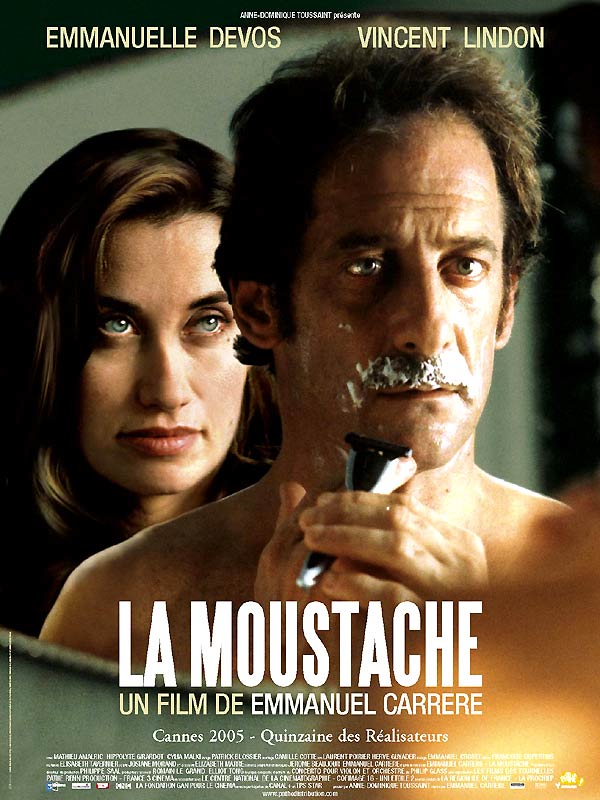
The main purpose of this whole thing was to show Emmanuel Carrere‘s surrealist film “La Moustache“. Because of this, I decided to leave my house on a Friday night for the first time since Carter was in office. I love the film. It is a deceptively simple story of madness and personal alienation. A man shaves his moustache and no one believes he ever had one. That’s really all of it. In spite of its insane story line, it manages to come across as a remarkably realistic picture what it is like to experience genuine confusion. For some reason, I had it in my head that seeing the film in a theater would be even better. What I didn’t really get until the lights dimmed was that seeing 2001: A Space Odyssey in a theatre is a unique experience because you have an opportunity to see special effects that were meant for a big screen. Seeing a yuppie French couple arguing over the husband’s bizarre personal grooming fantasies is not anymore enjoyable around a bunch of popcorn chomping film fans. As a matter of fact, it’s pretty damned depressing.
The woman who introduced the film was some former film critic from the Atlanta Journal Constitution who really didn’t know very much about the film or the writer or the director or French cinema or how she got to the building in the first place. She kept saying over and over that this film was “funny…really, really funny.” This set a monumentally bad tone for the evening. The crowd immediately settled in, ready for a French yuckfest on par with the work of Johnny Knoxville. I have to tell you, I’ve laughed at a lot of thoroughly inappropriate things in my day, so I guess I had this evening coming to me. I nearly got tossed out of the Phipps Plaza Theater some years back for nearly laughing myself into straightjacket for the last 15 minutes of the faux horror classic “The Devil’s Advocate”. I spent a good portion of my younger years telling horrendously insensitive jokes about everyone from Mother Theresa to Ted Bundy. This night was my punishment for many a sin against good taste. Hopefully, this will count as my confession and I will be absolved of further mental floggings.
I sat there for a good hour and a half with blank expression on my face. The audience exploded with laughter over and over again at the most inopportune times. Marc, the main character played by Vincent Lindon, wanders through the film slowly losing touch with everyone he knows and loves. He begins to doubt the very fabric of reality, becomes a stranger in his own body and disappears into a blinding fog of regret, scorn and loneliness. Hysterical stuff! Marc sifts through the trash, trying to find any proof that his experience is real, that he is not living an unexplainable fantasy and that his mind isn’t decaying. Stop it, my side is hurting!
Truth be told, this is a horrifically sad movie. So many wander through life trying to catch up to the world, trying to understand an endless series of in jokes and references that fly by them, hoping to understand what the world means while being handed self-help books and truisms about “being yourself” and “trying your hardest”. Our personal realities often do not mesh with the world. Our truths are often only true in our minds. One minute’s certainty is the next minute’s mirage. There are nearly 7 billion of us blindly groping for a light switch in the dark only to be handed an octopus. This is the message of The Moustache. To take this film as a lighthearted romp is to miss a wonderfully genuine explanation of what it is like to be a human. Or maybe I just don’t get it.
The Words Crawl in, The Words Crawl Out: Existential Dread and FDR’s Inaugural Address
Posted by Keith Spillett in Existential Rambings on October 23, 2010

An appropriate response to reality?
Sometimes expressions are so powerful, so significant, that it is easy to lose sight of how utterly absurd they are. American history is riddled with such quotes. A personal favorite of mine comes from FDR’s 1st Inaugural address. The story goes something like this: America was mired in the worst economic depression in it’s history. Roosevelt had just put an end to the rattling death spiral that was Herbert Hoover‘s Presidency and stood in front of the country promising the revitalization of the American Dream and the end of nearly four years of chaos, despair and misery.
Within the first few sentences of his first Presidential address, Roosevelt set a tone of vital, unabashed optimism when he uttered the now famous words “We have nothing to fear but fear itself.” Those words, along with many social programs or “fortuitous” sets of circumstances (depending on who you ask), picked America up and led it through some of it’s worst moments. It became a rallying cry for a troubled nation whose best days were ahead of it.
I need you to know that I am not six years old. I don’t believe in the Easter Bunny, the Tooth Fairy or the literal truth of expressions used by politicians in speeches. I am quite sure that Roosevelt was afraid of a few things besides fear. Maybe he was afraid of spiders, maybe he was paranoid about being in graveyards after 9 PM, maybe he was just plain scared of being attacked by a group of fanged clowns. I really am not sure what made FDR fret, but I am quite sure something did. The point is, the line was meant to be hyperbole.
Here’s the problem, if you hold the line up and look at it for a minute, even as hyperbole, it turns into mush in your hands. The truth of the matter is, there are an enormous amount of things to be afraid of. We are narrowly held on a mortal coil that could collapse at anytime. Our bodies, given a few years of exuberant youth, quickly melt away like ice cream on a summer afternoon. We rarely, if ever, are informed of when our time here will end and on the rare occasions we get that message in advance it is never good news. We form deep connections with those around us only to watch those bonds dissolved through mortality or miscommunication. As humans, we depend on a constant flow of sustenance that could dry up or be ripped away at any time. The possibility of mass annihilation through disease, war or famine are never far from our collective consciousness.
After death, who knows what bizarre carnival awaits us. Will I go to a smoking pit of flames, left to forever roast for eternity for some momentary lapse of judgement I made in the previous life? Or shall I fly away on white wings floating in a vast cosmic eternity day after day after day after day….with no end anywhere in sight? Will I simply get to experience the same mindless pain and suffering over and over, just from some new perspective? Will I come back as some “lower” animal, only to be slaughtered by other creatures for food, belts or coats or stepped on because I am “in the way”? Will I be at one with the universe, a desireless speck in an endless cosmos? Or will I lay in the ground and deteriorate slowly, a buffet for worms and bugs; a previously animated, once sentient form of high quality fertilizer? Which option would be preferable to me? (It doesn’t matter…I don’t really get to choose!)
If Roosevelt had any sense of the existential turmoil that lives at the root of our being, he would have left comedy to the comedians. How could someone look at the human condition and honestly utter the expression that there is only fear to fear? Fear is a completely reasonable response to an entirely preposterous set of circumstances. Maybe Roosevelt understood this and decided the best way to comfort humans was to deceive them and give them a false understanding of the terms of the world. You’ll forgive me if I don’t thank him for that. I have always believed that given the choice of comforting words or horrific facts, people tend to believe the latter, even if they don’t readily admit to it.
I am never more convinced that a person is lying to me and to themselves as when they say something like “I am not afraid of death”. This delusion can be truly catastrophic, not just because it allows people to pretend that their life is something that it is not, but because it allows people to rationalize the suffering of other creatures. “If I am not afraid of death, then it must not be that bad, then your death isn’t as bad as you think, then you should just get over your death (after all, I did), then you should stop dying because it reminds me I will die (which I am not, by the way, afraid of).” The logic (or lack of it) is torturous. “It is just a dumb beast, what does it matter if it dies or it is just a non-American, what does it matter if it dies or it is just one, what does it matter if it dies, or it’s just one of THEM, what does it matter if it dies or it’s not related to me or my friend, what does it matter if it dies.” These thoughts cannot be far behind.
Fear, I concede, can produce irrational responses and untold misery. However, it can also be a great tool to remind us of our humanity. It has the invaluable capability of reminding us what we share with the rest of these animated objects that surround us. Fear is not something to be feared, it is something to be listened to, reckoned with and understood. Otherwise, how can we ever truly begin to understand what we are and what we share with the creatures around us.
 The Tyranny of Tradition