The Locke-Hobbes Complex: Free the Goose, Locke up the Gander
Posted by Keith Spillett in Existential Rambings, The Politics Of Catastrophe on November 7, 2010

The American Leviathan rises up to clobber all of the “bad” people who dare threaten to take our stuff and use our hospitals
The ideas of John Locke and Thomas Hobbes lay at the root of the American governmental experience at many levels. Locke was a social-contract theorist who believed that all humans were born with rights and surrendered them in order to procure the advantages of civilized society. He thought that if there was no government things might not run as smoothly, but people could get by. Locke had a notion that people are rational creatures that are capable of making decisions that are in the best interests not just of themselves, but of the group. Thomas Hobbes also bought into the idea of the social contract, but that is one of the few things the two agreed on. Hobbes thought that human beings were essentially machines that functioned to protect themselves from injury and death and to get what gave them pleasure. Government was meant to act as a check on the base and violent desires of the masses. He thought that without government life (like Napoleon) would be “nasty, brutish and short”. Hobbes thought that you had one basic right, to be protected from the other maniacal machines around you. Any other right could be taken away freely by the government in order to keep the people safe from themselves.
The progenators of the American governmental system were highly influenced by Locke and Hobbes. Thomas Jefferson spent most of his political career doing a fair John Locke impression. He turned Locke’s “life, liberty and property” into “life, liberty and the pursuit of happiness” and parroted Locke’s controversial belief in the right of people to revolt against an unjust government. James Madison (writing as Publius in The Federalist Papers) was clearly channeling Hobbes when he wrote in Federalist #51 that “if men were angels, no government would be necessary” and “ambition must be made to counteract ambition”. Our constitution is a marvel of balancing Locke’s democratic intentions (the House of Representatives, the Bill of Rights) with Hobbes’ fear of the great unwashed hordes (the Senate prior to the 17th Amendment, the Electoral College).
Locke and Hobbes are still very much with us today, but in another more bizarre, irrational form. The Locke-Hobbes complex can most clearly be seen in the Tea Party Movement, although it is certainly not exclusive to them. Here’s how it looks: The inward view of many Americans seems to be that Locke was correct. The individual should be controlled by the government as little as possible. Americans should be freed from many of the burdens of taxation or regulation. What’s mine is mine and should not be taken, the government should not restrict the development of business, I should be able to say what I want to say and not be bound by political correctness, and the government should stay out of my private affairs. At first glance, it seems as if Locke would be entirely comfortable at Rand Paul campaign headquarters dressed up like Patrick Henry with a NoBama tattoo on his or her forehead.
However, Locke’s ideas seem to appear in the rhetoric of both major American political parties (and quite a few smaller ones). Some candidates rail against the idea of “big government” that doesn’t seem to get that “the government that governs best governs least”. Others loudly protest a government that restricts reproductive rights or the rights of individuals to choose to live life the way they want to. Whether it be keeping the government’s hands off my money or their laws off my body, the cries of individual liberty seem to echo from every corner of the American political landscape.
It would seem that a people so committed to the idea of the freedom and thriving of the individual would have no place for Hobbes’ principles…and yet they are very much alive in our culture. A person can’t go five minutes without baring witness to a political diatribe on the importance of freedom and yet thanks to ever more strict sentencing laws the Washington Post reported in 2008 that 1 in 100 adults in the United States is in jail or prison. The United States is the world’s leader in incarcerated adults both in percentage and in number. In order to really understand the perversity of this statistic one must realize that China, a nation that our leaders have regularly excoriated for their unconscionable human rights record, has an estimated population of over 1.3 billion people, while the United States, the world’s beacon for freedom and liberty, has around 303 million people. In spite of nearly a billion more people, China has less prisoners than the United States. According to a Bureau of Justice Statistics study, non-violent crimes made up nearly half of the state prison populations in 2006. On the federal level, non-violent crimes take up an even higher percentage of reasons for incarcerations. Large numbers of Americans are in prison for non-violent crimes that run the gamut from drug abuse to public intoxication. Clearly, much of the imprisonment in the United States does not even serve the purpose of public safety.
It would seem that a nation with such a highly advanced, Lockean conception of liberty would be able to come up with a solution that involved a bit more creativity than building more prisons, but that seems to be the solution we continue to come up with. At the root of our problem lies an incredibly Hobbesean conception of the role of the state. But, maybe we are just talking about the “bad” people here. A common refrain is that criminals (often defined as the amorphous mass of people out to harm us and take our stuff) are not deserving of the same rights as the rest of us. Even though the Bill of Rights spends nearly half of it’s time dealing with the issue of criminal justice, many believe that the rights of individuals should be obliterated upon the commission of a crime. One would think that this current wave of liberty based hysteria would have brought more politicians into power who opposed the federal government tearing rights away from citizens and yet, Russ Feingold, the one Senator who opposed the 2001 passing of the Patriot Act, the largest broadening of federal investigatory power in the last 50 years, was voted out of office. Is the message more liberty for the “good people”, less protection for “the bad”? How are we able to tell them apart?
There are some things to be feared and some things to be appreciated about each philosophy. Locke’s social contract was so loose that some would get away with crimes that could severely harm their neighbors, but he believed strongly enough in people’s judgements to believe that this problem could be overcome. Hobbes argued for a system that strangled human growth and potential on the altar of safety, but he also realized that there are characteristics that needed to be monitored in human beings in order to allow them to be protected from the loss of their most important right, the right to continue to stay alive. It’s as if our culture has picked out the most base, selfish characteristics of both philosophies and melded them into a giant Leviathan that attacks the liberties of the “bad” with one hand while cherishing the rights of the “good” with the other. What we fail to recognize is that we can easily be mistaken for either. Hell may be other people, but after a while it becomes us.
An Inconsistent Truth: A Psychological Review of The High Art Museum’s Showing of La Moustache 11/5/10
Posted by Keith Spillett in Existential Rambings, Mr. Spillett's Academy Of Film Study For The Mentally Tormented on November 6, 2010
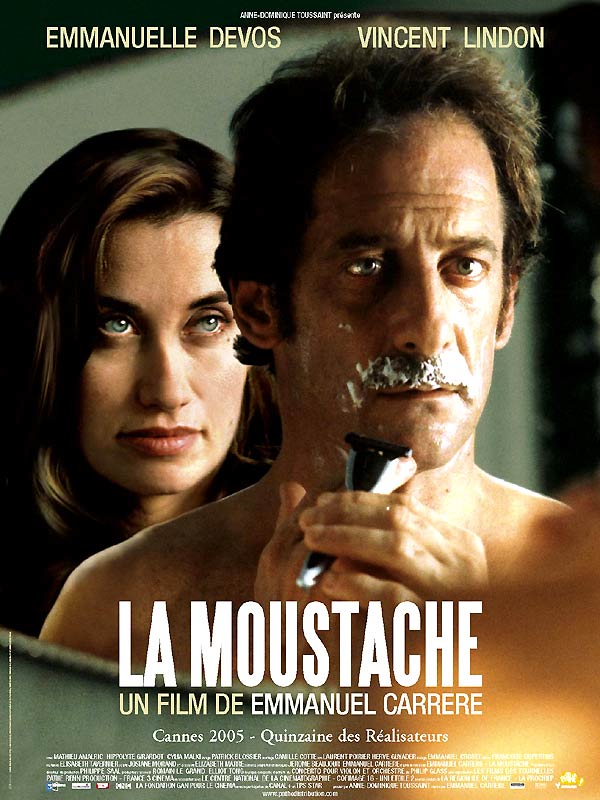
The Citizen Kane of mustache hallucination films
“No one who has not experienced how insubstantial the pageant of external reality can be, how it may fade, can fully realize the sublime and grotesque presences that can replace it, or exist along side of it.”
-R.D. Laing “The Politics of Experience”
It is truly frightening to be in a room full of people who are laughing and not get the joke. I don’t just mean not get the punch line, but not get the words, the meaning or anything else. To feel as if one is from another planet and has landed here with a cursory knowledge of the English language and a two-day session on the lives and mating patterns of human beings under his belt, only to have to listen to two voracious baseball fans discussing the importance of the infield fly rule. Maybe I missed something; maybe something was never there.
I walked into the High Art Museum at about 9:30 at night and was greeted by one person in a fake moustache, then another, then another. I was overwhelmed and confused. Apparently this was the theme of the evening. Moustaches, moustaches everywhere. I had heard that at some point in the evening some men who had real moustaches were going to shave them off. It was one of those hipster rollicking good time things that I’m sure would have really impressed me back when I had rollicking hipster intentions.
The main purpose of this whole thing was to show Emmanuel Carrere‘s surrealist film “La Moustache“. Because of this, I decided to leave my house on a Friday night for the first time since Carter was in office. I love the film. It is a deceptively simple story of madness and personal alienation. A man shaves his moustache and no one believes he ever had one. That’s really all of it. In spite of its insane story line, it manages to come across as a remarkably realistic picture what it is like to experience genuine confusion. For some reason, I had it in my head that seeing the film in a theater would be even better. What I didn’t really get until the lights dimmed was that seeing 2001: A Space Odyssey in a theatre is a unique experience because you have an opportunity to see special effects that were meant for a big screen. Seeing a yuppie French couple arguing over the husband’s bizarre personal grooming fantasies is not anymore enjoyable around a bunch of popcorn chomping film fans. As a matter of fact, it’s pretty damned depressing.
The woman who introduced the film was some former film critic from the Atlanta Journal Constitution who really didn’t know very much about the film or the writer or the director or French cinema or how she got to the building in the first place. She kept saying over and over that this film was “funny…really, really funny.” This set a monumentally bad tone for the evening. The crowd immediately settled in, ready for a French yuckfest on par with the work of Johnny Knoxville. I have to tell you, I’ve laughed at a lot of thoroughly inappropriate things in my day, so I guess I had this evening coming to me. I nearly got tossed out of the Phipps Plaza Theater some years back for nearly laughing myself into straightjacket for the last 15 minutes of the faux horror classic “The Devil’s Advocate”. I spent a good portion of my younger years telling horrendously insensitive jokes about everyone from Mother Theresa to Ted Bundy. This night was my punishment for many a sin against good taste. Hopefully, this will count as my confession and I will be absolved of further mental floggings.
I sat there for a good hour and a half with blank expression on my face. The audience exploded with laughter over and over again at the most inopportune times. Marc, the main character played by Vincent Lindon, wanders through the film slowly losing touch with everyone he knows and loves. He begins to doubt the very fabric of reality, becomes a stranger in his own body and disappears into a blinding fog of regret, scorn and loneliness. Hysterical stuff! Marc sifts through the trash, trying to find any proof that his experience is real, that he is not living an unexplainable fantasy and that his mind isn’t decaying. Stop it, my side is hurting!
Truth be told, this is a horrifically sad movie. So many wander through life trying to catch up to the world, trying to understand an endless series of in jokes and references that fly by them, hoping to understand what the world means while being handed self-help books and truisms about “being yourself” and “trying your hardest”. Our personal realities often do not mesh with the world. Our truths are often only true in our minds. One minute’s certainty is the next minute’s mirage. There are nearly 7 billion of us blindly groping for a light switch in the dark only to be handed an octopus. This is the message of The Moustache. To take this film as a lighthearted romp is to miss a wonderfully genuine explanation of what it is like to be a human. Or maybe I just don’t get it.
The Words Crawl in, The Words Crawl Out: Existential Dread and FDR’s Inaugural Address
Posted by Keith Spillett in Existential Rambings on October 23, 2010

An appropriate response to reality?
Sometimes expressions are so powerful, so significant, that it is easy to lose sight of how utterly absurd they are. American history is riddled with such quotes. A personal favorite of mine comes from FDR’s 1st Inaugural address. The story goes something like this: America was mired in the worst economic depression in it’s history. Roosevelt had just put an end to the rattling death spiral that was Herbert Hoover‘s Presidency and stood in front of the country promising the revitalization of the American Dream and the end of nearly four years of chaos, despair and misery.
Within the first few sentences of his first Presidential address, Roosevelt set a tone of vital, unabashed optimism when he uttered the now famous words “We have nothing to fear but fear itself.” Those words, along with many social programs or “fortuitous” sets of circumstances (depending on who you ask), picked America up and led it through some of it’s worst moments. It became a rallying cry for a troubled nation whose best days were ahead of it.
I need you to know that I am not six years old. I don’t believe in the Easter Bunny, the Tooth Fairy or the literal truth of expressions used by politicians in speeches. I am quite sure that Roosevelt was afraid of a few things besides fear. Maybe he was afraid of spiders, maybe he was paranoid about being in graveyards after 9 PM, maybe he was just plain scared of being attacked by a group of fanged clowns. I really am not sure what made FDR fret, but I am quite sure something did. The point is, the line was meant to be hyperbole.
Here’s the problem, if you hold the line up and look at it for a minute, even as hyperbole, it turns into mush in your hands. The truth of the matter is, there are an enormous amount of things to be afraid of. We are narrowly held on a mortal coil that could collapse at anytime. Our bodies, given a few years of exuberant youth, quickly melt away like ice cream on a summer afternoon. We rarely, if ever, are informed of when our time here will end and on the rare occasions we get that message in advance it is never good news. We form deep connections with those around us only to watch those bonds dissolved through mortality or miscommunication. As humans, we depend on a constant flow of sustenance that could dry up or be ripped away at any time. The possibility of mass annihilation through disease, war or famine are never far from our collective consciousness.
After death, who knows what bizarre carnival awaits us. Will I go to a smoking pit of flames, left to forever roast for eternity for some momentary lapse of judgement I made in the previous life? Or shall I fly away on white wings floating in a vast cosmic eternity day after day after day after day….with no end anywhere in sight? Will I simply get to experience the same mindless pain and suffering over and over, just from some new perspective? Will I come back as some “lower” animal, only to be slaughtered by other creatures for food, belts or coats or stepped on because I am “in the way”? Will I be at one with the universe, a desireless speck in an endless cosmos? Or will I lay in the ground and deteriorate slowly, a buffet for worms and bugs; a previously animated, once sentient form of high quality fertilizer? Which option would be preferable to me? (It doesn’t matter…I don’t really get to choose!)
If Roosevelt had any sense of the existential turmoil that lives at the root of our being, he would have left comedy to the comedians. How could someone look at the human condition and honestly utter the expression that there is only fear to fear? Fear is a completely reasonable response to an entirely preposterous set of circumstances. Maybe Roosevelt understood this and decided the best way to comfort humans was to deceive them and give them a false understanding of the terms of the world. You’ll forgive me if I don’t thank him for that. I have always believed that given the choice of comforting words or horrific facts, people tend to believe the latter, even if they don’t readily admit to it.
I am never more convinced that a person is lying to me and to themselves as when they say something like “I am not afraid of death”. This delusion can be truly catastrophic, not just because it allows people to pretend that their life is something that it is not, but because it allows people to rationalize the suffering of other creatures. “If I am not afraid of death, then it must not be that bad, then your death isn’t as bad as you think, then you should just get over your death (after all, I did), then you should stop dying because it reminds me I will die (which I am not, by the way, afraid of).” The logic (or lack of it) is torturous. “It is just a dumb beast, what does it matter if it dies or it is just a non-American, what does it matter if it dies or it is just one, what does it matter if it dies, or it’s just one of THEM, what does it matter if it dies or it’s not related to me or my friend, what does it matter if it dies.” These thoughts cannot be far behind.
Fear, I concede, can produce irrational responses and untold misery. However, it can also be a great tool to remind us of our humanity. It has the invaluable capability of reminding us what we share with the rest of these animated objects that surround us. Fear is not something to be feared, it is something to be listened to, reckoned with and understood. Otherwise, how can we ever truly begin to understand what we are and what we share with the creatures around us.

